

• Content type:

  • Topics:

  • Resource type:

  • Language:

  • Countries:

  • Regions:

  • Regional Hubs:

  • Regional Hub Themes:

  • Sort

Search within All Regions

18 results found

Briefing

Supporting the mpox response for people with diverse sexual orientation, gender identity and/or gender expression in contexts where their rights are restricted fr

This brief provides a socio-behavioural analysis of the vulnerabilities, risks and operational key considerations for working with people with diverse sexual orientation, gender identity and/or expression in the mpox response.
SSHAP
2025
Report

People’s Agenda for Pandemic Preparedness

Research from 25 countries across six continents by over 50 researchers: What do people need to recover from pandemics? How do people think we should prepare and respond differently for the next pandemic?
Institute of Development Studies
2023
Infographic

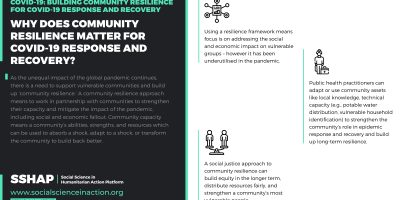
Building Community Resilience for COVID-19 Response and Recovery

Key messages from our briefing on Operational Considerations for Building Community Resilience for COVID-19 Response and Recovery
SSHAP
2021
Infographic

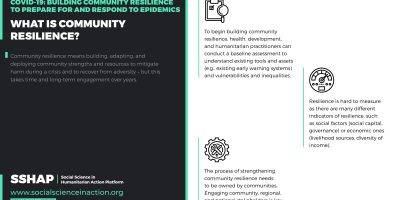
COVID-19: Building Community Resilience to Prepare for and Respond to Epidemics

Key messages from our briefing on Community Resilience: Key Concepts and their Applications to Epidemic Shocks
SSHAP
2021
UNICEF/UN0392520
Briefing

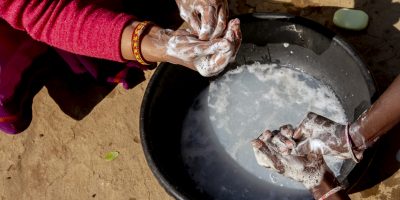
Community Resilience: Key Concepts and their Applications to Epidemic Shocks arfres

Exploring how the concepts of community resilience can be applied to epidemics
SSHAP
2021
UNICEF/UN0351955
Briefing

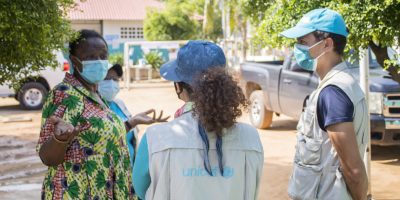
Key Considerations: Operational Considerations for Building Community Resilience for COVID-19 Response and Recovery arfres

How health and humanitarian practitioners can support communities to respond to, and recover from COVID-19 using a community resilience approach.

SSHAP
2021
UNICEF/UNI358629
Briefing

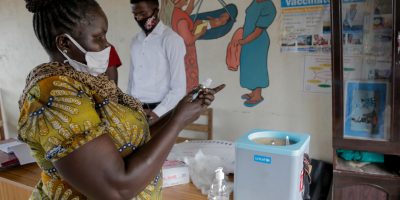
6 ways to incorporate social context and trust in infodemic management arfr

This brief explains how social science can inform infodemiology by making it more attuned to different social, political and cultural contexts and to the relationships between people and formal institutions.
SSHAP
2020
UNICEF/Obel
Briefing

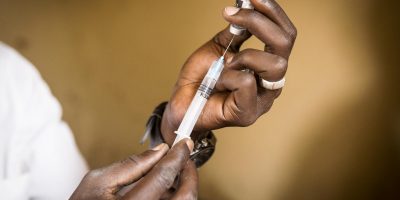
Rapid Review: Vaccine Hesitancy and Building Confidence in COVID-19 Vaccination arzhfres

This brief draws on social science literature and informal interviews with experts to illustrate that vaccine hesitancy is complex and context-specific, and often reflects diverse, everyday anxieties. It proposes strategies to guide actors involved in vaccine development, communication and deployment…
SSHAP
2020
UNICEF/Keita
Briefing

COVID-19 Vaccine Deployment: Behaviour, Ethics, Misinformation and Policy Strategies

Rapid review offering policy recommendations for vaccine deployment

The British Academy and the Royal Society
2020
UNICEF/Tesfaye
Briefing

Considerations and Principles for Shielding People at High Risk of Severe Outcomes from COVID-19 fr

Including proposed approaches to shielding, who may be included in shielding groups, as well as the likely difficulties of these measures, and ways to mitigate them.

SSHAP
2020
UNICEF | UNI313626 | Ojo
Briefing

Key Considerations: COVID-19 in Informal Urban Settlements zhfrptes

Key considerations for protecting informal urban settlements from the spread and impacts of COVID-19.

SSHAP
2020
UNICEF/Adelson
Briefing

Online Information, Mis- and Disinformation in the Context of COVID-19 zhfr

Practical considerations relating to flows of information, misinformation and disinformation though online media, particularly social media networks.

SSHAP
2020
SISTEMA 12 (CC BY-SA)
Briefing

Quarantine in the Context of COVID-19 zhfr

Key considerations relating to the design and impact of measures that restrict human movement patterns.
SSHAP
2020
SISTEMA 12 (CC BY-SA)
Briefing

Social Dimensions of the novel Coronavirus (nCoV) Outbreak and Response: Meeting Report

Report from a roundtable meeting at the Wellcome Trust, London, 3rd February 2020.
SSHAP
2020
UNICEF/UNI166988/Jallanzo
Evidence review

Rapid Qualitative Research Methods During Complex Health Emergencies: A Systematic Review of the Literature

The 2013-2016 Ebola outbreak in West Africa highlighted both the successes and limitations of social science contributions to emergency response operations. An important limitation was the rapid and effective communication of study findings. A systematic review was carried out to…
Social Science and Medicine
2017
UNICEF/UN035147/LeMoyne
Background report

Recurrent Failings of Medical Humanitarianism: Intractable, Ignored, or Just Exaggerated?

Humanitarian health workers operate in dangerous and uncertain contexts, in which mistakes and failures are common, often have severe consequences, and are regularly repeated, despite being documented by many reviews. This Series paper aims to discuss the failures of medical…
The Lancet
2017
UNICEF/UNI43619/Bannon

8 Critical Factors Behind Every Food Crisis

From the beginning of time, their have been food crises in one form or another. Ancient books such as the Bible have records of various famines devastating portions of the world. And while it’s easy to attribute these crises to…
Business Connect
2017
UNICEF/UN028839/Tremeau
Evidence review

El Niño: Overview of Impact, Projected Humanitarian Needs and Response as of 02 June 2016

The humanitarian impact of the 2015-2016 El Niño remains deeply alarming, now affecting over 60 million people. Central America, East Africa (particularly Ethiopia), the Pacific and Southern Africa remain the most affected regions. The El Niño phenomenon is now in decline, but projections indicate the situation will worsen…
OCHA
2016

Find emergency response resources

Curated collections of briefings, infographics, tools, blogs and other resources from SSHAP and other organisations working on social sciences in emergencies.
Share