Key findings
- This report was finalised on 29 September 2026. A search for relevant evidence was conducted on 18 September 2026.
- School-based transmission of orthoebolaviruses was examined in one article written on the 2022 Uganda outbreak and was not found to be a statistically significant risk factor.4 A further study mentions transmission in a school setting but provides limited detail.3
- We identified no studies estimating the incidence or epidemiological impact of school-based transmission, or any directly evaluating the effect of school closure or reopening on transmission.
- The available evidence does not establish schools as important amplifiers of orthoebolavirus transmission. Given the recognised modes of transmission and the potential harms of school closure, maintaining school access may be reasonable where outbreak surveillance and infection prevention measures can be implemented. Decisions should be made case-by-case and informed by local transmission patterns; the capacity and performance of public health measures such as contact tracing and isolation; and the risks to children and the wider community.
Context of the RRU request
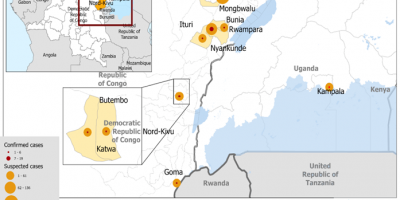
Authorities in the Democratic Republic of the Congo (DRC) instructed schools across regions affected by the ongoing Bundibugyo ebolavirus (BDBV) outbreak to re-open at the beginning of September 2026. In this rapid review, we sought to identify any published evidence reporting transmission of human pathogenic strains of orthoebolavirus in school-based settings. We also sought to identify any published evidence related to the impact of school closures or re-opening on orthoebolavirus transmission from the current or previous outbreaks.
We sought to identify relevant evidence to answer the following questions:
- What is the available evidence of transmission of orthoebolaviruses in school-based settings?
- What is the evidence of the impact of school closures or re-openings on orthoebolavirus transmission?
طُرق
We conducted two searches for published evidence on 18 September 2026 across two scientific databases selected for their breadth of coverage, MEDLINE (OVID) and Global Health. A search strategy was designed for each question. We included search terms in English and French and did not apply filters for the date of publication of articles or study design. An example search strategy for one database is detailed in Annexe 1, as well as details of the number of articles retrieved from each database. We checked the reference lists of relevant articles to identify any evidence that may not have been captured in the searches.
We additionally searched the websites of the following organisations for relevant evidence: UNICEF; World Health Organization (WHO); Africa Centers for Disease Control (CDC); Ministry of Health (MoH) Democratic Republic of Congo; MoH Uganda; MoH Sierra Leone; MoH Burundi; MoH Rwanda; MoH Guinea; MoH Liberia. Finally, we emailed our networks asking that any relevant evidence (published or unpublished) be shared with us. We contacted colleagues at WHO, UNICEF, and the UK Public Health Rapid Support Team (UK-PHRST). Evidence identified through our searches and calls was screened by a team of three reviewers, with one person reviewing each article for relevant evidence.
Findings of the review
Rapid review question 1: What is the available evidence of transmission of orthoebolaviruses in school-based settings?
A total of 533 individual articles were identified through the database search. One article reported incidences of school-based transmission of orthoebolaviruses. Three articles reported cases of children infected with orthoebolaviruses attending school whilst symptomatic for Ebola virus disease but did not report any subsequent transmission. The details of these four articles are provided in Table 1.
Table 1: Studies reporting evidence related to school-based transmission of orthoebolaviruses
| Study ID | Setting
Virus species (outbreak date) |
Study details | Reported evidence related to school-based transmission |
| Wolfe 20171 | Monrovia, Liberia
Zaire ebolavirus (2015) |
Contact tracing report covering 168 contacts of three cases. | Two confirmed cases attended school whilst symptomatic.
School-based surveillance was established. No secondary cases identified. |
| Dokubo 20182 | Monrovia, Liberia
Zaire ebolavirus (2015) |
Outbreak cluster report. | Symptomatic 15-year-old boy attended school for up to six days before hospital admission and subsequent diagnosis.
Two family members also positively diagnosed. No report of school-based transmission. |
| Ninsiima 20253 | Kampala, Uganda
Sudan ebolavirus (2022–23) |
Description and analysis of outbreak response. | Surveillance identified five cases in children attending three different schools prior to being confirmed as positive cases.
170 school-based contacts of these cases were identified. No report of onward transmission from the five cases but study states that ‘the outbreak also involved school-based transmission’. |
| Mulongo 20254 | أوغندا
Sudan ebolavirus (2022) |
Retrospective cohort study to identify predictors of transmission among 3,140 contacts. | 159 individuals were exposed in a school setting, and three subsequently developed Sudan Ebolavirus Disease (SUVD).
Bivariate analysis revealed that contact in a school setting was not a statistically significant risk factor for SUVD incidence among contacts in this cohort. |
المصدر: خاص بالمؤلفين.
An article published by Reuters describes the death of two babies in an orphanage in Bunia, DRC.5 It is not clear whether transmission occurred between the first and second case, or from another contact source. No further relevant evidence was identified.
Rapid review question 2: What is the evidence of the impact of school closures or re-openings on orthoebolavirus transmission?
A total of 16 individual articles were identified through the search. No articles were identified specifically reporting on the impacts of school closures or re-opening on ebolavirus transmission.
Several studies identified through the search described or evidenced the societal impact of school closures, including subsequent school drop-out rates, teenage pregnancies, and loss of education.6,7,8,9 Whilst other evidence exists reporting on societal impacts of school closures or re-opening due to Ebola outbreaks, no further search for this was made as it does not answer the specific question regarding the impact on transmission.
We identified documents on the websites for both Africa CDC and WHO supporting the decision for the re-opening of schools in DRC amid the 2026 outbreak.10,11 The articles support the need for risk assessments; guidance on safe hygiene practice and surveillance and referral procedures; and training of staff, but they do not reference the evidence used to reach this decision of support.
Limitations of this rapid evidence review
Due to the time constraints of this task, it was only possible to search two research databases. However, the two selected were chosen for their breadth of coverage. It was also not possible to search for evidence in languages other than English and French. Furthermore, no articles were received from expert contacts, which may be due to the time limit of the request, or may reflect a lack of available evidence.
الاستنتاجات
School-based transmission of orthoebolaviruses was examined in one article from the 2022 Uganda outbreak and was not found to be a statistically significant risk factor. A further study mentions transmission in a school setting but provides limited detail. The incidence of school-based transmission has not been investigated and reports of potential school-based contacts are poorly described. No evidence is available reporting the impact of school closures or re-opening on transmission.
The available evidence does not establish schools as important amplifiers of orthoebolavirus transmission. Given the recognised modes of transmission and the potential harms of school closure, maintaining school access may be reasonable where outbreak surveillance and infection prevention measures can be implemented. Decisions should be made on a case-by-case basis, informed by local transmission patterns, the capacity and performance of public health measures such as contact tracing and isolation, and the risks to children and the wider community.
مراجع
- Wolfe, C.M. وآخرون. (2017) Ebola virus disease contact tracing activities, lessons learned and best practices during the Duport Road outbreak in Monrovia, Liberia, November 2015. PLoS Negl Trop Dis 11(6): e0005597. https://doi.org/10.1371/journal.pntd.0005597
- Dokubo, E.K. وآخرون. (2018) ‘Persistence of Ebola virus after the end of widespread transmission in Liberia: an outbreak report’, مجلة لانسيت للأمراض المعدية, 18(9), pp. 1015–24. https://doi.org/10.1016/S1473-3099(18)30417-1
- Ninsiima, M. وآخرون. (2025) ‘Strategies Utilized During Sudan Virus Disease Outbreak Response in Kampala City, Uganda, 2022−2023’, Journal of Epidemiology and Global Health, 15, 92. https://doi.org/10.1007/s44197-025-00438-2
- Mulongo, M. وآخرون. (2025) ‘Incidence and predictors of Sudan ebolavirus transmission among contacts in Uganda in 2022: a retrospective cohort study’, بي إم سي للصحة العامة, 25, 3793. https://doi.org/10.1186/s12889-025-24739-0
- Muyisa, G., Nyemba, B. and Farge, E. (2026) ‘Two babies from Congo orphanage die of Ebola, highlighting risk to children’, رويترز, 10 June. Available at: https://www.reuters.com/business/healthcare-pharmaceuticals/newborn-congo-orphanage-dies-ebola-highlighting-risks-faced-by-children-2026-06-10/ (Accessed: 24 September 2026).
- Smith, W.C. (2021) ‘Consequences of school closure on access to education: Lessons from the 2013–2016 Ebola pandemic’, International Review of Education, 67, pp. 53–78. https://doi.org/10.1007/s11159-021-09900-2
- Onyekuru, N.A., Ihemezie, E.J., Ezea, C.P., Apeh, C.C. and Onyekuru, B.O. (2023) ‘Impacts of Ebola disease outbreak in West Africa: Implications for government and public health preparedness and lessons from COVID-19’, الإفريقي العلمي, 19, e01513. https://doi.org/10.1016/j.sciaf.2022.e01513
- Powers, S. and Azzi-Huck, K. (2016) ‘The impact of Ebola on education in Sierra Leone’, مدونات البنك الدولي, 4 May. Available at: https://blogs.worldbank.org/en/education/impact-ebola-education-sierra-leone (Accessed: 24 September 2026).
- Murray, R.T., Drew, L.B., Memmott, C., Bangura, Y-M. and Maring, E.F. (2021) ‘A community’s experience during and after the Ebola epidemic of 2014–2016 in Sierra Leone: A qualitative study’, PLOS الأمراض الاستوائية المهملة, 15(2), e0009203. https://doi.org/10.1371/journal.pntd.0009203
- Africa Centres for Disease Control and Prevention (2026) ‘Africa CDC supports the immediate implementation of the DRC Government’s decisions to control the 2026 Bundibugyo Ebola emergency’, Africa CDC, 10 August. Available at: https://africacdc.org/news-item/africa-cdc-supports-the-immediate-implementation-of-the-drc-governments-decisions-to-control-the-2026-bundibugyo-ebola-emergency/ (Accessed: 24 September 2026).
- World Health Organization (2026) ‘Second meeting of the IHR Emergency Committee on the epidemic of Ebola Bundibugyo virus disease in the Democratic Republic of the Congo – Temporary recommendations’, World Health Organization, 24 August. Available at: https://www.who.int/news/item/24-08-2026-second-meeting-of-the-ihr-emergency-committee-on-the-epidemic-of-ebola-bundibugyo-virus-disease-in-the-democratic-republic-of-the-congo-temporary-recommendations (Accessed: 24 September 2026).
Annexe 1: Example search strategy
Table A1: Search strategy used for Q1 on MEDLINE
| Block | String number | Terms | Total articles retrieved |
| Transmission block | 1 | Tiab (“transmission” OR “transmission chain” OR “chain of transmission” OR “transmission link” OR “contact*” OR “contract trac*” OR “contact investigation*” OR “transmission cluster*” OR “case cluster*” OR “transmission trac*” OR “secondary transmission” OR “secondary infection*” OR cluster* OR “transmission event*” OR “epidemiological link*” OR “epidemiologic link*” OR “epidemiological linkage” OR “epidemiologic linkage” OR “subsequently infect*” OR outbreak* OR case* OR “investigation des contacts” OR “chaîne épidémiologique*” OR “traçage des contacts” OR “chaîne de transmission” OR “transmission interhumaine” OR transmiss*) | 3,976,322 |
| Ebola block | 2 | Tiab (ebola OR ebolavirus OR “ebola virus” OR “ebola virus disease” OR “ebola hemorrhagic fever” OR “ebola infection” OR “ebola virus infection” OR bundibugyo OR “bundibugyo virus” OR “bundibugyo ebola virus” OR “bundibugyo ebolavirus” OR “BVD” OR “Zaire Ebola virus” OR “zaire ebolavirus” OR “zaire virus” OR “sudan ebola virus” OR “sudan ebolavirus” OR “sudan virus” OR “virus Ebola” OR “maladie à virus Ebola” OR “fièvre hémorragique Ebola” OR “infection à virus Ebola” OR “virus Ebola Bundibugyo” OR “virus Ebola Zaïre” OR “virus Ebola Soudan”) OR MH “Hemorrhagic Fever, Ebola”
|
11,828 |
| Children/school block | 3 | Tiab (children OR adolescen* OR youth* OR child* OR teenager* OR “young people” OR “young person” OR “young child*” OR baby OR infant* OR toddler* OR school-age* OR “school age*” OR school* OR nurser* OR pre-school OR “pre school” OR kindergar* OR “secondary school” OR “high school” OR orphanage* OR “sunday school*” OR “youth group*” OR enfant* OR nourrisson* OR bébé* OR école* OR collège*)OR MH “Adolescent” OR MH “Child+” | 1,970,580 |
| Final search | 4 | (1 AND 2 AND 3) | 492 |
Authors’ own.
Results of the database searches
For the search strategy for Q1, our MEDLINE search retrieved 492 articles, and our Global Health search retrieved 242 articles. After de-duplication, we screened a total of 533 articles.
For the search strategy for Q2, our MEDLINE search retrieved 15 articles, and our Global Health search retrieved eight articles. After de-duplication, we screened a total of 16 articles.
المساهمون
This brief was written by Tilly Fox (Liverpool School of Tropical Medicine, LSTM), Bruce Nyagol (Kenya Medical Research Institute), and James Stainthorpe (LSTM).
شكر وتقدير
This brief has been produced for the Multi-Hazard Research Network (MHRN). This project is funded by the UK Government’s Foreign, Commonwealth & Development Office (FCDO) through the Science for Emergencies Centre (SEC), under the Global Research and Technology Development (GRTD) portfolio. The views expressed in this brief are those of the authors and do not necessarily reflect the official policies or positions of the FCDO, the UK Government, or its partners.
نُشرت هذه الدراسة لأول مرة في أكتوبر 2026 من قبل معهد الدراسات الإنمائية.
الاقتباس المقترح: Fox, T.; Nyagol, B. and Stainthorope, J. (2026), Rapid Evidence Review: School-Based Transmission of Orthoebolaviruses, Multi-Hazard Research Network (MHRN), Brighton: Institute of Development studies, DOI: 10.19088/MHRN.2026.004
هذا ملخص الوصول المفتوح الموزع بموجب شروط رخصة المشاع الإبداعي النسبة 4.0 الدولية (CC BY), ، مما يسمح بالاستخدام والتوزيع والنسخ في أي وسيط، شريطة نسب الفضل إلى المؤلفين الأصليين والمصدر، مع الإشارة إلى أي تعديلات أو تحويرات.
متوفر من:
معهد دراسات التنمية، طريق المكتبة،,
برايتون، BN1 9RE، المملكة المتحدة
+44 (0)1273 606261
آي دي إس هي شركة خيرية محدودة بالضمان ومسجلة في إنجلترا
رقم تسجيل الجمعية الخيرية 306371
رقم الشركة الخيرية 877338A