This hybrid seminar hosted at the London School of Hygiene & Tropical Medicine on 17 June 2026 will explore the current landscape of pandemic preparedness, who it serves and what learnings can be taken from social science research to better inform future preparedness.
The 2026 Anthropological Responses to Health Emergencies (ARHE) Policy Brief Award is now open for submissions. The award aims to encourage and acknowledge the contributions of anthropologists and anthropological methods in responses to health emergencies.
A new UK Government-funded network will extend the work of SSHAP to include a wider range of disciplinary expertise for response and a more extensive hazard focus, including natural hazards in addition to health.
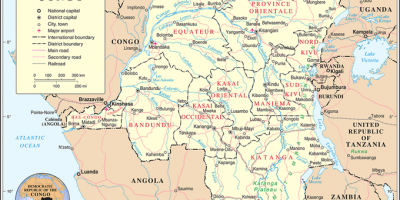
Members of SSHAP participated in the State-of-the-art Symposium in Kinshasa, Democratic Republic of Congo, in December 2025. This blog shares insights from the Symposium; considers the important of social and behavioural science and the existing evidence gaps; and lessons for global health security.
SSHAP has published a collection of short videos featuring methods, tools and thinking to aid the use of social science approaches in humanitarian and health emergency response practice. This free collection is for researchers, humanitarian practitioners or others interested in learning and incorporating social science analysis in their work.
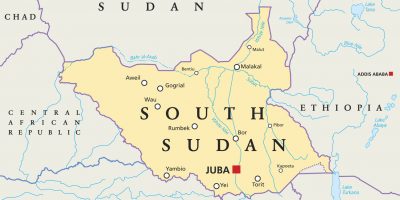
In South Sudan, information is as vital as food, water, and shelter. Yet, amid ongoing funding cuts to global aid, development and emergency response, one of the most critical – and often overlooked – lifelines is being threatened: community radio.
Central and East Africa Hub
Sarah Poni Subandrio, Stephen Omiri, Chris Marol, Jennifer Palmer
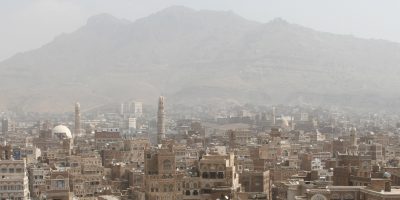
In the wake of nearly a decade of protracted conflict in Yemen, Mamoon Al-Absi, a former SSHAP Fellow, considers the uncomfortable intersection between international frameworks and local realities and asks: can localised governance and community-driven strategies truly build resilience in fragile, urban environments?
Humanitarian crises are growing in complexity and impact. According to the United Nations Office for the Coordination of Humanitarian Affairs nearly 300 million people globally needed humanitarian assistance and protection in 2024. In a world plagued by natural disasters, violent conflict, and public health emergencies, humanitarian service delivery is critical.
Among the countries worst affected from the sudden and wide-ranging US aid cuts is South Sudan. South Sudan relies on international assistance to provide basic services to its people. Cuts will devastate its healthcare system, including its ability to prepare for and respond to infectious disease outbreaks.
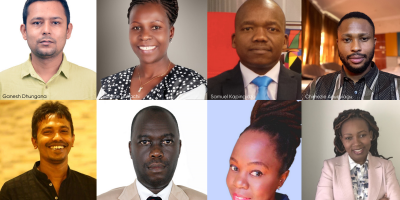
A key dimension of the Social Science in Humanitarian Action Platform’s approach to mobilising evidence on the social dimensions of emergency responses is helping to build capacity and regional networks of social scientists and practitioners. This blog shares insights from the experiences of participants.
Tom Barker, Joe Taylor, Megan Schmidt-Sane, Santiago Ripoll
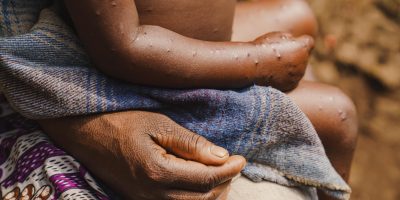
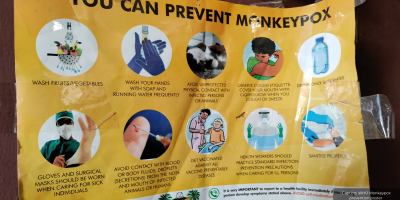
As mpox continues to spread within the Democratic Republic of Congo and neighbouring countries, concern is growing over how best to respond to this second mpox Public Health Emergency of International Concern (PHEIC). Research in Nigeria during the first PHEIC points to the importance of involving affected community perspectives.
The UK's Humanitarian Innovation Hub has featured SSHAP in its series of case studies on academic-practitioner collaborations in humanitarian settings. The case study features learning from SSHAP and highlights key components of SSHAP's approach, including localisation, network building and evidence on demand.
EVENT 18 February 2025 Who controls the borderlands? Rents, debts and the role of political and commercial elites on the Kenya-Ethiopia and Sudan-South Sudan borders
The Rift Valley Forum is hosting a panel discussion to explore the research findings and examine the impact of the evolving dynamics in borderland regions in Kenya and South Sudan.
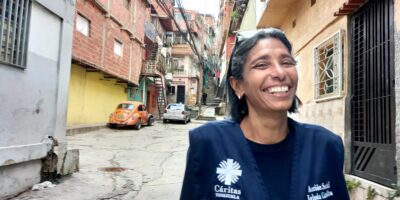
A two-year investigation for Caritas identified the capabilities, contribution to social mobilisation and the reconstruction of social ties at community level of humanitarian action volunteers in Venezuela.
Find ways to address the doubts of seasoned emergency responders in this last in a five-part blog series. The series offers social scientists tips to better connect with humanitarian responders and planners in advocating for evidence-informed emergency response
Learn why setting up multiple channels, presenting in different fora and adapting to decision makers’ schedules is key in this fourth in a five-part blog series. The series offers social scientists tips to better connect with humanitarian responders and planners in advocating for evidence-informed emergency response.
Find out why you should know your audience – their name, their organisation, their sector (and its jargon) – in this third in a five-part blog series. The series offers social scientists tips to better connect with humanitarian responders and planners in advocating for evidence-informed emergency response.
How to advocate for good practice in social science is covered in this second in a five-part blog series. The series offers social scientists tips to better connect with humanitarian responders and planners in advocating for evidence-informed emergency response.
Suggestions on how to respond to questions about social science methodologies comprise the first in a five-part blog series. The series offers social scientists tips to better connect with humanitarian responders and planners in advocating for evidence-informed emergency response.
Key learnings on mobilising evidence and expertise on the social dimensions of diseases outbreaks, health emergencies and humanitarian crises to improve preparedness and response.
The spread of the current mpox outbreak in the Democratic Republic of Congo has increased both the suffering of communities and the scale of the challenge facing humanitarian actors and authorities. In such circumstances, how can an effective response to mpox, including through vaccination, be achieved?
Risk Communication and Community Engagement (RCCE) is a critical component of cholera outbreak response. Sharing insights, strategies, and best practices for RCCE from national and regional efforts to combat cholera can enable actors to co-create solutions to common challenges and help pave the way towards stronger and more empowered communities.
Ginger A. Johnson, Rachel James, Sophie Everest, Nadine Beckmann
Equipping people working in community engagement and communications during humanitarian crises with the knowledge to use social science research can enable them to generate robust, rigorous and context-relevant socio-behavioural evidence to inform interventions and policymaking. Ginger Johnson highlights the important work of Collective Service partners to support governmental and non-governmental…
In this blog, Hayley MacGregor considers how the surge of mpox cases in the Democratic Republic of the Congo (DRC) and beyond underscores the need for urgent global action, stronger health systems and ongoing investment in pandemic preparedness.
The Social Science in Humanitarian Action Platform (SSHAP) supported the Enugu State Primary Health Care Development Agency and the Enugu State Ministry of Health to strengthen their qualitative research capacity to improve preparedness for disease outbreak. This blog shares learning from the process.
Whilst the SSHAP website can be viewed in Arabic, French and English, SSHAP continues to produce tailored translations of downloadable (PDF) evidence briefs and other outputs in a of languages based on partners’ needs and contexts.
Rapid qualitative assessments can contribute to efforts to strengthen community awareness, preparedness and response by improving practitioners’ understandings of emergency contexts and helping to tailor strategies and approaches to people’s needs, capacities, and resilience mechanisms. The Collective Service and partners have been piloting a comprehensive and open source social science…
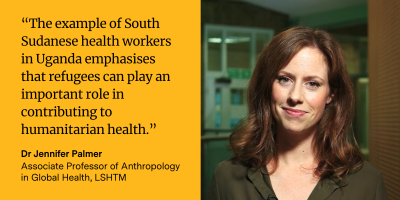
Around the world many health professionals displaced as refugees face multiple barriers to securing meaningful work in host countries' health systems. Dr Jennifer Palmer, Associate Professor of Anthropology in Global Health, LSHTM, and SSHAP team member, talks about her research among South Sudanese health workers who are refugees in Uganda.
Contextual social, political and livelihood understandings, factors affecting care-seeking and challenges to vaccination rollout were among the on-the-ground realities relating to mpox spread that experts discussed.
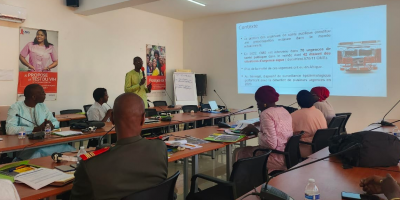
To facilitate reflection on epidemic preparedness and response in Senegal, and the role played by the social sciences in this process, a roundtable event was held in Dakar in December 2023. Read more about the event in this short news item by Khoudia Sow and Mariam Ballo Boyon.
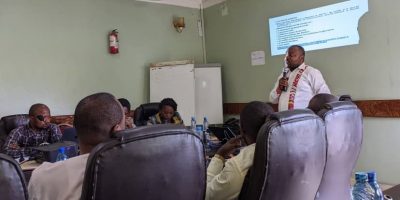
In December 2023, a workshop on the deteriorating security situation in North Kivu was held in Bukavu, South Kivu. Read more about the workshop in this short news item by Godefroid Muzalia from Groupe d’Etudes sur les Conflits et la Sécurité Humaine (GEC-SH) – a Central & East Africa Regional…
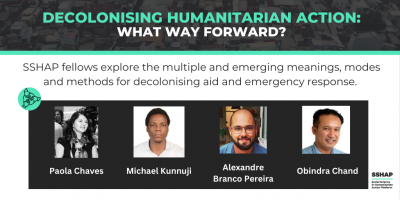
How can we decolonise humanitarian action given the multiplicity of meanings, modes and methods? In this blog post, SSHAP Fellows and webinar panellists share their reflections.
Obindra B Chand, Alexandre Branco-Pereira, Michael Kunnuji, Nancy Paola Chaves Perez, Gabrielle Daoust
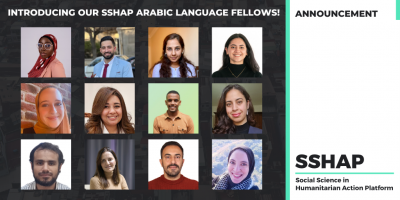
We are excited to announce the 12 individuals who will be participating in the first Arabic language phase of the SSHAP fellowship. This cohort includes social scientists and humanitarian practitioners from The MENA region as well as West and East Africa.
In the context of the global cholera upsurge and in particular the most recent outbreak in Zambia, Eva Niederberger, Santiago Ripoll and Tom Barker blog about the importance of centring cholera outbreak preparedness and response strategies on the circumstances and needs of communities and the experiences and insights of local…
In the context of protracted and resurgent conflicts, economic crises, and climate change, SSHAP and partners worked to generate evidence and insights to inform locally led solutions to complex health and humanitarian challenges. This blog post shares some of the highlights of our work from 2023.
We are launching the next phase of our Fellowship Programme in Arabic to begin in February 2024. The fellowship is for future leaders who can make linkages between social science and humanitarian emergencies in a locally relevant way.
Find emergency response resources
Curated collections of briefings, infographics, tools, blogs and other resources from SSHAP and other organisations working on social sciences in emergencies.