




Boosting developing nations’ access to medical advances is top of the agenda at Berlin’s World Health Summit, but will it improve healthcare for the poorest?
Briefing
Healthcare Innovations Won’t Cure Global Health Inequality – Political Action Will
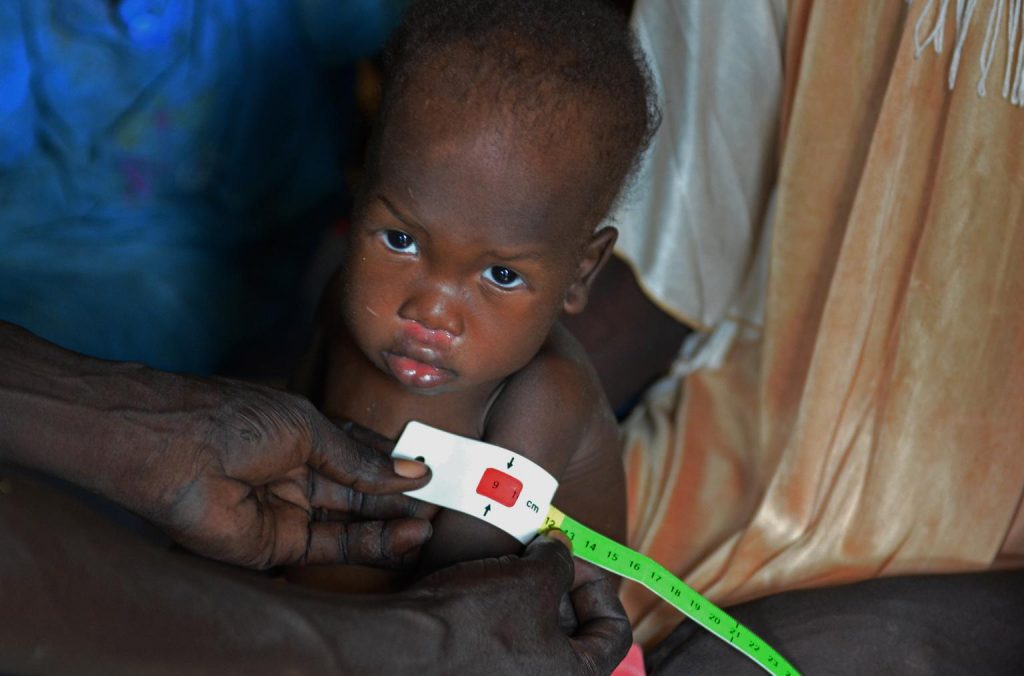
A health worker measures the arm of 3-year-old Nyarony Choing as she sits in her mothers lap, inside their familys makeshift shelter at the Protection of Civilians (PoC) site on the United Nations peacekeeping mission in South Sudan (UNMISS) base in the city of Malakal, capital of Upper Nile State. The measurement, using a mid-upper arm circumference (MUAC) band, is taken to determine nutrition status during emergencies. The red section of the armband indicates that Nyarony is severely malnourished. Nyarony was admitted to the outpatient nutrition centre at the International Medical Corps clinic at the PoC site two weeks ago. Her mother, Nyabac Chan Yor, originally fled to Malakal from Juba with Nyarony and her three siblings in December 2013. They afterwards travelled to the town of Kodok, where Nyarony was admitted to the ICRC (International Committee of the Red Cross) hospital, with oedema (swelling caused by an excessive build-up of fluid in the bodys tissues) in both feet a sign of severe acute malnutrition. She subsequently was referred to the UNMISS site in Malakal for further medical care. All of Ms. Chan Yors important documents, including her ration card and referral papers, were lost during flooding (from recent heavy rains) at the site. During the rain, this house becomes full of water, she said. My husband is in Juba, and sometimes the money he sends doesnt arrive. I need the food rations. There is no way to change [move from] this place and go to another place. I have nowhere to go, its all I have. The only thing that disturbs me more is the condition of my child.
In mid-August 2014 in South Sudan, 1.3 million people have been displaced since resurgent conflict erupted in mid-December 2013. An estimated 695,172 of the displaced are children. Some 442,600 people have also sought refuge in neighbouring countries. The conflict has also worsened the nutrition situation in South Sudan. Nearly 1 million children under age
Related content

Report
MHRN Roundtable Report: Social and Behavioural Science Priorities for Ebola Clinical Trials in DRC
This August 2026 roundtable consolidated lessons from past SBS research in/on Ebola clinical trials and discussed current challenges with clinical trial design and rollout.
Briefing
Key Considerations: Cross-Border Dynamics Between Uganda and DRC in the Context of the Bundibugyo Ebola Outbreak
This brief synthesises existing social and behavioural science evidence from the current and previous outbreaks on key socioeconomic and political dynamics in the Uganda-DRC borderlands.
Briefing
Key Considerations: Cross-Border Dynamics Between South Sudan and DRC in the Context of the Bundibugyo Ebola Outbreak
This brief updates previous SSHAP analyses to highlight key socioeconomic and political considerations in the South Sudan–DRC borderlands that shape Ebola preparedness and response.
Article
Contextual note: Funeral practices in Ituri
This note is the second produced by "the collective for Ituri", an informal network primarily driven by social scientists who provide contextual information for the response to the Bundibugyo Ebola epidemic in Ituri, eastern DRC. This note expands on the…
