




To tackle HIV rates we must give a voice to people prevented from accessing treatment due to social stigma.
Briefing
It Isn’t Lack of Drugs Preventing Us Eradicating AIDS, But Inequality
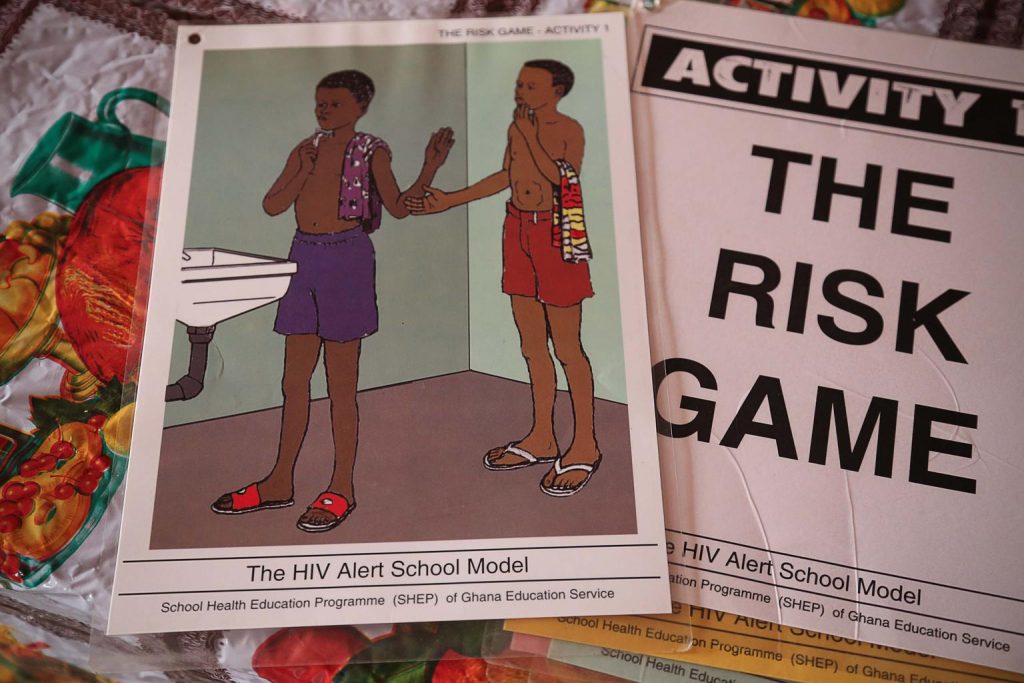
(Sequence: 9 of 10) The HIV Alert School Model is designed to incorporate HIV prevention education in the basic education curricula of schools in Ghana. Here are some samples of the materials used for the teacher and student-led pillars.
Activities under each pillar reinforce each other in order to ensure that the school child acquires the information, life skills and competence to reduce his/her risks and vulnerability to HIV. The skills the children will develop are expected to equip them to deal effectively with present adolescent challenges and those of the future as adults.
Although Ghana has a relatively low HIV prevalence at 1.3 per cent , only one third of adolescents aged 15-19 have comprehensive knowledge of HIV , which puts young people in this age group at high risk of HIV infection. Therefore, HIV and AIDS education in this important stage of childrenÕs life is key to reduce their vulnerability to HIV infection.
To address this vulnerability, the Ghana Education Service in implementing the HIV Alert School Model in junior high schools (pupils aged 13-16) across the country. Launched in 2006, the Model was developed with the support of UNICEF and piloted in one district in Upper East region before being rolled out country-wide.
The Alert Model is design to incorporate HIV education in the existing school curriculum. It seeks to mobilise teachers, school children, and the school community on HIV prevention education as an integrated package. Each group constitutes a ÔpillarÕ.
Related content

Report
MHRN Roundtable Report: Social and Behavioural Science Priorities for Ebola Clinical Trials in DRC
This August 2026 roundtable consolidated lessons from past SBS research in/on Ebola clinical trials and discussed current challenges with clinical trial design and rollout.

Briefing
Key Considerations: Cross-Border Dynamics Between Uganda and DRC in the Context of the Bundibugyo Ebola Outbreak
This brief synthesises existing social and behavioural science evidence from the current and previous outbreaks on key socioeconomic and political dynamics in the Uganda-DRC borderlands.
Briefing
Key Considerations: Cross-Border Dynamics Between South Sudan and DRC in the Context of the Bundibugyo Ebola Outbreak
This brief updates previous SSHAP analyses to highlight key socioeconomic and political considerations in the South Sudan–DRC borderlands that shape Ebola preparedness and response.
Article
Contextual note: Funeral practices in Ituri
This note is the second produced by "the collective for Ituri", an informal network primarily driven by social scientists who provide contextual information for the response to the Bundibugyo Ebola epidemic in Ituri, eastern DRC. This note expands on the…
