

Ebola demonstrates the critical link between health and human rights, the lack of governance, and the misdirection that befalls the international community in addressing such outbreaks. Human rights experts agree that the Ebola response falls into Lawrence Gostin’s paradigm whereby “the perception persists that disease threats originate in the global South, requiring international law to prevent their spread to affluent regions.”
In the case of Ebola, it becomes painfully clear that such perceptions apply given that six months separated the Centers for Disease Control’s recognition of the outbreak in March and the call for international mobilization by President Obama in mid-September.
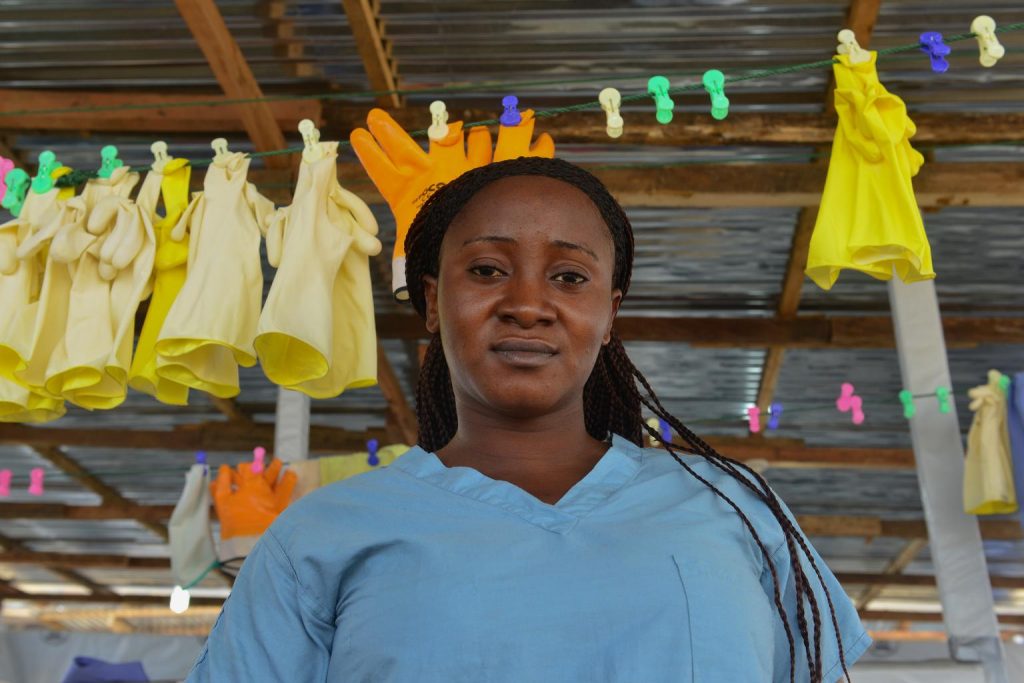
![On 13 November 2014, Mariama Kiadii, an Ebola survivor, stands near heavy duty gloves that she has washed and has hung on a line to dry, at a newly built Ebola treatment unit (ETU) in Monrovia, the capital. The gloves, which she has disinfected in water mixed with chlorine, are part of the protective gear worn by health workers as protection against exposure to the virus when they enter high-risk zones. Ms. Kiadii says: My grandfather was sick. I used to pay him a visit. After he died, the children got sick and were taken to the ETU. After that so many people got sick, including me, and my mother, my little sister; we were taken to JFK [another ETU in Monrovia]. By the grace of God, we survived. And then they called us, that we were important, to be a help to them because we already survived the virus, so we would be the best people to help. So that was how we came to this place. Ive got my department, which is the laundry. We wash the scrubs, the boots, the gloves, and so on. Ive been here for the past two weeks now, as theyve just opened the place. At least I was successful in surviving the virus, because its not an easy task to enter the ETU ward and walk out. Twenty-one members of Ms. Kiadiis family have died from EVD. Thank God some of us were successful to come through, she adds. Theres a saying that the virus cannot catch us anymore. Other people need our help and that is why Im here. The treatment unit, located in Monrovias Congotown neighbourhood, near the Ministry of Defence, is one of two built in October 2014 by UNICEF, the World Health Organization (WHO) and the Liberian Government, to help treat the overflow of Ebola patients. The units each have a 100-bed capacity. UNICEF is supplying water to meet the drinking, washing, bathing and disinfecting needs for patients at the health facility, which has two chlorine disinfecting stations. At least 150 litres of water is required to fully care for each Ebola patient UNICEF/UNI174715/Nesbitt](https://www.socialscienceinaction.org/wp-content/uploads/2017/01/UNI174715_Med-Res-1024x683.jpg)