




Social Anthropologist Julienne Anoko visits communities to encourage safe and dignified burial. Infection of the Ebola virus can occur from touching the bodies of those who have died from Ebola virus disease (EVD)
Resource
Video: Encouraging Safe and Dignified Burial of People who have Died from Ebola
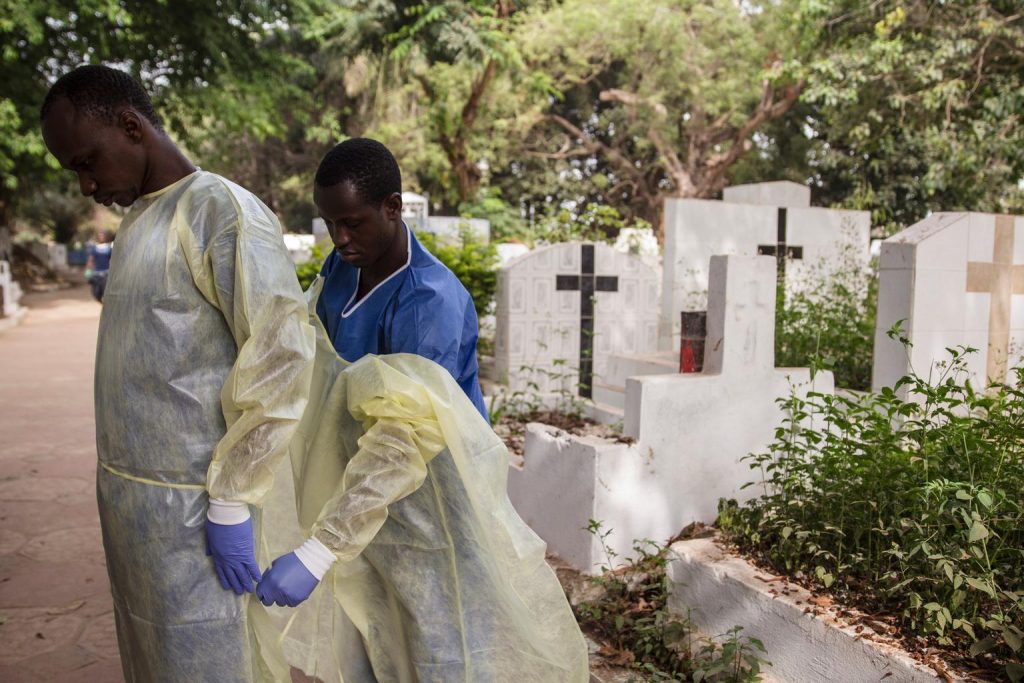
On 17 January, a worker from the International Federation of Red Cross and Red Crescent Societies (IFRC) helps a fellow worker doff his personal protective equipment in Conakry, the capital. They are part of a team helping transport the body of a woman who died from EVD from Donka Hospital to a nearby cemetery. The workers are responsible for safe and dignified burials, which respect cultural and religious customs while still ensuring persons do not come in contact with highly contagious corpses. Also critical to curtailing the outbreak is raising awareness of how the disease is spread and of the importance of safe burials, as well as working to ensure that families inform health facilities when someone is sick or has died. UNICEF continues to support social mobilization initiatives that promote understanding of these best practices among households across the country.
By 14 January 2015, Guinea remained one of three countries suffering widespread and intense transmission of Ebola virus disease (EVD). To date, there had been 2,806 cumulative cases (confirmed, probable and suspected), resulting in 1,814 deaths, in the country. As of 13 January, over 4.1 million children were living in areas affected by the virus, while 564 children and youth aged up to 20 years have themselves become infected. Despite these obstacles, in the week leading up to 14 January, the country reported its lowest weekly total of new confirmed EVD cases since the week ending 17 August 2014. UNICEF, together with partners, continues to provide vital support across multiple sectors, including communication for development (C4D), including efforts to raise awareness of the disease and effect behavioural changes that help halt its spread; health and nutrition; water, sanitation and hygiene; child protection; and education.
Related content
Evidence review
Rapid Evidence Review: School-Based Transmission of Orthoebolaviruses
This rapid review sought to identify published evidence reporting transmission of human pathogenic strains of orthoebolavirus in school-based settings.

Report
MHRN Roundtable Report: Social and Behavioural Science Priorities for Ebola Clinical Trials in DRC
This August 2026 roundtable consolidated lessons from past SBS research in/on Ebola clinical trials and discussed current challenges with clinical trial design and rollout.
Briefing
Key Considerations: Cross-Border Dynamics Between Uganda and DRC in the Context of the Bundibugyo Ebola Outbreak
This brief synthesises existing social and behavioural science evidence from the current and previous outbreaks on key socioeconomic and political dynamics in the Uganda-DRC borderlands.
Briefing
Key Considerations: Cross-Border Dynamics Between South Sudan and DRC in the Context of the Bundibugyo Ebola Outbreak
This brief updates previous SSHAP analyses to highlight key socioeconomic and political considerations in the South Sudan–DRC borderlands that shape Ebola preparedness and response.
