




This SSHAP Case Study explains how an anthropologist negotiated a medically safe burial for a pregnant woman who had died of Ebola Virus Disease (EVD) in a Kissi community at the beginning of the 2014 Ebola epidemic in Guinea. The epidemiological protocol to organise a safe burial for a deceased pregnant woman with suspected EVD clashed with the local community’s need for a ritual burial following a post-mortem caesarean. A tense stand-off occurred. According to Kissi culture, when a pregnant woman dies the foetus should be removed before burial, to avoid a curse on the community.
Case study
Balancing Burial Rituals with Public Health Demands During the 2014 Guinean Ebola Epidemic
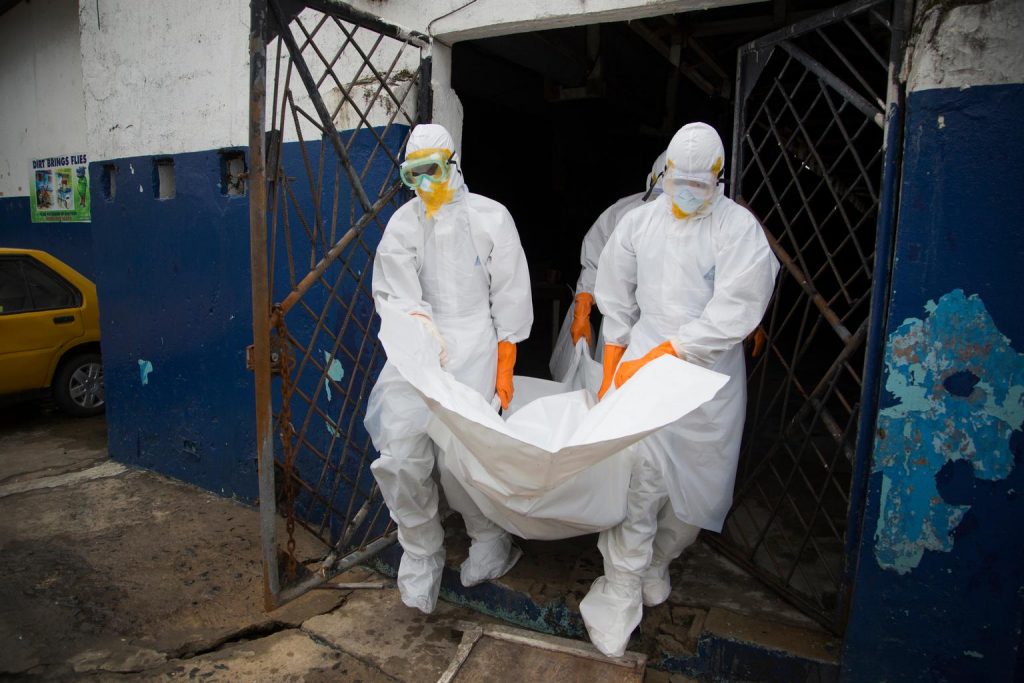
On 28 August in Liberia, workers wearing head-to-toe personal protective equipment remove a body from a holding facility in the West Point neighbourhood of Monrovia, the capital. The neighbourhood was under quarantine from 20 to 30 August to help stop the spread of EVD.
The worst outbreak of Ebola virus disease (EVD) in history continues to ravage communities in West Africa. UNICEF estimates that 8.5 million children and young people under the age of 20 live in areas affected by EVD in Guinea, Sierra Leone and Liberia, countries where disease transmission is widespread and intense. Of these, 2.5 million are under the age of 5. Preliminary UNICEF estimates also indicate that at least 3,700 children in Guinea, Liberia and Sierra Leone have lost one or both parents to EVD since the start of the outbreak. Nigeria and Senegal are also affected, having experienced an initial case or cases, or localized transmission. UNICEF remains at the forefront of efforts to respond to and help curtail the outbreak. In Guinea, UNICEF has been distributing bars of soap, bottles of chlorine for handwashing and household water treatment, and flyers with information on EVD; preventative practices have also been shared through a door-to-door campaign supported by UNICEF and partners. In Liberia, UNICEFs partners, in co-ordination with the Ministry of Health and Social Welfare and the United States Agency for International Development (USAID), are distributing household protection kits in the hardest-hit areas. The kits contains critical supplies protective gowns, gloves and masks, as well as soap, chlorine and a sprayer, along with instructions on the use and safe disposal of materials that help family caregivers look after Ebola sufferers as safely as possible. From 1921 September in Sierra Leone, UNICEF supported a Government-led campaign to reach every household countrywide with life-saving messages on EVD. On 16 September, UNICEF appealed for over US$200 million to cont
Related content

Report
MHRN Roundtable Report: Social and Behavioural Science Priorities for Ebola Clinical Trials in DRC
Against the backdrop of a large outbreak of the Bundibugyo Ebola virus in the DRC, this August 2026 roundtable consolidated lessons from past SBS research in/on Ebola clinical trials and discuss current challenges with clinical trial design and rollout.
Briefing
Key Considerations: Cross-Border Dynamics Between Uganda and DRC in the Context of the Bundibugyo Ebola Outbreak
This brief synthesises existing social and behavioural science evidence from the current and previous outbreaks on key socioeconomic and political dynamics in the Uganda-DRC borderlands.
Briefing
Key Considerations: Cross-Border Dynamics Between South Sudan and DRC in the Context of the Bundibugyo Ebola Outbreak
This brief updates previous SSHAP analyses to highlight key socioeconomic and political considerations in the South Sudan–DRC borderlands that shape Ebola preparedness and response.
Article
Contextual note: Funeral practices in Ituri
This note is the second produced by "the collective for Ituri", an informal network primarily driven by social scientists who provide contextual information for the response to the Bundibugyo Ebola epidemic in Ituri, eastern DRC. This note expands on the…
