

This descriptive cross-sectional study assessed the knowledge, attitudes and practices of Lassa Fever in and around Lafia, Central Nigeria. Structured questionnaires were administered to 200 consenting respondents from urban and sub-urban areas in Lafia. Of the 200 respondents, 87% heard of Lassa Fever with 89% and 80% from urban and sub-urban areas. There was no significant difference on the awareness of Lassa Fever among respondents from urban and sub-urban areas (P>0.05). There was misperception about species affected and modes of transmission of the disease, nevertheless bleeding was mentioned by 39% of the respondents as the major clinical manifestation.
Also, 83% of the respondents had rats/rodents in and around their residence, of which 28% come into contact with urine/feaces of the rodents and 24% consume foods contaminated by the rodents. However, 85% of the respondents do not believe in the existence of Lassa Fever. Most respondents (41%) reported that they will show some discriminatory attitudes towards individuals suspected or having Lassa Fever. Furthermore, 67% of the respondents were optimistic to accept possible vaccine candidate against the disease. Public health awareness especially among the sub-urban dwellers should be intensified so as to reduce the spread of both the vector and the virus.
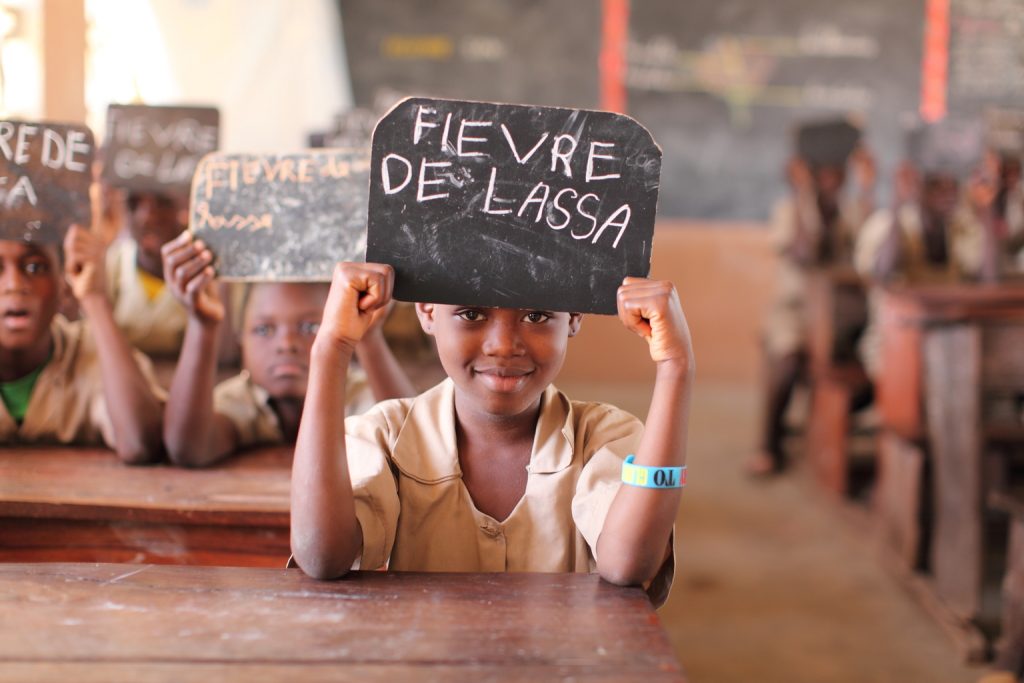
![In late February/early March 2016 in Benin, (foreground) Carine, a student at the district school in Tchaourou, smiles as she holds up her slate with the correct answer Lassa Fever to the question posed by her teacher: What disease is making people in our town sick these days and is being transmitted from rats to humans and from person to person? Schoolchildren at this and other schools in the surrounding area are being taught how the disease is transmitted and how to protect themselves against it, and the importance of not discriminating against their fellow students whose parents may have gotten sick from Lassa Fever. Lassa Fever, a viral disease that can be fatal in severe cases, is transmitted through contact with rats infected with the virus and through person-to-person contact. UNICEF is scaling up its emergency response to help prevent further spread of the disease and to support people affected by the ongoing outbreak.
[ORIGINAL TEXT IN FRENCH] Carine sourit car elle a trouvé la bonne réponse : « Quelle maladie fait du mal dans notre ville en ce moment et qui se transmet par le rat et aussi de lhumain à lhumain lhomme? » La Fièvre Lassa a-t-elle écrit sur son ardoise. A lécole de quartier de Tchaourou, comme dans toutes les écoles des environs, les enseignants apprennent aux élèves les modes de transmissions et de prévention de la maladie mais également la nécessité de ne pas discriminer les camarades dont les parents auraient été malades. UNICEF/UN014699/Bonnaud](https://www.socialscienceinaction.org/wp-content/uploads/2017/01/UN014699_Med-Res-1024x683.jpg)