




The current outbreak of Ebola in eastern DR Congo, beginning in 2018, emerged in a complex and violent political and security environment. Community-level prevention and outbreak control measures appear to be dependent on public trust in relevant authorities and information, but little scholarship has explored these issues. The authors aimed to investigate the role of trust and misinformation on individual preventive behaviours during an outbreak of Ebola virus disease (EVD).
Briefing
Institutional Trust and Misinformation in the Response to the 2018–19 Ebola Outbreak in North Kivu, DR Congo: a Population-Based Survey
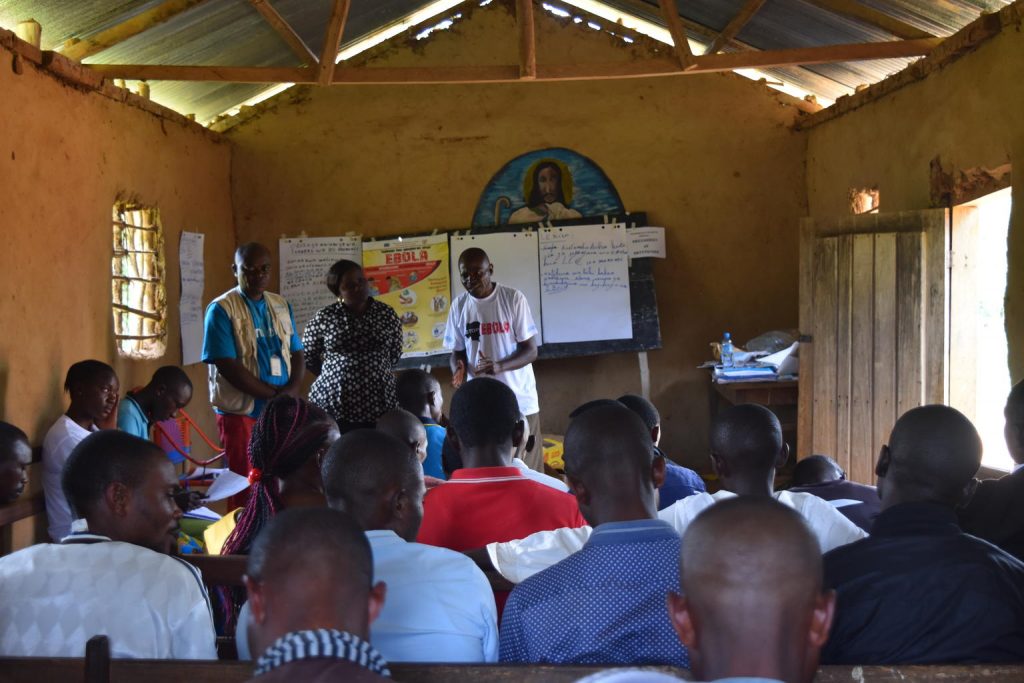
UNICEF/UN0231606/Herrmann
On 31 July 2018 in the Democratic Republic of the Congo, Leandre Kaseraka (right), an Ebola survivor, and UNICEF Communication Specialist Jean-Pierre Masuku (left) urge community members seated in a church in Mununze, North Kivu, to share toll-free numbers that provide information on the symptoms of Ebola.
Following the 1 August 2018 announcement by the Government of the Democratic Republic of the Congo (DRC) of a new Ebola Virus Disease (EVD) outbreak in North Kivu, UNICEF has mobilized its teams to help contain the spread of the disease and protect children. The impact of an outbreak on children can be far reaching. It’s known from earlier outbreaks in the DRC as well as in West Africa that children can be affected in various ways. Children can themselves be infected by the disease, but the impact goes beyond; it impacts their families and communities as children can lose their parents, care-givers and teachers. Access to basic services such as health care and education can become severely compromised. Also, children who are infected or whose relatives are, face stigmatization and social exclusion.
The Congolese Government has activated its response plan and called its partners, including UNICEF, to participate in the response. UNICEF has deployed a team to Beni for the response, including health specialists, communication specialists and a water, sanitation and hygiene specialist from the Ebola-response team in the Province of Equateur. Health, water, sanitation and hygiene and communication supplies have been sent to the affected areas including 300 laser thermometers to monitor the health conditions of people in the affected region and 2,000 kg of chlorine to treat water to help contain the spread of the disease. As at 14 August 2018, UNICEF has installed 35 chlorination points, as well as handwashing units in 45 public places and in health facilities in the affected areas of Beni and Mangina in North Kivu. UNICEF has supported the distribution of preven
Related content

Report
MHRN Roundtable Report: Social and Behavioural Science Priorities for Ebola Clinical Trials in DRC
This August 2026 roundtable consolidated lessons from past SBS research in/on Ebola clinical trials and discussed current challenges with clinical trial design and rollout.
Briefing
Key Considerations: Cross-Border Dynamics Between Uganda and DRC in the Context of the Bundibugyo Ebola Outbreak
This brief synthesises existing social and behavioural science evidence from the current and previous outbreaks on key socioeconomic and political dynamics in the Uganda-DRC borderlands.
Briefing
Key Considerations: Cross-Border Dynamics Between South Sudan and DRC in the Context of the Bundibugyo Ebola Outbreak
This brief updates previous SSHAP analyses to highlight key socioeconomic and political considerations in the South Sudan–DRC borderlands that shape Ebola preparedness and response.
Article
Contextual note: Funeral practices in Ituri
This note is the second produced by "the collective for Ituri", an informal network primarily driven by social scientists who provide contextual information for the response to the Bundibugyo Ebola epidemic in Ituri, eastern DRC. This note expands on the…
