Résumé des considérations clés
- Mobilité à travers des frontières poreuses : Les mouvements transfrontaliers sont soutenus par la famille, le commerce, les soins de santé et les déplacements. Ils varient selon l'itinéraire, le jour de marché, le genre et la dynamique des conflits. La préparation doit se concentrer sur la compréhension des corridors de mobilité et des points de rassemblement, et non sur l'hypothèse que les fermetures à elles seules peuvent stopper la transmission.
- Impacts de la fermeture des frontières : Les fermetures ont affecté mais n'ont pas éliminé les déplacements, poussant les populations vers des traversées plus précaires. Malgré ces fermetures, les traversées moyennant des paiements informels peuvent alimenter la méfiance reliant Ebola à la génération de revenus.
- Rassemblements de masse : Les marchés, les funérailles et les événements religieux provoquent d'importantes hausses de mobilité (par exemple, le marché de Mpondwe atteint environ 20 000 personnes les jours de marché). Les réductions ont principalement reposé sur une application coercitive plutôt que sur l'instauration d'un climat de confiance.
- Commerce: Le commerce transfrontalier est genré, les femmes dominant le commerce informel des produits agricoles et du tissu. Les hommes dominent d'autres industries frontalières telles que le mouvement transfrontalier informel des marchandises. En collaboration avec les associations de commerce et de transport, les restrictions devraient être évaluées pour leurs effets sur les moyens de subsistance, et pas seulement sur l'épidémiologie.
- Réseaux de commerce informels et illicites : La contrebande et la mobilité liée à l'exploitation minière (par exemple, l'or artisanal de Lubero sortant par Beni–Butembo–Kasindi vers l'Ouganda) sont importantes mais moins visibles. La cartographie de ces routes et acteurs peut identifier des points d'entrée pour la surveillance des maladies et la communication sur les risques.
- Titrisation Les agences militaires et de sécurité appliquent strictement le contrôle des frontières et des épidémies, avec des violences documentées dans des zones telles que le district de Kasese. La réponse de santé publique repose sur la cohésion, ce qui risque de compromettre la surveillance des maladies et la recherche de soins. Il est essentiel de renforcer les acteurs communautaires de confiance.
- Surveillance à base communautaire (SBC) : La surveillance à base communautaire (SBC) menée par les équipes de santé villageoises (VHT) est active dans certaines régions de l'Ouganda et a fonctionné lors d'épidémies passées. La priorité devrait être d'intégrer le signalement des symptômes aux connaissances locales sur la mobilité, les rumeurs et l'évitement, en s'appuyant sur les réseaux de parenté transfrontaliers.
- Recours aux soins Les femmes congolaises cherchent souvent des soins médicaux en Ouganda, ce qui devient difficile lorsque les frontières ferment, en particulier près des centres de santé frontaliers. Les craintes liées à Ebola incitent déjà à éviter les structures de santé et à pratiquer l'automédication ; les guérisseurs et les prestataires privés ou religieux devraient être impliqués plutôt que stigmatisés.
- Autorité publique La confiance et le pouvoir varient selon les lieux, les problèmes et le temps, de sorte qu'il est essentiel de cartographier les figures d'autorité locale (dirigeants élus, VHT, chefs de clan, guérisseurs, associations professionnelles). Cette cartographie doit distinguer l'autorité formelle, la capacité d'application et les médiateurs de confiance pour les questions sensibles.
- Diversité sociolinguistique : Les zones frontalières sont multilingues et le choix de la langue revêt un poids politique (par exemple, l'association militaire du swahili dans certaines régions de l'Ouganda). La communication sur les risques nécessite une sélection de la langue minutieuse et cartographiée au niveau local pour instaurer la confiance.
- Vulnérabilités Les femmes, les populations de pêcheurs, les commerçants informels, les réfugiés, les écoliers transfrontaliers et les personnes travaillant dans l'agriculture, l'exploitation minière et le transport sont touchés de manière disproportionnée par les fermetures et l'application des mesures. Les groupes marginalisés tels que les Batwa/Twa et les Mbuti font face à une forte discrimination, ce qui nécessite un engagement ciblée.
- Expertise locale : Les communautés possèdent une vaste expérience des flambées épidémiques passées, telles que l'adaptation des pratiques d'inhumation et l'aide mutuelle dans la région du Nil occidental en Ouganda en 2018, ainsi que la surveillance communautaire (CBS) menée par des réfugiés dans le camp de Bidibidi. Cette expertise existante doit être examinée et intégrée dans les interventions menées au niveau local.
- Autres recherches sur le SBS : Des recherches supplémentaires sont nécessaires sur l'évolution de la mobilité, les effets des fermetures et les adaptations locales, en particulier du côté de la RDC, qui a fait l'objet de peu d'études. Compte tenu de la proximité de l'épidémie avec les zones minières, les priorités sont la recherche sur la mobilité des mineurs et leur recours aux soins, ainsi que sur l'impact des coupes budgétaires de l'aide sur la capacité de réponse.
À propos de ce briefing
L'épidémie actuelle du virus Ebola de Bundibugyo, qui a été confirmée pour la première fois dans la province d'Ituri en République démocratique du Congo (RDC) le 15 mai 2026, présente des risques spécifiques pour les pays voisins. Des frontières poreuses, des antécédents de conflits et de déplacements, ainsi que de solides liens sociaux et commerciaux transfrontaliers signifient que la transmission entre pays est un risque. En effet, le virus s'est déjà propagé à l'Ouganda. À ce jour, l'Ouganda a enregistré 20 cas, dont 17 guérisons. Le dernier patient a and and quitte l'hôpital le 16 juillet et l'Organisation mondiale de la santé (OMS) a déclaré le pays exempt d'Ebola le 26 août. Cependant, l'épidémie en RDC reste dans une phase de ‘ transmission intense ’.’1 et, compte tenu de la mobilité transfrontalière entre les deux pays, l'Ouganda reste en état d'alerte quant à la possibilité d'une réintroduction de la maladie.
L'objectif de cette note d'orientation est de synthétiser les données probantes existantes en sciences sociales et comportementales (SSC) issues des épidémies actuelles et passées concernant les dynamiques socio-économiques et politiques clés dans la zone frontalière entre l'Ouganda et la RDC. Elle se concentre sur les données probantes qui sont importantes pour la conception d'activités de riposte et de préparation à Ebola qui soient efficaces, dignes de confiance et adaptées au contexte. Nous mettons en évidence les impacts sociaux de l'épidémie et de ses mesures de contrôle ; les facteurs contextuels susceptibles d'influencer la mise en œuvre des différentes stratégies de contrôle de l'épidémie ; et les opportunités de collaboration qu'offrent les liens transfrontaliers étroits dans cette région. Une analyse des dynamiques sociales de la vie dans les zones frontalières vise à aider à concevoir des mesures adaptées aux réalités du terrain et efficaces avec moyens de subsistance transfrontaliers, parenté, commerce, autorité publique et expertise locale.
Le rapport succinct se concentre sur les moyens de subsistance transfrontaliers, la mobilité et la recherche de soins de santé, en accordant une attention particulière au risque de réimportation et aux aspects de préparation du côté ougandais de la frontière. D'autres notes d'information récentes du Collectif de l'Ituri et du Réseau de recherche sur les multi-risques (MHRN)2–5, ainsi que sur le travail en cours de la SBS dans les provinces touchées de la RDC, se concentrer plus directement sur les considérations clés pour la RDC.
Nous avons examiné la littérature académique et grise disponible, y compris les bulletins d'épidémie des principales agences et les résultats de la recherche opérationnelle rapide en cours. Luisa Enria a dirigé la synthèse et la rédaction, avec des contributions contextuelles substantielles de Grace Akello et de co-auteurs qui ont fourni des révisions approfondies et des informations supplémentaires. Nous avons complété cette synthèse en obtenant une analyse de la situation actuelle auprès de chercheurs basés dans les zones frontalières de l'Ouganda, dans les districts de Kasese et Pakwach (Bob Okello, Peter Kermundu et Moses Baluku). Godefroid Muzalia a contribué à un rapport d'analyse sur les effets de la dynamique sécuritaire de la RDC sur les mesures de riposte à Ebola dans les zones frontalières du pays. Le document d'orientation a ensuite été soumis pour révision à cinq spécialistes des sciences sociales possédant une expertise sur l'Ouganda, la RDC et les moyens de subsistance trans frontaliers, avant d'être transmis aux examinateurs du FCDO et de l'OMS.
Le résumé est limité par sa focalisation principalement sur la littérature anglaise, avec une partie en français. Il est également limité par la nature rapide de l'examen, ce qui a rendu impossible de mener une large consultation auprès d'experts par pays et par sujet ou de mener des recherches empiriques.
Considérations clés
- Mobilité à travers des frontières poreuses: La frontière entre l'Ouganda et la RDC est extrêmement poreuse, et les mouvements transfrontaliers sont soutenus par des liens familiaux, des pratiques culturelles, le commerce, les soins de santé, les moyens de subsistance quotidiens et les déplacements liés aux conflits. Elle varie donc selon l'itinéraire, le jour de marché, le moyen de subsistance, le genre, la dynamique des conflits locaux et l'accès aux services. Les gens traversent par des points de passage formels et informels (connus sous le nom de panya routes), ainsi qu'en empruntant des voies navigables et en progressant le long des corridors de transport reliant l'Ituri, le Nord-Kivu, Kasese, Bundibugyo, Pakwach, le Nil occidental et Kampala. Les efforts de préparation doivent par conséquent se concentrer sur la compréhension et la gestion des corridors de mobilité, des points de rassemblement et des motifs de déplacement, plutôt que de supposer que la fermeture seule peut stopper la transmission transfrontalière.
- Impacts de la fermeture des frontières: Les fermetures de frontières liées à Ebola ont affecté les mouvements sans pour autant les éliminer. Les paiements informels aux agents de contrôle aux frontières et les passages informels non surveillés sont courants et se poursuivent. Les fermetures détournent les gens vers des points de passage plus dangereux. L'extorsion de paiements informels aux postes frontières prédatait Ebola, mais elle entraîne aujourd'hui une méfiance accrue car elle nourrit la perception qu'Ebola est lié à la génération de revenus.
- Rassemblements de masse: La mobilité augmente autour des marchés hebdomadaires, des funérailles, des événements religieux et d'autres jours sensibles. Les principaux marchés comprennent Mpondwe, Panyimur, Kasindi/Ubiriha et Bunagana-Bunagana. Au marché de Mpondwe, les mouvements trans frontaliers peuvent atteindre 20 000 personnes les jours de marché. Les réductions des déplacements grâce à la fermeture des marchés et des frontières ont été obtenues principalement par la coercition et l'application de la loi par les agences de sécurité plutôt que par l'instauration de la confiance. L'enregistrement officiel pour les transports publics ou les événements religieux peut être réalisable, mais nécessite une consultation approfondie avec les autorités publiques de confiance.
- Commerce: Le commerce transfrontalier entre la RDC et l’Ouganda est estimé à environ $478 millions de dollars américains, auxquels s’ajoutent $320 millions de dollars américains provenant du commerce informel. Ce commerce fait traverser les frontières terrestres et maritimes à des personnes se rendant dans des pays tiers, et concerne des marchandises issues des secteurs formel, informel et illicite. Le commerce présente également une dimension de genre : les femmes dominent le commerce informel des produits agricoles, des cosmétiques et des tissus kitenge. Les fermetures précédentes ont donc également eu des répercussions liées au genre, comme ce fut le cas pendant la pandémie de Covid-19. Les restrictions doivent être évaluées non seulement en fonction de leur impact épidémiologique, mais aussi en fonction de leur incidence sur les principaux axes de circulation et les moyens de subsistance des différents groupes. Il sera essentiel de mobiliser les coopératives commerciales transfrontalières, les associations de pêcheurs, les groupes d’épargne et de crédit, les associations de chefs d’entreprise ainsi que les associations de camionneurs et de motards afin d’identifier les voies de transmission et d’élaborer conjointement des mesures de réduction des risques réalisables.
- Réseaux de commerce informels et illicites: Les routes commerciales informelles et illicites, notamment la contrebande et la mobilité liée à l'exploitation minière, constituent des dimensions importantes mais moins visibles des mouvements transfrontaliers. La contrebande et le commerce à petite échelle empruntent fréquemment des points de passage et des systèmes de paiement informels qui sont largement connus mais non officiels. Une proportion importante de l'or artisanal produit dans des régions de la RDC telles que Lubero sortirait du pays par la route Beni-Butembo-Kasindi, l'Ouganda étant la principale destination. La cartographie de ces routes et des acteurs impliqués permettra d'identifier les points d'entrée pour la surveillance, la communication sur les risques et les mesures négociées de réduction des risques.
- Titrisation: L'armée et d'autres agences de sécurité sont fortement impliquées dans l'application du contrôle des frontières et des réglementations épidémiques. Dans certaines zones frontalières telles que le district de Kasese, cela a entraîné des cas documentés de violence et contribue à une méfiance accrue, bien que les relations avec les acteurs de la sécurité varient selon les régions. Le recours à une application coercitive risque de compromettre à la fois la surveillance et la recherche de soins. Un défi majeur pour les efforts de préparation est de savoir comment limiter l'application militarisée et surveiller les abus. Ils devraient plutôt chercher à renforcer la surveillance communautaire par le biais d'acteurs de confiance et localement légitimes, qui peuvent inclure des équipes de santé villageoises ou d'autres selon le contexte.
- Surveillance à base communautaire: La surveillance à base communautaire (SBC) par le biais des VHT est active dans certaines parties de l'Ouganda et a été utilisée efficacement lors d'épidémies précédentes. Pour les zones frontalières entre l'Ouganda et la RDC, une priorité devrait être de développer une surveillance intégrée qui associe le signalement des symptômes et des événements à des informations qualitatives et locales sur la mobilité, les moyens de subsistance, les passages informels, le recours aux soins, les rumeurs, l'évolution des pratiques d'application de la loi et l'évitement croissant des services. Des leçons peuvent être tirées des mécanismes de longue date d'observation des mouvements et de signalement des préoccupations par le biais des réseaux de parenté transfrontaliers. Cela rendrait la surveillance plus adaptée aux réalités du terrain.
- Recherche de soins: La recherche de soins de santé transfrontaliers depuis la RDC est motivée par la perception de meilleurs soins en Ouganda, par les difficultés d'accès liées aux conflits en RDC, par les liens familiaux et par l'expertise spécialisée des herboristes et des guérisseurs spirituels. Les femmes congolaises cherchent souvent des soins médicaux dans les centres de santé en Ouganda. Cela devient difficile lorsque la frontière est fermée, en particulier si le centre de santé est situé près de la frontière (par exemple, à Dei, dans le district de Pakwach). Les craintes liées à Ebola entraînent déjà l'évitement des structures de santé, l'automédication et des retards dans les traitements, tandis que les restrictions sur le franchissement des frontières peuvent interrompre les soins de routine et d'urgence. Il est essentiel de mobiliser les associations de professionnels de la santé, les pharmacies, ainsi que les structures privées et religieuses. Les guérisseurs sont souvent stigmatisés ou interdits pendant les épidémies, ce qui fait rater l'occasion de mettre à contribution leur expertise et d'exploiter leur position de praticiens de confiance que les populations continuent de consulter.
- Autorité publique: Les communautés ne sont pas homogènes, et les personnes de confiance ou puissantes diffèrent selon les lieux, les enjeux et le temps. Cartographier le pouvoir dans différentes régions frontalières et identifier les collectifs et les individus de confiance peut aider à identifier les bons intermédiaires pour l'engagement communautaire. Cela peut inclure des dirigeants locaux élus, des agents de santé villageois, des travailleurs d'organisations non gouvernementales (ONG), des chefs religieux, des aînés de clans, des institutions culturelles, des associations de commerce et d'épargne, des guérisseurs, des groupes de jeunes, ainsi que des acteurs politiques et de sécurité. Cette cartographie doit faire la distinction entre les acteurs qui détiennent une autorité formelle ; les formes d'autorité traditionnelles centralisées et décentralisées ; les acteurs capables de faire respecter les décisions ; et les acteurs suffisamment dignes de confiance pour servir de médiateurs dans des questions sensibles telles que les funérailles et le recours aux soins de santé. Elle doit également inclure des groupes qui sont habituellement négligés, tels que les aînés de clans ou les institutions culturelles capables de réunir des herboristes et des guérisseurs spirituels.
- Diversité sociolinguistique: Les zones frontalières sont des espaces multilingues diversifiés et les choix linguistiques revêtent des significations politiques. La communication sur les risques, l'engagement communautaire et d'autres activités d'intervention doivent en tenir compte pour concevoir des interventions ciblées et adaptées au contexte local, ainsi que pour instaurer la confiance. Cela devrait commencer par l'établissement d'une cartographie complète des langues appropriées pour la communication au sein des différentes communautés frontalières. Dans certaines régions de l'Ouganda, par exemple, le swahili a historiquement été associé à l'militaire. Il convient donc d'être prudent lors du choix de la langue à utiliser pour les messages.
- Vulnérabilités: Certains groupes sont plus vulnérables au risque de contracter Ebola et d'être négativement affectés par les impacts socio-économiques des réglementations de contrôle de la maladie. Les femmes sont particulièrement menacées en raison de leur rôle d'aidantes principales et de travailleuses de première ligne. Les pêcheurs, les commerçants informels, les réfugiés, les enfants scolarisés de l'autre côté de la frontière et les personnes dont les moyens de subsistance dépendent de l'agriculture, des mines, de la pêche ou du transport peuvent également être touchés de manière disproportionnée par les fermetures et les mesures d'application. Des groupes ethniques tels que les Batwa/Twa du côté de la RDC et les Twa/Mbuti en Ouganda ont historiquement fait l'objet de discrimination, y compris dans les structures de soins de santé, ce qui peut les rendre moins enclins à interagir avec les structures de réponse formelles. Des stratégies d'engagement ciblées devraient être élaborées pour comprendre et contrer les vulnérabilités, les préoccupations et les expériences spécifiques de ces groupes.
- Expertise locale: Les habitants en Ouganda et en RDC ont connu plusieurs épidémies d'Ebola. La sensibilisation est élevée et il existe sur le terrain une connaissance approfondie de la manière de réagir. Lors de l'épidémie d'Ebola de 2018, par exemple, la population a signalé des cas dans la région du Nil occidental en Ouganda, a adapté les pratiques d'inhumation et a organisé l'aide mutuelle pour faire face aux effets des restrictions. Dans les camps de réfugiés tels que Bidi Bidi dans le district de Yumbe, les réfugiés ont mené une surveillance communautaire (CBS) efficace en s'appuyant sur leur expertise en tant agentes et agents de santé au Sud-Soudan. Ces adaptations et cette expertise existante devraient être examinées et intégrées dans la co-élaboration d'interventions menées au niveau local.
- Autres recherches sur le SBS : Des recherches supplémentaires et continues sont nécessaires sur les dynamiques transfrontalières actuelles, notamment l'évolution des schémas de mobilité, les effets des fermetures de frontières et de la sécurisation, les adaptations locales et l'efficacité des différentes stratégies de lutte contre les maladies et d'engagement communautaire. C'est particulièrement le cas du côté de la RDC dans les zones frontalières, où les données probantes sont actuellement plus limitées, notamment en raison de problèmes d'accès. Compte tenu de la proximite de l'épicentre de l'épidémie avec les activités minières, il est également important de mener des recherches plus spécifiques sur la mobilité des mineurs et leurs parcours de recours aux soins, car ces informations ne sont actuellement pas disponibles. L'épidémie actuelle se déroule au lendemain de réductions significatives de l'aide extérieure qui soutenait auparavant les activités de réponse et de préparation ainsi que la mobilisation des ONG locales ; il est important d'évaluer les effets de ces coupes budgétaires. Dans ce contexte, il est crucial de comprendre comment les prestataires de soins de santé concilient la fourniture de soins de routine et le pivot vers la riposte à Ebola, tant pour garantir la continuité des soins que parce que les perturbations des services peuvent affecter la volonté de s'engager avec le système de santé.
Borderlands : Caractéristiques socio-économiques
Géographie
L'Ouganda partage une frontière de 765 km avec la RDC. Une partie de cette frontière traverse deux lacs, le lac Édouard (qui borde les districts de Kasese et Kanungu) et le lac Albert (qui borde les districts de Ntoroko, Kagadi, Kikuube, Hoima et Buliisa), où la démarcation du territoire peut être incertaine.6 De plus, la rivière Lubhiriha sépare la RDC de l'Ouganda, notamment autour de la zone de Kasese-Bwera-Mpwonde. L'épidémie actuelle en RDC, concentrée principalement dans la province de l'Ituri, a incité le gouvernement ougandais à classer environ 36 districts comme étant confrontés à un risque accru, y compris les districts frontaliers occidentaux de Bundibugyo, Ntoroko et Kasese ainsi que les districts septentrionaux d'Arua, Adjumani, Yumbe, Lamwo, Moyo, Koboko et Obongi.7,8 Il y a au moins 65 points d'entrée officialisés en Ouganda, et 35 d'entre eux ont été identifiés comme importants pour l'épidémie actuelle, bien qu'il soit reconnu qu'il existe de nombreux autres points de passage informels.9
Liens sociaux transfrontaliers, ethnicité et langue
Les frontières formelles ne reflètent pas les structures sociales, les liens familiaux, la culture et les pratiques qui unissent les gens de chaque côté de la frontière.10 Les gens se marient, font du commerce et socialisent de part et d'autre de la frontière. Comme l'a formulé un participant à une étude sur les moyens de subsistance dans les zones frontalières lors de l'épidémie d'Ebola de 2018 : ‘ nous sommes une seule famille, une seule tribu ’.10 Les membres d'une même famille élargie se trouvent souvent de part et d'autre de la frontière, y compris les familles polygames où le chef de famille entretient des familles des deux côtés. Des groupes tels que les Lukonjo en Ouganda et les Nande en RDC sont considérés comme faisant partie de la même famille ethnolinguistique. Il existe cependant aussi une grande diversité linguistique dans ces régions frontalières. Dans les districts du Nil Occidental (par exemple, Arua, Adjumani, Moyo, etc.), plusieurs langues sont parlées, notamment le lugbara, le ma’di, l’aringa, l’alur et le kinubi, qui présentent tous également des variations dialectales, ainsi que d’autres langues parlées par les réfugiés résidant dans les campements des zones frontalières (bien que le lugbara et l’alur soient intelligibles pour beaucoup dans la région).11 Cela dit, nombre de ces langues sont similaires ou intercompréhensibles pour beaucoup dans la région (par exemple, le lugbara et l'alur ou le lukonjo et le nande qui sont les mêmes dans la région du Rwenzori, et les similitudes entre le kinyarwanda et le kirundi).
Les habitants de Kasese parlent principalement le lukhonzo et, en raison d'interactions de longue date avec les langues voisines, peuvent également converser en swahili, notamment à des fins commerciales. En effet, dans toute la région, les gens sont multilingues en raison du commerce et des liens de parenté transfrontaliers. L'anglais est parlé principalement par les personnes instruites. Le swahili est la langue officielle de la Communauté est-africaine et il est parlé par les réfugiés congolais. Cependant, en Uganda, il peut aussi être associé dans certaines régions à l'armée.11 La prudence est donc de mise lors de la détermination des langues appropriées pour les messages de santé publique dans différentes localités frontalières. Les radios locales proposent des programmes dans différentes langues locales. La fermeture récente de médias en Ouganda fait peser un risque sur le rôle précieux que jouent les radios dans la communication sur les risques.12
Moyens de subsistance et commerce transfrontalier
Les moyens de subsistance dans les zones frontalières de l'Ouganda vont de l'agriculture paysanne (principalement de subsistance, le surplus des récoltes étant vendu sur les marchés locaux) à l'élevage, la pêche et le commerce. Nombre de ces activités se déroulent de part et d'autre de la frontière. Par exemple, la pêche amène les populations le long du Nil Blanc à son entrée dans le lac Albert, de sorte que les gens traversent fréquemment la frontière pour s'occuper de leurs jardins et de leurs fermes. En outre, les éleveurs traversent les parcs et les frontières pour faire paître leur bétail. L'extraction de ressources naturelles a également lieu au-delà des frontières, des personnes extrayant du sable le long de la rivière Lubiriha, qui fait partie de la frontière.
Le commerce, qu’il s’agisse d’activités formelles, informelles ou de contrebande (par exemple, de carburant, de cigarettes ou de cosmétiques éclaircissants), constitue une autre activité transfrontalière importante. En 2024, le commerce formel entre l’Ouganda et la RDC était estimé à environ $478 millions de dollars américains, le ciment étant le principal produit échangé.13 Les principales routes commerciales comprennent Mpwonde, Bundibugyo, Bunagana et Goli, ainsi que des routes bien établies traversant Arua et le marché d'Ariwara en Ituri.6 Les deux pays sont membres du bloc commercial du Marché commun de l'Afrique orientale et australe (COMESA) et des efforts ont été faits ces dernières années pour réduire les barrières non tarifaires au commerce. Les élites politiques, l'armée et d'autres personnalités influentes sont impliquées dans le commerce, et les profits proviennent souvent d'une sous-déclaration pour échapper à l'impôt. Lors de précédentes flambées d'Ebola, des craintes ont été exprimées quant au fait que la surveillance aux frontières puisse être perçue comme potentiellement perturbatrice, augmentant le contrôle sur les mouvements de marchandises et de personnes à travers la frontière.6
Le commerce informel a également pris de l'importance, avec une valeur estimée à environ $320 millions de dollars américains en 2021.14 Le commerce informel est une stratégie clé de subsistance. Bien que la majorité des commerçants informels soient des femmes, les hommes ont tendance à réaliser des bénéfices plus élevés.15 Les marchandises échangées comprennent l'huile de palme, les bananes plantains, les cosmétiques, les motos, le bétail, le cacao, le café ainsi que le tissu Kitenge en provenance de la RDC, ce dernier étant particulièrement rentable. Certains groupes ethniques se spécialisent dans le commerce de produits spécifiques, par exemple les Bankozo font le commerce du café du côté congolais. Des produits tels que le café peuvent faire l'objet d'un commerce tant formel qu'informel, car ils peuvent être introduits aux côtés de cultures vivrières pour passer inaperçus ou être commercialisés formellement pour couvrir le commerce d'autres marchandises telles que les minerais.16 Globalement, bien que les réglementations spécifiques changent fréquemment, l'évitement de la surveillance étatique est important et motivé à la fois par le commerce informel et illicite.
Le commerce est également genré. Par exemple, les femmes dominent le commerce du tissu Kitenge et des cosmétiques, tandis que les hommes font le commerce des motos, qui sont moins chères du côté de la RDC. Les produits agricoles et le poisson restent des denrées importantes malgré les contraintes liées aux problèmes de sécurité et à la réglementation. Par exemple, le poisson salé est exporté des lacs George et Edward vers la RDC. Les modes de transport empruntés par les commerçants sont également pertinents pour la gestion des épidémies, car les commerçants les plus pauvres dans des centres comme Arua empruntent souvent des véhicules en surcharge.
Les produits informels tels que les cigarettes, les motos, le riz et l'essence sont moins chers en RDC et sont par conséquent fréquemment contrebandiers en Ouganda.15 Des marchandises peuvent également entrer et sortir par la frontière. Par exemple, lorsqu'elles arrivent en Ouganda en provenance d'un pays tiers, elles sont déclarées en transit vers la RDC pour échapper aux taxes, mais sont en réalité passées en contrebande pour revenir en Ouganda.15 Le commerce informel à petite échelle est souvent soumis à une fiscalité informelle, y compris aux points de passage informels par l'intermédiaire d‘’ agents » civils travaillant pour le gouvernement.15 Ces pratiques – bien que non officielles – sont largement connues et mises en œuvre.17 La contrebande arriverait par environ 300 itinéraires, principalement par des passages informels, notamment l'or, l'ivoire et le bois d'œuvre, en particulier provenant des zones déboisées de l'Ituri.6 L'exploitation minière est un autre moyen de subsistance important, qui échappe souvent au contrôle de l'État. On estime qu'environ 20 pour cent de l'or artisanal produit dans des régions de la RDC telles que Lubero sort du pays par la route Beni-Butembo-Kasindi, avec l'Ouganda comme destination principale.16 L'exploitation minière est organisée autour de réseaux de ‘ grands hommes ’ (des personnes disposant de capital à investir et de liens avec des réseaux d'intermédiaires locaux et dans les centres politiques en RDC).18 Cartographier la manière dont ces structures de pouvoir clés s'étendent à l'Ouganda par le biais du commerce minier pourrait identifier des points d'entrée essentiels pour la riposte actuelle contre Ébola.
Autorité publique dans les zones frontalières
Les zones frontalières restent politiquement marginalisées, et l'histoire de leurs relations fragiles avec les autorités du gouvernement central a façonné la méfiance (ou la défiance) à l'égard des interventions de santé publique. Alors qu'en Ouganda, la méfiance envers les autorités publiques est liée aux expériences de présence ou d'ingérence de l'État, il est important de noter qu'en RDC, l'État est moins visible. Des années de conflit en RDC ont particulièrement sapé la confiance envers les autorités gouvernementales et les acteurs internationaux, et cela est parfois exploité par des groupes armés.19
En Ouganda, la perception de la corruption, par exemple à travers la fiscalité informelle pour transporter des marchandises, incite non seulement le commerce à emprunter des points de passage informels, mais réduit également la confiance envers des fonctionnaires perçus comme travaillant pour leur propre profit.10 Les exercices de cartographie du pouvoir menés dans les districts frontaliers de l'Ouganda dans le contexte d'épidémies précédentes ont mis en évidence que les niveaux de confiance les plus élevés résident dans les dirigeants locaux tels que les membres des conseils locaux de niveau I (qui sont élus au niveau du village par leurs administrés), les travailleurs des ONG qui sont perçus comme impartiaux, les équipes de santé villageoises et les guérisseurs traditionnels.10,20 Les groupes marginalisés tels que les pêcheurs avaient une confiance particulièrement faible envers les autorités officielles, et en particulier envers l'armée, étant donné que cette dernière saisissait fréquemment leurs biens.6 C'est également vrai pour la RDC, où l'armée est connue pour cette pratique. La présence de l'armée ougandaise en Ituri (analysée plus en détail ci-dessous) est également considérée avec beaucoup de suspicion par les Congolais, en particulier compte tenu de l'implication de l'armée dans le commerce des ressources naturelles et les pillages par le passé.
Les chefferies et les structures claniques constituent également des formes importantes d'organisation sociale et peuvent s'étendre au-delà de la frontière. Par exemple, les Alur des deux côtés de la frontière (à Pakwach en Ouganda et sur le territoire de Mahagi dans la province de l'Ituri en RDC) sont des sujets de la même chefferie dont le palais royal se trouve à Panyimur, du côté ougandais. Les clans peuvent être influents, en particulier dans les zones rurales de l'Ouganda. Ils ont tendance à être présidés par des anciens de sexe masculin et chaque clan est associé à ses propres totems, tabous et responsabilités sociales qui servent à maintenir l'ordre social et la continuité. Cependant, ils sont rarement mobilisés pour les interventions de santé publique, bien qu'ils soient organisés en associations au niveau des districts qui ont l'expérience de la collaboration avec des ONG dans d'autres domaines.10,11
Des recherches antérieures sur l'épidémie d'Ebola de 2018 en RDC ont souligné un manque d'analyse approfondie sur la dynamique du pouvoir et de la méfiance.21 Dans le Grand Nord, il a été noté que le conflit avait supprimé ‘ les mécanismes d'autorité préétablis et les réseaux de confiance... rendant l'engagement difficile ’.22 La recherche SBS en cours en Ituri lors de l'épidémie actuelle montre un rôle particulièrement important des leaders religieux ainsi que des chefs de ménage masculins.23 Une cartographie empirique détaillée du pouvoir et de la manière dont il est affecté par les dynamiques actuelles des conflits et des épidémies peut fournir des informations plus granulaire sur l'autorité publique.24
Vulnérabilités
Certains groupes peuvent nécessiter une attention particulière, soit en raison de leur exposition au risque d'Ebola, soit en raison de leur marginalisation existante. Il s'agit notamment des pêcheurs, qui sont particulièrement marginalisés et économiquement défavorisés, faisant souvent face à l'endettement, à des risques sanitaires tels que le choléra et la schistosomiase, ainsi qu'à des abus fréquents et à des extorsions de la part des militaires, des groupes armés et des agents frontaliers.6,25 Comme indiqué plus en détail ci-dessous, les femmes font face à des risques particuliers en tant que principales dispensatrices de soins et travailleuses de santé de première ligne, ainsi qu'en raison des schémas genrés de mobilité transfrontalière mentionnés plus bas. Les groupes ethnolinguistiques tels que les Batwa/Twa du côté de la RDC et les Twa/Mbuti du côté ougandais font également souvent l'objet de discrimination, ce qui entraîne leur désengagement des structures de soins de santé formelles et des autorités.26 D'autres groupes ethniques tels que les Banyabindi et les Basongora à Kasese ou les Lendu et les Bagungu à Pakwach font également face à des discriminations, dont certaines sont liées aux conflits régionaux et aux déplacements (par exemple, l'arrivée des Basongora à la suite du conflit dans l'est de la RDC au milieu des années 2000). Certains, comme les Banyabindi, demandent à être organisés en une chefferie distincte.
Les enfants peuvent être particulièrement vulnérables aux conséquences socio-économiques d'une flambée d'Ebola, car les fermetures de frontières et les réglementations d'urgence peuvent affecter la fréquentation scolaire, en particulier pour ceux qui vont à l'école de l'autre côté de la frontière. Les vulnérabilités structurelles expliquent également les risques à long terme et la résurgence d'Ebola, notamment les déplacements à grande échelle dus aux conflits et aux catastrophes naturelles, la pauvreté qui pousse les personnes à s'engager dans des activités susceptibles d'accroître l'exposition malgré leur connaissance des risques (voir plus bas), le mauvais accès à l'eau potable et la faiblesse des systèmes de santé.27 En effet, dans certaines communautés, comme dans certaines zones du district de Pakwach, des gens ont remis en question l'urgence d'Ebola par rapport à leurs craintes que le choléra ait plus de chances d'affecter leur vie. Cela souligne qu'un problème clé, plutôt que le manque de sensibilisation à Ebola, est le fait qu'Ebola émerge dans un contexte de crises croisées et de désavantage. Cela signifie qu'il est nécessaire d'adopter des approches globales et à long terme pour penser la préparation aux épidémies transfrontalières.27
Modèles de mobilité transfrontalière
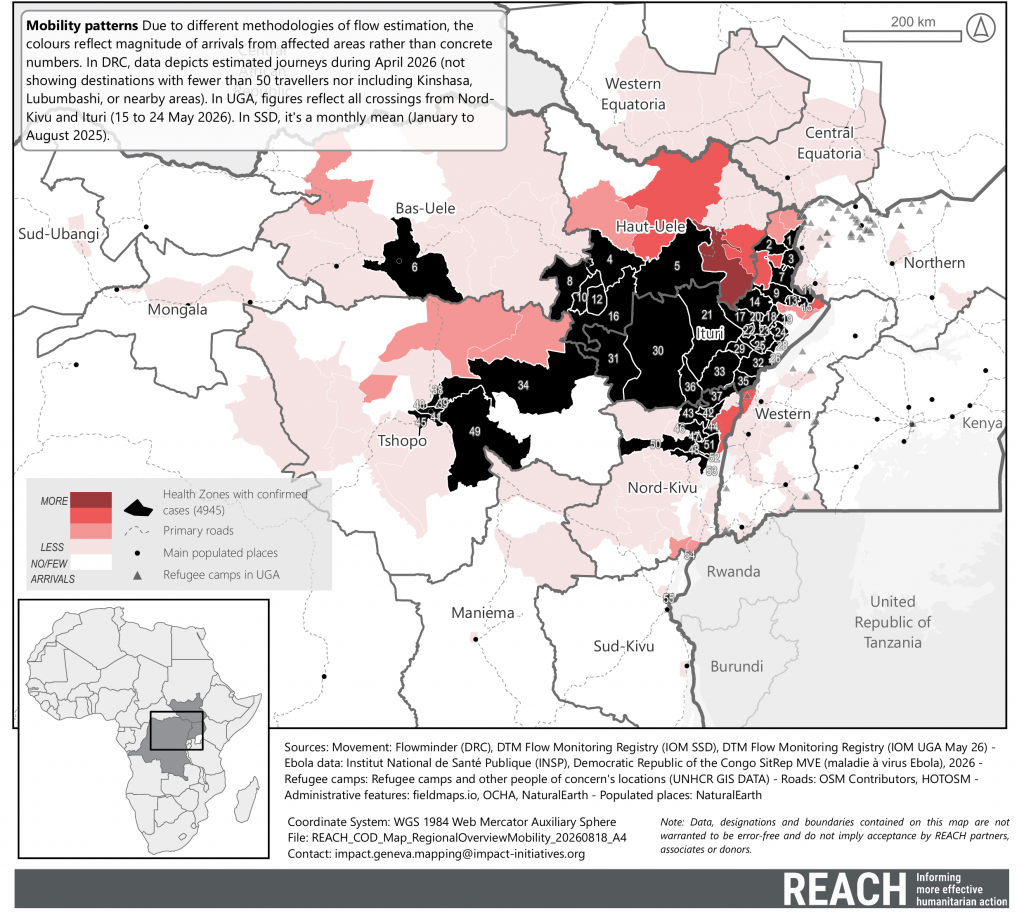
Une analyse récente démontre que l'épidémie actuelle s'est propagée le long des principaux axes de transport et des routes commerciales, et met en évidence des mouvements de population importants reliant les zones touchées de l'Ituri et du Nord-Kivu aux pays voisins, notamment l'Ouganda.28,29 L'analyse identifie les voies de mobilité à travers les principaux centres urbains, marchés et plaques tournantes du transport, renforçant la nécessité de concentrer les efforts de préparation sur les systèmes de mobilité et les points de rassemblement. Ces itinéraires représentent des risques de transmission, mais aussi des opportunités pour la communication sur les risques et l'engagement communautaire (voir la Figure 1). Une limite de cette analyse est que la mobilité vers l'Ouganda repose sur des données formelles, ce qui risque de passer à côté des passages informels. De même, les données de mobilité provenant de bases de données telles que Flowminder, qui s'appuient sur des données mobiles, comportent également des limites, par exemple parce qu'elles dépendent d'un seul opérateur de réseau et en raison des défis liés à la couverture réseau et à l'accès au téléphone mobile.
Figure 1 : Zones de santé (RDC) et comtés frontaliers (en Ouganda et au Sud-Soudan) à risque d'Ebola, sur la base des schémas historiques de mobilité
Points de passage formels et informels et axes clés
La frontière entre l'Ouganda et la RDC est poreuse, et les gens utilisent à la fois les points de passage formels et des sentiers informels connus sous le nom de panya. Dans le district de Kasese, par exemple, on estimait que chaque village frontalier comptait au moins quatre points de passage non officiels. La fermeture de la frontière ougandaise le 27 mai a poussé les populations vers des passages informels, et la fermeture du poste frontière de Cyanika entre l'Ouganda et le Rwanda — que de nombreux Congolais utilisaient après être entrés au Rwanda depuis Gisenyi par les lignes de bus populaires en provenance de Goma et de Butembo — aura probablement le même effet que lors des épidémies précédentes, obligeant les gens à opter pour des itinéraires moins sûrs.30
Les principaux axes de circulation comprennent Kasindi–Mpwonde–Kasese, Beni–Mbau–Kamango–Bundibugyo–Fort Portal et la route Kabale–Kisoro qui s'étend jusqu'à Kampala.6 Un exercice de suivi des flux de l'Organisation internationale pour les migrations (OIM) réalisé en mai 2026, avant la fermeture de la frontière, à des points frontaliers sélectionnés a révélé que la majeure partie des mouvements passait par Cyanika (à la frontière entre le Rwanda et l'Ouganda), Busunga et Bunagana.31 La plupart des personnes traversant depuis la RDC provenaient du Nord-Kivu, de l'Ituri et du Haut-Uele, les mouvements en provenance du Nord-Kivu transitant principalement par les points de passage de Busunga, Bunagana et Mpownde, tandis que les mouvements en provenance de l'Ituri passaient par les postes frontaliers de Goli et Vurra. Une cartographie de la mobilité des populations a également identifié d'autres routes importantes pour l'épidémie, telles que la liaison de Bunia à Kasenyi et Tchomia via le lac Albert pour le commerce du poisson, de Bunia à Mahagi vers l'Ouganda par la route 27 empruntée par environ 2 000 personnes chaque jour, et de Bunia à Aru jusqu'à Kengezi via la route 27 vers l'Ouganda par le point d'entrée d'Offoo.32 Depuis Bunia plus précisément, il est possible de se rendre à Kasenyi (US$10), de traverser le lac Albert (US$30) et d'atteindre Kampala (US$25).2 On peut traverser à pied certaines parties de la rivière Lubhiriha, et les lacs peuvent être traversés en bateau, souvent sous le contrôle limité des services de santé portuaires.
Contrôle et surveillance des frontières
L'infrastructure de contrôle frontalier peut varier de part et d'autre de la frontière (par exemple, à un passage de Mpwonde, il y a un contrôle plus formel du côté ougandais), tandis que dans certaines zones comme Arua, les gens avaient l'impression que les Congolais pouvaient passer plus facilement tandis que les Ougandais craignaient la violence et les amandes en traversant.6,11 Les visas ont été supprimés pour la traversée, bien qu'il existe des exigences telles que des certificats de fièvre jaune et que les paiements informels restent courants. Des recherches en Ouganda ont souligné que la traversée est souvent à la discrétion des agents frontaliers, qui par exemple ont refusé par le passé de tamponner les passeports de chercheurs ougandais pour traverser la frontière au motif qu'ils pourraient être arrêtés en RDC par des groupes armés exigeant une rançon. Particulièrement pour les personnes vivant dans les zones frontalières, il peut être facile de traverser la frontière, bien que l'épidémie semble modifier cette dynamique dans ce qui est perçu comme des mesures politiques visant à isoler les ressortissants congolais parmi les nombreux individus possédant des documents de voyage ougandais, par exemple à travers des expulsions récemment signalées. Un très grand nombre d'agences participent au contrôle des frontières des deux côtés (au moins huit du côté ougandais et cinq du côté de la RDC).[1], ce qui rend parfois la coordination difficile.15 L'armée et d'autres agences de sécurité jouent un rôle important dans le contrôle des frontières et l'application des mesures de lutte contre les épidémies, tout en étant présentes dans certains des panya routes. En Ouganda, cette surveillance militaire est présente depuis la pandémie de Covid-19, mais la présence de personnel armé aux passages formels et informels s'est intensifiée depuis l'émergence d'Ebola en RDC (voir plus bas). L'unité maritime des Forces de défense du peuple ougandais (UPDF) a également mis en place des systèmes de surveillance radar sur l'eau.
Depuis le début de l'épidémie d'Ebola, la frontière ougandaise est officiellement fermée. Il existe cependant plusieurs nuances. Les personnes traversant à pied n'ont officiellement pas le droit de traverser, tandis que les chauffeurs de camion y sont autorisés s'ils disposent de l'autorisation nécessaire de l'Autorité fiscale ougandaise (Ugandan Revenue Authority). Dans la pratique, des rapports provenant des districts de Pakwach et de Kasese indiquent que les personnes disposant de ressources financières peuvent traverser et acheminer des marchandises moyennant des paiements informels. À Pakwach, ces paiements ont été estimés entre 2 000 et 5 000 UGX. Il a été signalé que ces paiements sapent la confiance dans la riposte contre l'Ebola, car les gens, non sans raison, y voient une opportunité pour l'armée de gagner de l'argent.
L'OIM et d'autres agences soutiennent le dépistage d'Ebola et la formation des travailleurs de première ligne aux points frontaliers. Le dépistage d'Ebola est également en cours dans les aéroports ougandais, bien que de récentes observations aient noté que des soldats incitent les gens à cocher ‘ non ’ pour les symptômes d'Ebola et à ne pas mentionner de voyage vers la RDC sur les fiches de débarquement. Aux postes frontaliers de Kasese et de Pakwach, il a été observé que le dépistage et le lavage des mains étaient mis en œuvre de manière inconstante. Au point de passage de Dei, le gouvernement et des partenaires internationaux ont mis en place une tente de dépistage d'Ebola composée de membres d'une équipe de santé villageoise (VHT) soutenus par du personnel de sécurité, et le passage s'effectuait entre 7h et 19h. À Kasese, le centre d'isolement de l'hôpital de Bwera a été réactivé et un centre de traitement a été établi à l'hôpital de Kagando.
Motifs et modes de déplacement
Une grande partie des mouvements dans les zones frontalières est circulaire, c'est-à-dire que des personnes viennent de part et d'autre pour vendre des marchandises avant de rentrer chez elles.10 Le suivi des flux de l'OIM souligne que les principales raisons de déplacement sont d'ordre économique (33 pour cent pour la période d'observation), familial (19 pour cent) et le retour (17 pour cent), l'achat de biens (9 pour cent), les déplacements liés aux conflits (8 pour cent) et les soins de santé (3 pour cent), bien que cela soit probablement sous-déclaré. L'eau a également été signalée comme un motif de déplacement dans certaines zones frontalières, par exemple à Bunagana, en raison de l'absence de sources d'eau potable en ville, obligeant les habitants à traverser pour s'en procurer.10 Une étude sur l'épidémie de 2018-2019 a montré que, bien que des personnes telles que les conducteurs de camions et de motos eussent connaissance des risques liés à Ebola et craignaient effectivement l'infection, elles estimaient ne pas pouvoir renoncer aux paiements (par exemple pour transporter un cadavre ou une personne malade sur un boda boda) en raison de l'insécurité économique.10 La mobilité liée à l'exploitation minière peut être plus difficile à retracer car une grande partie s'effectue par des voies informelles ; cela nécessite des recherches supplémentaires. Lors de la dernière épidémie d'Ebola, il a été observé que les femmes de Kasese étaient plus susceptibles de traverser la frontière, non seulement parce qu'elles étaient engagées dans le commerce informel et l'agriculture transfrontaliers, mais aussi parce que leurs maris constataient une augmentation de la violence de la part des soldats envers les hommes cherchant à traverser.33 Ces mouvements seront probablement très spécifiques à chaque lieu et dépendront de la nature des stratégies de subsistance locales et des schémas genrés des différents types de commerce.
Effets d'Ebola sur la mobilité et les moyens de subsistance transfrontaliers
La fermeture des frontières, bien que mise en œuvre de manière ponctuelle comme indiqué ci-dessus, a des répercussions importantes sur la mobilité et les moyens de subsistance transfrontaliers. De nouveaux itinéraires informels, moins sûrs, ont vu le jour, par exemple à travers la zone boisée du parc national Queen Elizabeth. Les gens sont plus enclins à voyager la nuit lorsque la surveillance des frontières est plus limitée. Les passages frontaliers pour des raisons de santé se poursuivent, mais les personnes visiblement malades ont été arrêtées et les voyageurs sont invités à présenter des formulaires de référence officiels pour pouvoir traverser. Les registres du centre de santé de Dei (district de Pakwach) ont montré une baisse estimée de la fréquentation d'environ 55 pour cent (cela pourrait aussi être dû en partie à un évitement local en raison d'Ebola). Le refus de traverser pour des visites auparavant de routine a eu, selon les rapports, des conséquences importantes dans certaines régions ; par exemple, à Pakwach, des rapports ont fait état d'une femme de la RDC qui est décédée en accouchant après n'avoir pas pu assister à ses services prénatals réguliers en Ouganda.
Les moyens de subsistance ont également été négativement affectés. Des agriculteurs de Kasese ont fait part de leurs craintes de ne pas pouvoir s'occuper de leurs fermes et jardins de l'autre côté de la frontière à l'approche de la saison des pluies. De plus, à Kasese, les restrictions sur l'extraction de sable ont été contestées, par exemple lors d'un affrontement violent avec des officiers militaires qui ont attaqué une femme contestant le lien entre les réglementations sur Ebola et la cessation des activités d'extraction. Des écoliers de la RDC ont été absents de l'école. Les coûts des produits de base ont augmenté (par exemple, un sac de riz à Dei et Panyimur est passé de 65 000 à 75 000 UGX). Fermetures de marchés, notamment le marché aux poissons de Panyimur et le marché de Mpondwe. Bien que des commerçants opéreraient prétendument en dehors des portes fermées du marché, les activités auraient considérablement diminué, les commerçants ne pouvant pas traverser pour se rendre sur les marchés des deux côtés. Le fait que des marchés situés un peu plus loin de la frontière, tels que Kinyamaseke ou Kisinga, restent ouverts a soulevé des questions quant à la cohérence des réglementations.
Marchés et jours de marché
Les mouvements transfrontaliers ne semblent pas particulièrement saisonniers, mais les jours de marché déterminent les déplacements d'un point de passage à un autre selon les jours de la semaine. Il existe des marchés des deux côtés de la frontière dont les jours alternent et qui se spécialisent dans des produits particuliers. Parmi les principales zones de marché figurent Mpondwe, qui attire des marchandises d'une vaste zone et se spécialise dans le bétail ougandais, ainsi qu'un marché aux poissons à Panyimur. On estime que le trafic au poste frontière de Mpondwe peut atteindre jusqu'à 20 000 personnes par jour les jours de marché.34 Du côté congolais de la frontière, le marché de Kasindi/Ubiriha vend du charbon de bois et du bois d'œuvre.15 Buangana est un autre marché important.
Funérailles
Les pratiques funéraires ont été une préoccupation centrale des efforts de riposte contre Ebola, étant donné les risques de transmission associés à la manipulation des corps. Comme l'ont souligné les auteurs du collectif de l'Ituri, ‘ il n'y a rien de spécifiquement africain ou congolais dans le désir d'organiser des funérailles respectueuses du défunt ’, et toutes les sociétés ont leurs pratiques.3 Certains aspects des pratiques funéraires de la région qui peuvent être pertinents pour la lutte contre les maladies comprennent l'arrivée de parents pour rendre visite au mourant ou au défunt, ce qui peut inclure un contact direct dans le cadre des adieux à un être cher, des salutations impliquant un contact physique et la toilette des corps. En Ituri, une pratique qui a été soulignée est le mouvement des membres après la mort.3 Les veillées funèbres peuvent inclure un rassemblement autour du défunt et, dans certaines occasions, un contact physique.
Compte tenu des liens sociaux étroits et des réseaux familiaux transfrontaliers, les funérailles entraînent des déplacements de part et d'autre de la frontière (tout comme d'autres événements tels que les mariages). Dans la région du Nil occidental en Ouganda, par exemple (mais cela vaut également pour d'autres communautés), les dépouilles des défunts sont généralement ramènées soit dans leur ville d'origine s'il s'agit d'hommes, soit dans celle de leur mari s'il s'agit de femmes, y compris en empruntant les transports en commun si nécessaire.11 Les funérailles ont lieu rapidement après le décès et requièrent la présence de toute personne liée au défunt, et la taille des funérailles augmente avec la notoriété. Il a été signalé que la participation aux funérailles en provenance de l'autre côté de la frontière a diminué lors de la flambée actuelle, avec des exemples à Pakwach montrant que la sécurité frontalière et l'imposition d'une quarantaine aux voyageurs revenant de RDC ont fait que des membres de la famille n'ont pas assisté aux funérailles. Compte tenu de l'expérience récurrente des épidémies d'Ebola ces dernières années, des ajustements substantiels, menés par la communauté, ont déjà été apportés aux pratiques d'inhumation vers des procédures sûres et digne, par exemple parmi les communautés de la région du Nil occidental.
Les décisions concernant les modifications des rassemblements de masse, tels que les funérailles, étaient prises par les chefs de clan ou de famille, puis largement communiquées au moyen d'un mégaphone. (muzindalo). Un décès récent à Kasese, par exemple, a vu les autorités du district engager des anciens pour reporter l'enterrement jusqu'à ce qu'un résultat de test négatif soit confirmé. Cela a cependant également été appliqué par le déploiement de policiers. Les considérations concernant la faisabilité de l'enregistrement des événements à Kasese et Pakwach ont suggéré que l'enregistrement lors des funérailles pouvait s'avérer difficile étant donné qu'il s'agit de grands rassemblements informels avec des mouvements fluides de personnes, tandis que cela pourrait être plus facile à organiser pour les transports publics. Dans ces districts, les agents de santé villageois (VHT) ont été considérés comme le mécanisme le plus fiable pour retracer la participation et les mouvements étant donné leur rôle dans la surveillance communautaire.
Réfugiés
L'Ouganda accueille plus de 2 millions de réfugiés et de demandeurs d'asile, dont, selon les dernières estimations, 670 240 proviennent de la RDC et 1 059 650 du Soudan du Sud (HCR, 31 août 2026). Il n’est toutefois pas toujours facile de déterminer qui est réfugié. Dans le district de Kasese, par exemple, des personnes ont rejoint leurs proches de l’autre côté de la frontière, en Ouganda, en raison de l’insécurité en RDC, et y sont restées en tant qu’hôtes jusqu’à ce qu’elles se sentent en sécurité, faisant régulièrement la navette entre les deux pays. Parmi les camps de réfugiés situés près de la frontière avec la RDC, on peut citer celui de Rhino, qui s’étend entre les districts de Madi Okollo et de Terego, celui de Kyangwali à Kikuube, celui de Kyaka II à Kyegegwa et celui de Nakivale à Isingiro.8 D'autres localités importantes situées dans des districts à haut risque comprennent Palabek à Lamwo et Bidibidi à Yumbe. Les points de transit officiels pour les réfugiés comprennent Kisoro, Bundibugyo et Matanda, où les réfugiés sont hébergés temporairement pendant leur enregistrement. .6 Quatre-vingt-douze pour cent des réfugiés ougandais vivent dans des installations aux côtés des communautés d'accueil plutôt que dans des camps formels. Cela entraîne parfois des tensions avec ces communautés au sujet de questions telles que l'attribution des terres.35 Les réfugiés et les migrants originaires du Congo peuvent également faire l'objet de discriminations en raison du lien avec l'épidémie actuelle. D'autre part, les catégories d'hôte et de réfugié ne reflètent pas toujours les réalités de la mobilité transfrontalière, par exemple les Sud-Soudanais qui sont nés en Ouganda lors d'un déplacement antérieur, sont retournés au Sud-Soudan et sont revenus.
Il a été souligné que les fermetures de frontières et la suspension des admissions de demandeurs d'asile présentaient un risque d'accroître les mouvements irréguliers par le biais de points de passage informels. En RDC, aucun cas de contamination par Ebola n'a encore été signalé parmi les réfugiés, mais 19 déplacés internes des sites de Kpangba, Kigonze et Beyembi en Ituri ont été infectés, et plus de 2 millions de personnes déplacées résident dans des zones à haut risque, dont 320 000 réfugiés et demandeurs d'asile.36
Il peut y avoir des opportunités importantes et inexplorées pour une riposte à Ebola menée par des réfugiés dans certains de ces camps. Des recherches récentes menées dans le camp de Bidibidi à Yumbe, en Ouganda, ont par exemple démontré la capacité significative des agents de santé villageois à mener une surveillance à base communautaire (y compris par rapport à la surveillance communautaire locale), car ils sont souvent dirigés par des agents de santé sud-sudanais formés et expérimentés qui sont sous-employés en Ouganda.37,38
Dynamique des conflits et sécurisation
Dynamique des conflits
Les régions frontalières ont longtemps été des terrains de recrutement pour les groupes rebelles lors des périodes de conflit en Ouganda et des guerres en cours en RDC, en raison d'une résistance généralisée au contrôle de l'État.6 Des groupes armés ougandais tels que les Forces démocratiques alliées (ADF) ont survécu de l'autre côté de la frontière, ce qui contribue au déploiement occasionnel de l'armée ougandaise de l'autre côté de la frontière. L'opération Shujaa en 2021 met en lumière les liens entre la dynamique des conflits et les intérêts commerciaux qui offrent un contexte important pour comprendre les dynamiques transfrontalières.16 L'opération visait à cibler les forces des ADF à la suite d'une tentative d'attentat-suicide à Kampala, mais elle s'est progressivement élargie. En février 2025, l'UPDF, l'armée ougandaise, est entrée à Mahagi, dans la province de Ituri. Ces incursions ont été perçues non seulement comme une réponse à des préoccupations sécuritaires, mais aussi comme un moyen pour l'Ouganda de consolider sa ‘ zone d'intérêt ’ en RDC face à l'expansion perçue du Rwanda à travers son soutien au groupe rebelle M23. Une partie de l'opération visait, par exemple, à soutenir la construction d'une route reliant Goma à Bunagana. Étant donné le rôle joué par l'armée ougandaise lors de la seconde guerre du Congo, la présence ougandaise, en particulier en Ituri, est perçue avec suspicion tant par les autorités congolaises que par la population.
Le déploiement militaire ougandais dans les zones frontalières augmente périodiquement en réponse aux menaces perçues des groupes armés de la RDC. En outre, les groupes armés des zones frontalières sont directement impliqués dans le commerce local pour financer leurs activités, ainsi que dans la vente de protection aux civils.6 D'autres conflits récents dont il a été constaté qu'ils influencent la méfiance envers le gouvernement central lors de précédentes épidémies d'Ebola étaient, par exemple, les tensions dans la région du Rwenzori en Ouganda, en particulier à la suite d'un raid de la police sur le palais royal du Rwenzururu ayant entraîné la mort de huit gardes royaux.
Les territoires frontaliers du côté de la RDC sont directement touchés par le conflit en cours, ce qui pose des défis particuliers pour la riposte contre Ébola (voir Villa et coll. (2026) pour un aperçu plus détaillé de la dynamique des conflits en RDC et de leur pertinence pour l'épidémie5Le territoire de Djugu, dans la province de l'Ituri, qui est limitrophe du district de Zombo en Ouganda, a par exemple connu des violences récurrentes de la part de groupes armés locaux tels que la Coopérative pour le développement du Congo (CODECO). Cela a entraîné un déplacement interne important de ménages qui font maintenant face à d'importantes pénuries de nourriture, d'eau potable, de soins de santé et d'autres services, et qui, en raison de l'insécurité, sont difficiles d'accès. Les attaques contre les sites de déplacés internes ont poussé les populations à se déplacer fréquemment, y compris lorsqu'elles s'occupent de malades. La violence prolongée, comme indiqué ci-dessus, a conduit des habitants de l'Ituri à s'établir en Ouganda.
Sécurisation de la frontière et contrôle des épidémies
La sécuritisation de la lutte contre les maladies a une longue histoire en Ouganda, y compris dans la gestion coloniale de la maladie du sommeil. L'armée ougandaise était déjà impliquée dans l'épidémie d'Ebola de 2000-2001 qui a eu lieu dans les zones de guerre du Nord. Des rapports faisaient état à l'époque de violations des droits de l'homme, mais l'implication de l'armée dans cette épidémie est depuis devenue un modèle pour la gestion des futures épidémies.39 L'UPDF, par exemple, a été chargée de faire respecter le confinement lié au Covid-19 en collaboration avec des unités paramilitaires locales. Des témoignages faisant état de passages à tabac ont ensuite nourri l'idée que la pandémie était une tentative d'étendre le pouvoir de l'État et que les vaccins constituaient un moyen pour l'armée de surveiller la population.39 La recherche à Pakwach et à Kasese pendant la pandémie de COVID-19 a montré que l'utilisation de la réglementation relative au COVID-19 pour renforcer le pouvoir local par la militarisation a conduit les populations à développer ‘ de nouveaux modes de réciprocité pour résister aux réglementations et les subvertir ’, suggérant que cela a en fait compromis l'efficacité de la gestion de l'épidémie.40 Dans ce contexte, les réglementations et la militarisation ont eu un impact plus important sur la population (par la perte de moyens de subsistance et la violence) que la pandémie elle-même. L'application stricte des réglementations, incluant l'arrestation et l'isolement de patients atteints de la Covid-19 mais asymptomatiques, a également érodé la confiance et provoqué des tensions sociales, avec des signalements de personnes utilisant ces réglementations pour dénoncer auprès de la task-force Covid-19 des voisins avec qui elles avaient des litiges fonciers.41 Il a également été évalué que la militarisation du déploiement obligatoire du vaccin contre le Covid-19 a eu des effets contre-productifs sur les programmes de vaccination de routine, bien que l'adhésion au vaccin contre le Covid-19 ait été élevée.42
Les rapports actuels en provenance de la frontière ougandaise suggèrent que des dynamiques similaires sont à l'œuvre face à l'épidémie de Bundibugyo. À Dei, à Pakwach, le nombre de membres de l'UPDF est passé d'environ 60 à 200. Le rôle prépondérant de l'armée dans le contrôle des frontières (notamment le long de panya routes) et l'application des règlements d'urgence sanitaire ont signifié qu'ils sont également ceux qui profitent des pot-de-vin pour les passages frontaliers. L'militaire a également une présence dans certaines structures de santé, par exemple en effectuant des contrôles à l'hôpital de Bwera et en imposant le port du masque (qu'ils vendent également). Comme indiqué plus haut, cela a contribué à la perception de l'Ébola comme une opportunité de gagner de l'argent au détriment des moyens de subsistance de la population.
Des violences ont également été signalées, par exemple lors des affrontements liés à l'extraction de sable mentionnés ci-dessus ou lors du passage tabassé d'une femme enceinte essayant de traverser pour des soins prénatals à Dei, dans le district de Pakwach, en juin 2026. Pour certaines personnes vivant dans les zones frontalières, cette militarisation semble entraîner des restrictions plus strictes liées à Ebola du côté ougandais plutôt que du côté de la RDC. Étant donné que la maladie touche beaucoup plus la RDC, cela soulève des questions quant à savoir si les restrictions servent des intérêts autres que la santé publique. Il convient de noter que les relations entre l'armée et les populations frontalières peuvent varier selon les régions, et des violences ainsi que des pots-de-vin ont été signalés dans le cadre de notre recherche empirique dans deux districts. Dans d'autres zones, telles que la région du Nil occidental, l'armée a participé au transport de personnes malades vers l'hôpital et les relations peuvent y être moins tendues.
Santé
Infrastructures de santé et pluralisme médical
L'Ouganda dispose d'un système de santé mixte comprenant des structures de santé publiques, des structures et des acteurs privés à but non lucratif et des structures privées à but lucratif. Les structures étatiques sont organisées par unités administratives, allant des équipes de santé villageoises (VHT) au niveau du village jusqu'aux hôpitaux régionaux de référence (par exemple, à Arua). Des recherches ont montré que le secteur de la santé privé domine de manière significative, en particulier parce que les gens ont tendance à se rendre dans les pharmacies pour acheter des traitements ou à consulter des herboristes et des guérisseurs traditionnels pour des affections spécifiques.43,44 Le choix du prestataire est déterminé par le coût et le type de maladie ainsi que par des caractéristiques démographiques telles que le niveau d'éducation et l'âge. Les structures publiques et privées peuvent constituer un premier recours pour les maladies courantes telles que le paludisme et la fièvre typhoïde, mais si les symptômes persistent, d'autres solutions peuvent être recherchées et de multiples parcours peuvent être suivis simultanément.11
Les herboristes se soignent en utilisant des remèdes à base de plantes et sont différents des guérisseurs spirituels, tandis que les guérisseurs religieux tels que les praticiens chrétiens charismatiques et la guérison par la foi islamique dans les régions à majorité musulmane comme Yumbe prennent une importance croissante (et il existe souvent des chevauchements entre les savoirs chrétiens, islamiques et ‘ traditionnels ’).11,45 Les herboristes sont particulièrement recherchés pour les affections chroniques telles que le diabète, tandis que les guérisseurs spirituels peuvent être sollicités pour des problèmes de santé mentale.26 La guérison est souvent pratiquée de manière très privée, étant donné qu'elle peut être perçue négativement, notamment par le christianisme et l'islam. Des deux côtés de la frontière, les morts subites, y compris celles dues à des conditions médicales connues, peuvent être attribuées à un empoisonnement et nécessitent une enquête, mais il est tabou de parler d'empoisonnement publiquement.2,11Au cours des flambées d'Ebola, il a été constaté que les pratiques de guérison et les cérémunies présentaient des risques de transmission en raison du contact avec les corps des malades et du manque d'équipements de protection. L'implication directe des guérisseurs dans les activités de riposte a contribué à atténuer ce problème, mais des occasions sont souvent manquées d'impliquer plus substantiellement les guérisseurs, en s'appuyant sur leur expertise et leur statut social plutôt qu'en s'en remettant à des interdictions de guérison ou à la reconversion professionnelle.46
La confiance envers les différents types de services de santé influe également sur le choix du praticien. Par exemple, les établissements publics dans les zones frontalières de l'Ouganda, telles que Hoima, Kasese et Kisoro, étaient perçus par les résidents comme offrant des soins limités, connaissant des pénuries de médicaments et ayant de longs temps d'attente, à moins de pouvoir payer pour attirer l'attention des agents de santé.26 Certains groupes ethniques, tels que les Batwa, ont fait l'objet de discriminations particulières dans les structures de santé, ce qui les a incités à se tourner plutôt vers la médecine par les plantes. Le fait que les agents de santé ne soient pas payés ou le soient avec du retard a nui à leur moral, détériorant encore davantage leurs relations avec les patients. Le fait que le personnel de santé ait dû travailler pendant la pandémie de Covid-19 sans protection adéquate, par exemple dans la région du Nil occidental, fait que le sentiment de vulnérabilité peut ressurgir lors de nouvelles flambées épidémiques.
La RDC présente un paysage de santé tout aussi pluraliste, bien que l'on dispose de moins de données sur l'utilisation des soins de santé.47 Le système fonctionne selon un modèle à quatre niveaux : les hôpitaux universitaires, les hôpitaux provinciaux, les centres de santé de référence et les centres de santé communautaire. Les établissements confessionnels sont également importants et, bien qu'officiellement intégrés dans le système national, ils fonctionnent souvent en parallèle. Dans l'ensemble, le sous-financement chronique du système entraîne des pénuries récurrentes de médicaments et les personnels ne sont pas payés ou le sont insuffisamment. Les structures privées ont tendance à inspirer davantage confiance et sont perçues comme offrant des soins de meilleure qualité.48 Les pharmacies, les prestataires informels et l'automédication constituent le premier recours pour beaucoup, en particulier parmi les pauvres. Dans la province de la Tshopo, il a été constaté que les guérisseurs traditionnels remplissaient bon nombre des fonctions de base attendues des agents de santé communautaire.49 Cela est dû à la fois au fait que les guérisseurs sont jugés plus abordables et accessibles, et aux distinctions locales entre les sphères de maladies, dont certaines ne peuvent être traitées que par des guérisseurs (par exemple, des maladies telles que cousin photo, une maladie fébrile accompagnée de diarrhée chez les enfants). Le Ministère de la Santé reconnaît six catégories de guérisseurs : les phytothérapeutes, les herboristes, les naturalistes, les spiritualistes, les exorcistes et les ritualistes, bien que les catégories se chevauchent.50
Recours transfrontalier aux soins de santé
Malgré les difficultés du système de santé ougandais, confronté à un financement insuffisant et à des pénuries de personnel, de médicaments et de moyens de diagnostic, celui-ci parvient tout de même à offrir un ensemble solide de services de santé qui attirent des personnes de l'autre côté de la frontière, un nombre élevé de patients vivant dans les zones frontalières provenant de la RDC et du Sud-Soudan. Les premiers cas importés de VGB témoignent de cette confiance dans le système.
Des résidents congolais traversent fréquemment la frontière pour accéder aux soins de santé en Ouganda, où les services sont perçus comme étant de meilleure qualité. L'hôpital de référence d'Arua, par exemple, est un pôle régional de soins souvent fréquenté par des patients congolais. Des recherches menées auprès de travailleurs de la santé à Kasese ont montré qu'ils considéraient les Congolais comme des proches et qu'en tant que tels, ils ne refuseraient pas de leur dispenser des soins de santé. Les hôpitaux de référence en Ouganda traitent également fréquemment des résidents congolais et certains éléments indiquent que cela inclut le traitement de combattants issus du conflit en RDC.6 Il est particulièrement courant pour les femmes congolaises mariées dans des familles ougandaises mais résidant en RDC de traverser la frontière et de rester avec leur famille pour chercher des soins de santé dans des structures ougandaises ou auprès de guérisseurs le long de la frontière.11 Des observations dans le district de Pakwach ont fait état de la perception selon laquelle les guérisseurs en RDC possédaient des connaissances spécialisées, ce qui incitait à certaines visites transfrontalières. Le suivi des flux de l'OIM mentionné ci-dessus a indiqué que 3 pour cent des mouvements transfrontaliers au cours de la semaine d'observation étaient liés à la recherche de soins de santé, et ce chiffre est probablement plus élevé si l'on tient compte des traversées non observées.
Effets d'Ebola sur le recours aux soins de santé
Il est bien documenté, lors des épidémies d'Ebola dans la région et au-delà, que ces épidémies peuvent affecter le recours aux soins de santé. Au Congo, lors de l'épidémie de 2018-2019 par exemple, il a été constaté que les populations évitaient les centres de santé, se tournant vers les soins de santé privés et la guérison traditionnelle, par peur de l'isolement, etc.51 Les parcours thérapeutiques se caractérisaient alors par l'automédication suivie de visites en pharmacie.52 Une étude sur les mouvements vers l'Ouganda lors de la même épidémie d'Ebola a révélé que des personnes venaient de RDC pour accéder à des soins de santé moins chers et de meilleure qualité en Ouganda.30 Cela risque d'être exacerbé dans les zones touchées par Ebola en RDC, où les systèmes de santé débordés s'ajoutent aux craintes de contracter Ebola dans les structures locales. Les recherches en cours sur les sciences sociales et comportementales (SBS) dans le cadre de cette épidémie mettent en évidence des schémas similaires à ceux des épidémies précédentes, notamment l'évitement des centres de santé, la peur des centres de traitement et le recours des populations à l'automédication (par exemple, avec une préparation maison connue sous le nom de kadawasi).23 Cette recherche montre également un affaiblissement du système actuel, les travailleurs communautaires étant sous-financés et sous-estimés, des retards considérables dans le paiement des salaires du personnel de santé et un manque d'équipements de protection.
Lors de précédentes épidémies d'Ebola en Ouganda, chez le peuple Acholi, on pensait qu'Ebola était causé par gémo (des esprits qui répandaient rapidement des maladies), de sorte que des tambours collectifs étaient joués pour les chasser. gémo et purifier la communauté. Cette pratique, connue sous le nom ryemo gemo Il a également été utilisé lors des épidémies suivantes, notamment la Covid-19.53 Dans les villages de Dei et Pakwach, des pots de nettoyage contenant un mélange d’herbes sont utilisés pour le nettoyage rituel avant que l’épidémie n’ait entraîné des décès dans la communauté. Cependant, ces activités ne sont pas pratiquées ouvertement en raison de la peur d’être arrêtés par les forces de sécurité gouvernementales. Il est également important de noter que ces pratiques, ainsi que le pluralisme médical en général, ne signifient pas non plus l’impossibilité d’intervenir cliniquement – les gens savent que le virus Ebola peut être mortel et peuvent rechercher plusieurs sources de protection et de guérison en même temps.
Dans les épidémies précédentes, des tensions ont également été documentées autour des sites des centres de traitement de l’Ébola.33 La perception du Covid-19 comme une réponse politisée à une maladie qui n’affectait pas autant la vie des personnes que les restrictions, aggravée par une militarisation accrue, a eu des répercussions et créé une méfiance persistante envers les mesures de contrôle des épidémies au fil des ans. On a observé une certaine méfiance envers les centres de santé à Kasese et à Pakwach, notamment des informations selon lesquelles on craignait de contracter le virus Ebola chez d’autres patients.
Les schémas de soins et les risques selon le genre
Les femmes sont souvent les principales responsables de l’aide apportée aux personnes touchées, mais elles restent pourtant ‘ discrètement invisibles ’ dans les efforts de réponse aux épidémies.54 Dans les régions frontalières de l’Ouganda, les femmes exercent non seulement des fonctions de soins à domicile (par exemple en prenant soin des malades, en soutenant la naissance de l’enfant et en s’occupant des enfants), mais elles sont également disproportionnellement nombreuses parmi les personnels de santé sur le front de la lutte contre la pandémie.55 Comme les soins à domicile ne sont pas rémunérés, cela rend les femmes vulnérables à une double charge, alors qu’elles cherchent à trouver un moyen de subsistance qui les expose à de nouveaux risques.55 Cela signifie tout d’abord que les femmes sont plus exposées aux risques d’Ebola. Ce phénomène est aggravé par les caractéristiques indiquées ci-dessus, qui montrent que les femmes sont plus susceptibles d’être impliquées dans le commerce informel et que le fait de se marier les oblige souvent à traverser la frontière pour des raisons familiales ou liées à la santé, ce qui suggère que les dynamiques sexospécifiques des risques transfrontaliers doivent être prises en compte.
Perceptions de l'urgence
Il existe des preuves selon lesquelles il y a actuellement une perception de faible risque liée à l’épidémie actuelle d’Ebola sur le côté ougandais de la frontière, car les gens la considèrent comme une simple problématique congolaise, contrairement aux précédentes épidémies mortelles d’Ebola. Au lieu d’être une urgence, cette situation est perçue comme une réalité lointaine, car les gens doivent faire face à des urgences ‘ quotidiennes ’ telles que le paludisme, la faim, la pauvreté, le VIH/sida et l’insécurité causée par des groupes rebelles. Dans les observations effectuées à Kasese et Pakwach, les chercheurs ont constaté une large sensibilisation à l’épidémie et aux mesures de contrôle, ainsi que des craintes quant à la propagation de la maladie, mais aussi un sentiment que cette situation n’est pas encore grave en Ouganda. L’évitement des centres de santé était jugé plus probable si les gens apprenaient qu’un cas d’Ebola avait été admis dans un hôpital local. En outre, dans certaines régions du nord de l’Ouganda, les populations ont l’expérience de la gestion des épidémies d’Ebola, de sorte que celles-ci ne sont pas perçues comme des ‘ situations d’urgence ’ de la même manière qu’ailleurs, et elles sont intégrées dans une approche plus large de la gestion de multiples défis.45
Des recherches qualitatives en cours dans la province d’Ituri en RDC montrent un tableau différent. Il existe une prise de conscience de la maladie et les perceptions de risque augmentent, mais, comme lors des épidémies précédentes, les préoccupations portent notamment sur la colère face au ‘ business Ebola ’ (c’est-à-dire les personnes qui profitent de la situation d’urgence), les craintes que les centres de traitement soient ‘ des lieux où on ne revient pas ’, et les inquiétudes concernant la suspension des pratiques funéraires clés considérées comme essentielles à une bonne mort.23 Comme en Ouganda, les communautés d’Ituri ont une longue expérience des épidémies précédentes de virus Ebola et des informations récentes indiquent que des groupes communautaires se mobilisent spontanément pour informer leurs habitants sur le virus Ebola.
Prise en charge de l’épidémie d’Ebola en Ouganda
Surveillance
Le système de surveillance de l’Ouganda est supervisé par le Département de l’épidémiologie intégrée, de la surveillance et des urgences en santé publique du ministère de la Santé (MOH). La surveillance est menée par l’IDSR (avec l’eIDSR déployé dans de nombreux districts mais pas tous). Il existe un système bien établi pour la surveillance par indicateurs et par événements (IBS/EBS), qui comprend la surveillance tant communautaire (CEBS) que institutionnelle (FEBS). La CEBS fonctionne grâce aux rapports des VHT, des agents de vulgarisation communautaire (CHEW), des dirigeants locaux et religieux et des membres de la communauté. Les membres de la communauté peuvent signaler des événements suspects aux VHT, aux dirigeants locaux ou directement par SMS ou par des numéros gratuits.56 La surveillance basée sur les installations capture les signaux d’événements inhabituels provenant des établissements de santé (ainsi que des installations de santé animale et du suivi de l’environnement dans le cadre des approches One Health). Des centres régionaux d’intervention d’urgence en santé publique existent dans 16 régions de santé et, au moment de l’exercice d’évaluation externe conjointe de 2025, des équipes multidisciplinaires de réponse rapide ont été déployées dans 70 districts pour faciliter l’enquête sur les événements.9 Des mécanismes de collaboration transfrontaliers existent pour la surveillance, notamment le partage d’informations.9 Des points focaux dans les districts frontaliers sont chargés de la surveillance des événements et la détection d’un signal devrait conduire à la création d’équipes mixtes d’évaluation des risques à travers la frontière.57 La surveillance communautaire semble seulement être efficace contre l’Ébola dans certains districts, mais les agents de santé communautaire (qui seront bientôt remplacés par des agents de santé communautaires) sont formés à la détection des signes et symptômes de l’Ébola.
Concrètement pour Bundibugyo, une équipe de soutien à la gestion des incidents continentaux (IMST) du groupe de coordination de l’Afrique de l’Ouest (Africa CDC) de l’OMS a été mise en place à Kampala le 27 juin 2026 afin de coordonner les opérations entre la RDC et l’Ouganda ainsi que de soutenir la préparation dans 11 autres pays.58 Cette coordination comprend des interventions dans les corridors frontaliers à haut risque ainsi que la mise au point de plans pour des laboratoires mobiles et des unités de traitement allant de l’Ouganda vers la RDC.58 L’exercice d’évaluation externe conjoint de 2025 a identifié certains défis en matière de surveillance, notamment des budgets limités, une mauvaise qualité des rapports des établissements privés, de mauvaises connexions Internet pour les rapports électroniques, une infrastructure sanitaire portuaire limitée aux points d’entrée, une infrastructure limitée pour les installations d’isolement et de détention, une faible capacité de partage pratique des informations transfrontières et la capacité à mobiliser des systèmes de soutien transfrontaliers rapides en cas d’urgence.9 Les dynamiques transfrontalières complexes évoquées dans ce bref document, dont beaucoup contournent les points d’entrée formels et passent par des territoires contestés tels que les lacs, rendent la surveillance efficace bien plus difficile. Cette intégration des VHT, des acteurs locaux de confiance et des intelligence de mobilité qualitative pourrait renforcer la préparation.
L’Ouganda dispose également de trois laboratoires statiques de niveau de biosécurité 3 (BSL3) et de trois laboratoires mobiles de ce niveau. Il compte plus de 170 techniciens médicaux d’urgence (EMTs) formés à l’avance, un plan visant à les multiplier à plus de 500 pendant la flambée épidémique, et plus de 170 agents de santé formés à la réponse d’urgence grâce à l’initiative AVoHC-SURGE. L’initiative AVoHC-SURGE combine le Corps des volontaires de santé africains (AVoHC) de l’Afrique CDC et le programme Strengthening & Utilizing Response Groups for Emergencies (SURGE) de l’OMS.
Communication sur les risques et engagement communautaire (RCCE)
L’exercice JEE a permis de constater l’existence d’infrastructures RCCE ainsi que l’existence de professionnels formés, ainsi que de plusieurs plateformes de communication, d’un référentiel central de documents relatifs aux RCCE, de structures communautaires et d’informations sur les organisations communautaires et les mécanismes de feedback des communautés.9 Certaines difficultés identifiées comprennent des délais de réponse aux demandes des communautés et une collecte et une analyse inadaptées des commentaires. Le plan national de préparation à l’émergence d’un virus Ebola de juin 2026 identifie les activités du RCCE, notamment l’utilisation de camions-citernes, de tours audio communautaires, de camions numériques, l’engagement des parties prenantes (y compris avec le secteur privé et les acteurs du transport public), l’écoute des opinions de la communauté et un centre d’appels pour recueillir les commentaires des communautés.59 Le plan évoque également des projets visant à déployer des anthropologues et à réaliser des évaluations rapides de la préparation des communautés, ainsi que des efforts visant à intégrer les interventions liées à l'ébola aux activités communautaires déjà en place.
D'après les éléments de preuve présentés ci-dessus, il y a des leçons importantes à tirer quant à la nécessité d'assurer que la diversité linguistique soit prise en compte dans les efforts visant à impliquer les communautés, et notamment de tenir compte des connotations politiques des langues telles que l'anglais et le swahili (voir également les éléments de preuve issus des précédentes flambées sur les avantages des communications localisées).60). De même, une évaluation minutieuse et une cartographie des structures des pouvoirs publics, de la manière dont ils diffèrent d'une communauté à l'autre et de leur évolution au fil du temps (y compris suite à la réponse à l'épidémie d'Ebola) peuvent aider à identifier des interlocuteurs dignes de confiance, notamment ceux qui n'ont normalement pas été pris en compte, tels que les associations d'anciens de clan.24 Les associations professionnelles sont également importantes et varient d'un territoire à l'autre, mais comprennent aussi des syndicats de pêche ainsi que des organisations spécialisées dans certains produits alimentaires énumérés ci-dessus. De même, les groupes religieux, les associations de jeunes et d'autres formes d'associations sociales sont reconnus comme des sources importantes d'autorité fiable.11 Cela ne signifie pas que l’on puisse contourner des acteurs tels que l’élite politique locale et l’armée, car ceux-ci restent puissants.,10 Cependant, il s’agit d’un rappel important de la nécessité de diversifier les sources de financement. Les ONG sont généralement très actives dans le domaine de la participation communautaire, mais il sera important de mesurer les effets des récentes réductions des aides internationales sur leur capacité à fonctionner.
Adaptations locales et expertise
Les habitants de la région ont connu plusieurs épidémies, notamment des flambées récurrentes d’Ebola, et possèdent ainsi une expérience considérable de l’adaptation de leur vie et de leurs moyens de subsistance afin de se protéger contre les maladies. Les preuves historiques montrent que des adaptations et des formes locales de confinement (‘ lockdowns indigènes ’) existaient déjà dans les années 19ème et 20ème des siècles, en réponse par exemple aux épidémies de méningite et de peste bovine.61 De même, lors de l’épidémie d’Ebola en RDC en 2018, des réseaux de parenté transfrontaliers ont été mobilisés pour surveiller les déplacements et signaler les préoccupations aux autorités.62 À Kasese et à Pakwach, pendant la pandémie de Covid-19, les habitants ont créé des réseaux d’entraide pour se soutenir mutuellement dans la lutte contre les effets durables des mesures de confinement sur leurs moyens de subsistance.40 Les réseaux de mobilisation communautaire sont réactivés pour faire face à de nouvelles flambées de maladies et des associations telles que les associations locales de crédit et de épargne, principalement constituées de femmes, constituent des plateformes importantes pour les femmes dans le partage de l’information, le débat sur les défis et la coordination des réponses locales à la pandémie et aux questions connexes liées à la sécurité alimentaire et à la vaccination. Les souvenirs des précédentes flambées de maladies servent alors de forme de ‘ préparation de la base ’.63,64
[1] Du côté ougandais : Autorité des recettes de l’Ouganda ; Direction de l’immigration et du contrôle de la citoyenneté ; Police ougandaise ; Organisation de sécurité intérieure ; Organisation de sécurité extérieure ; Forces de défense populaires de l’Ouganda ; Chef du renseignement militaire ; et représentants des autorités locales. Du côté congolais : Direction Générale de la Migration ; Direction Générale des Douanes et accises (DGDA) ; Office Congolais de Contrôle ; Direction de la quarantaine internationale ; Police des frontières.
Contributeurs
Ce mémoire a été rédigé par Luisa Enria (London School of Hygiene & Tropical Medicine, LSHTM), Grace Akello (Université de Gulu), Bob Okello (LSHTM et Université Makerere), Peter Kermundu (consultant indépendant), Moses Baluku (consultant indépendant), Godefroid Muzalia (Groupe d’Études sur les Conflits et la Sécurité Humaine, GEC-SH), Megan Schmidt-Sane (Institut des études de développement, IDS), Sophie Mylan (London School of Economics and Political Science, LSE), Jennifer Palmer (LSHTM) et Annie Wilkinson (IDS). Il a été examiné par Kristof Titeca (Université d’Anvers), Hugh Lamarque (African Borderlands Research Network), Caesar Lubangakene (LSHTM), Elizabeth Storer (Queen Mary University, Londres) et Melissa Parker (LSHTM).
Remerciements
Ce document a été élaboré pour le réseau de recherche sur les multiples risques (MHRN). Ce projet a été financé par le Foreign, Commonwealth & Development Office (FCDO) du gouvernement britannique via le Science for Emergencies Centre (SEC), dans le cadre du programme Global Research and Technology Development (GRTD). Les opinions exprimées dans ce document sont celles des auteurs et ne reflètent pas nécessairement les politiques ou positions officielles du FCDO, du gouvernement britannique ou de ses partenaires.
Luisa Enria tient à remercier le financement reçu dans le cadre du programme Future Leaders Fellowship du UKRI (Numéro de référence MR/Z000130/1).
Publié pour la première fois par l’Institute of Development Studies en septembre 2026.
EST CE QUE JE: 10.19088/MHRN.2026.002
Citation suggérée : Enria, L. et coll. (2026), ‘ Considérations clés : dynamiques transfrontières entre l’Ouganda et la RDC dans le contexte de l’épidémie d’Ebola à Bundibugyo ’, Rapport du Réseau de recherche sur les multiples risques (MHRN) n° 2, Brighton : Institut d'études de développement, DOI : 10.19088/MHRN.2026.002
Il s'agit d'un document en libre accès distribué selon les termes du Licence Creative Commons Attribution 4.0 Internationale (CC BY), qui permet l’utilisation, la distribution et la reproduction sur tout support, à condition que les auteurs originaux et la source soient mentionnés, et que toute modification ou adaptation soit indiquée.
Disponible à partir de :
Institut d'études de développement, Bibliothèque Road,
Brighton, BN1 9RE, Royaume-Uni
+44 (0)1273 606261
IDS est une société de charité à responsabilité limitée et immatriculée en Angleterre.
Numéro d'enregistrement de l'association 306371
Société de bienfaisance n° 877338A

Les références
- Organisation mondiale de la santé. Maladie d’Ebola causée par le virus de Bundibugyo – République démocratique du Congo. https://www.who.int/emergencies/disease-outbreak-news/item/2026-DON615 (2026).
- Villa, J. et coll. Note contextuelle sur l'épidémie d'Ebola Bundibugyo en Ituri (2026). https://hal.science/hal-05632368 (2026).
- Villa, J. et coll. Contextual note: Funeral practices in Ituri.
- Schmidt-Sane, M. et coll. Recommendations: Rapid Synthesis of Social and Behavioural Science Learnings on Ebola for the Bundibugyo Virus Outbreak (2026), Ituri, DRC. https://www.socialscienceinaction.org/resources/recommendations-rapid-synthesis-of-social-and-behavioural-science-learnings-on-ebola-for-the-bundibugyo-virus-outbreak-2026-ituri-drc/ (2026).
- Villa, J., Wilkinson, A., Bedford, J., Schmidt-Sane, M. & Duclos, D. Ituri Ebola Outbreak 2026 (DRC): Summary Overview of Context. https://www.socialscienceinaction.org/resources/ituri-ebola-outbreak-2026-drc-summary-overview-of-context/ (2026).
- Bedford, J. & Akello, G. Uganda-DRC cross-border dynamics. F1000Recherche 9, 390 (2020).
- Uganda Minsitry of Health. UGANDA NATIONAL RESPONSE PLAN FOR EBOLA BUNDIBUGYO DISEASE OUTBREAK 2026. (2026).
- REACH. 2026 Ebola Outbreak: Mobility and Health System Vulnerabilities in Eastern DRC and Bordering Areas. (2026).
- Organisation Mondiale de la Santé. Joint External Evaluation of the International Health Regulations (2005) Core Capacities of Uganda: Mission Report, 23–27 October 2023. https://www.who.int/publications/i/item/9789240112971 (2025).
- Schmidt-Sane, M. M. et coll. Challenges to Ebola preparedness during an ongoing outbreak: An analysis of borderland livelihoods and trust in Uganda. PLoS UN 15, e0230683 (2020).
- Storer, E. & Pearson, G. Cross-border dynamics and healthcare in West Nile, Uganda. F1000Recherche 9, 386 (2020).
- BBC News. Uganda’s leading media outlets shut down by army chief. https://www.bbc.co.uk/news/articles/cj9gyk1z7ngo (2026).
- The Observatory of Economic Complexity. Uganda (UGA) and Democratic Republic of the Congo (COD) Trade. https://oec.world/en/profile/bilateral-country/uga/partner/cod.
- Ayoki, M. Informal Cross-Border Trade by MSMEs in East Africa: Opportunities, Challenges, and Gendered Experiences at Cyanika, Mpondwe, and Vvura Border Areas. https://mpra.ub.uni-muenchen.de/127325/1/MPRA_paper_127325.pdf (2025).
- Titeca, K. Informal Cross-Border Trade Along the Uganda–DRC Border. https://www.undp.org/africa/publications/borderland-policy-briefing-series-informal-cross-border-trade-along-drc-uganda-border (2020).
- Titeca, K. & Salvaggio, G. Understanding Uganda’s (Ambiguous) Actions in Eastern DRC: Military Interventions to Protect Roads and Trade? https://egmontinstitute.be/app/uploads/2025/06/Titeca_Salvaggio_Paper_134_vFinal.pdf (2025).
- Titeca, K. & De Herdt, T. Regulation, Cross-border Trade and Practical Norms in West Nile, North-Western Uganda. Afrique 80, 573–594 (2010).
- Vogel, C. N. Conflict Minerals, Inc.: War, Profit and White Saviourism in Eastern Congo. (Oxford University Press, 2022).
- Center for African Security Studies and Thinking. The Ebola Outbreak Tests the Security Fragility of Eastern Congo. https://www.cass-center.org/public/en/blog/the-ebola-outbreak-tests-the-security-fragility-of-eastern-congo (2026).
- Schmidt-Sane, M. & Kwaa-Mafigiri, D. Authority Briefing. (2021).
- Mayhew, S. H. et coll. Responding to the 2018-2020 ebola virus outbreak in the Democratic Republic of the Congo: Rethinking humanitarian approaches. Risk management and healthcare policy 14, 1731–1747 (2021).
- Bedford, J. Key Considerations: The Context of North Kivu Province, DRC. https://www.socialscienceinaction.org/resources/key-considerations-the-context-of-north-kivu-province-drc/ (2018).
- Pilier de Recherche, EGI Ituri. Evaluation Rapide Pour La Protection Communautaire – 17e Épidemie, Ituri, RDC: 1er Cycle, Résultats. (2026).
- Enria, L. et coll. Mapping Power in Community Engagement: Methodological Reflections from Health Emergencies. Méthodologie de la recherche médicale BMC https://doi.org/10.1186/s12874-026-02905-1 (2026) doi:10.1186/s12874-026-02905-1.
- Parker, M. et coll. Border Parasites: Schistosomiasis Control among Uganda’s Fisherfolk. Revue d'études sur l'Afrique de l'Est 6, 98–123 (2012).
- Schmidt-Sane, M. & Kaawa-Mafigiri, D. Health-Seeking Briefing. (2021).
- Akello, G., Moro, L. & Muzalia, G. Workshop Report: How Can Epidemic Preparedness and Response be Improved in the Central and East African borderlands? (2024).
- REACH. Nord-Est de la RDC – Zones frontalières: Vue d’ensemble régionale: Schémas de mobilité – juillet 2026. (2026).
- IMPACT Initiatives. Emergency Thread – Ebola Outbreak. https://www.impact-initiatives.org/crisis/ebola-outbreak-thread/ (2026).
- Nakiire, L. et coll. Population Movement Patterns Among the Democratic Republic of the Congo, Rwanda, and Uganda During an Outbreak of Ebola Virus Disease: Results from Community Engagement in Two Districts — Uganda, March 2019. MMWR Morb. Mortal. Wkly. Rep. 69, 10–13 (2020).
- International Organization for Migration. DTM – Uganda: Flow Monitoring – Ebola Virus Disease Outbreak, 15–24 May 2026. (2026).
- International Organization for Migration. Population Mobility Mapping: Epidemic Preparedness and Response: Ituri, Democratic Republic of the Congo, 27–29 May 2026. (2026).
- Akello, G. Life for Women Living on an Ebola Border. Institut d'études sur le développement https://www.ids.ac.uk/opinions/life-for-women-living-on-an-ebola-border/ (2020).
- World Health Organization Regional Office for Africa. Uganda Steps Up Ebola Preparedness Response in 22 High-Risk Districts. https://www.afro.who.int/news/uganda-steps-ebola-preparedness-response-22-high-risk-districts (2018).
- Bjørkhaug, I. Revisiting the Refugee–Host Relationship in Nakivale Refugee Settlement: A Dialogue with the Oxford Refugee Studies Centre. Journal on Migration and Human Security 8, 266–281 (2020).
- United Nations High Commissioner for Refugees. Ebola Outbreak: Democratic Republic of the Congo and Uganda – External Update #3. https://data.unhcr.org/en/documents/details/123281 (2026).
- Lubangakene, C. Disease Surveillance Responsiveness in Humanitarian Refugee Camps: A Qualitative Study in Uganda and South Sudan. (London School of Hygiene & Tropical Medicine).
- Palmer, J. et coll. From Humanitarian Crisis to Employment Crisis: The Lives and Livelihoods of South Sudanese Refugee Health Workers in Uganda. La Revue internationale de planification et de gestion de la santé 39, 671–688 (2024).
- Allen, T. & Parker, M. In the line of duty: Militarising African epidemics. Politique mondiale 15, 97–108 (2024).
- Parker, M. et coll. Epidemics and the Military: Responding to Covid-19 in Uganda. Sciences sociales et médecine 314, 115482–115482 (2022).
- Akello, G. Covid-19 in Northern Uganda: Resistance, Defiance and Hospitalising Asymptomatic Cases. BMJ Global Health Blog https://blogs.bmj.com/bmjgh/2020/07/09/covid-19-in-northern-uganda-resistance-defiance-and-hospitalising-asymptomatic-cases/ (2020).
- Parker, M. et coll. Did Covid-19 vaccine enforcement work? Evidence from northwestern and northern Uganda. Sciences sociales et médecine 382, 118273 (2025).
- Konde-Lule, J. et coll. Private and public health care in rural areas of Uganda. BMC Int Health Hum Rights 10, 29 (2010).
- Turyamureba, M., L Yawe, B. & Oryema, J. B. Factors influencing public and private healthcare utilisation in Uganda. Afr H. Sci. 23, (2023).
- Mylan, S. ‘There is No Fixed time’: Epidemic Preparedness and Relational Time Among Acholi Refugees in Uganda. Anthropologie médicale 45, 94–108 (2026).
- Enria, L. Doing Collaboration Otherwise: The Politics of Evidence during Health Emergencies. Anthropologie actuelle 67, 000–000 (2026).
- Nyakasane, R. et coll. The Democratic Republic of the Congo: Country Report. https://www.publichealth.columbia.edu/sites/default/files/media/documents/2023-03/drc_v4-compressed.pdf (2023).
- Bwirire, D. et coll. Community Perspectives on Inequalities in the Provision of Basic Healthcare Services for the Most Vulnerable Populations in the Eastern Congo: A Qualitative Study. Community Health Equity Research & Policy 46, 195–208 (2026).
- Dalglish, S. L. et coll. Who Are the Real Community Health Workers in Tshopo Province, Democratic Republic of the Congo? BMJ Santé mondiale 4, e001529 (2019).
- Kazamwali, M. et coll. Traditional, Complementary, and Alternative Medicine and the Provision of Health Care to Internally Displaced Persons in South Kivu, Democratic Republic of the Congo. Frontières de la dynamique humaine 6, 1289169 (2024).
- Carter, S. E. et coll. Barriers and Enablers to Treatment-Seeking Behavior and Causes of High-Risk Practices in Ebola: A Case Study From Sierra Leone. Journal de communication sur la santé 22, 31–38 (2017).
- Diarra, T. et coll. Therapeutic Itineraries, Therapeutic Itinerances in Democratic Republic of Congo. Journal of Immunological Sciences Supplement 3, 88–101 (2023).
- Mwaka, J. O. & Ochola, E. Harmony and tension in integrating Indigenous responses to covid-19 in Uganda. Journal of Management, Spirituality & Religion 18, 425–443 (2021).
- Harman, S. Ebola, gender and conspicuously invisible women in global health governance. in La dimension internationale de l'épidémie d'Ebola 152–169 (Routledge, 2018).
- Schmidt-Sane, M. et coll. Gendered care at the margins: Ebola, gender, and caregiving practices in Uganda’s border districts. Santé publique mondiale 17, 899–911 (2022).
- Ministry of Health, Department of Integrated Epidemiology, Surveillance and Public Health Emergencies. Event-Based Surveillance Guidelines for Uganda. https://library.health.go.ug/index.php/ebola-virus-disease-evd/ebola-guidelines/event-based-surveillance-guidelines-uganda-may-2026 (2026).
- Uganda Ministry of Health. Uganda National Response Plan for Ebola Bundibugyo Disease Outbreak 2026. (2026).
- World Health Organization Regional Office for Africa. Bundibugyo Virus Disease Outbreak: Democratic Republic of the Congo, Uganda, France. Weekly External Situation Report No. 08 (Data as of 05 July 2026). (2026).
- Uganda Ministry of Health. Uganda National Response Plan for Ebola Bundibugyo Disease Outbreak 2026. (2026).
- Translators without Borders. Localized Communication in the Equateur Ebola Response. https://translatorswithoutborders.org/wp-content/uploads/2021/06/Localized-communication-in-the-Equateur-Ebola-response-report-brief.pdf (2021).
- Aluma, C., Anguyo, I., Storer, E. & Pearson, G. Indigenous Lockdowns: A Historical Exploration of Epidemic Containment in Arua District, West Nile Sub-Region, Uganda. https://researchonline.lse.ac.uk/id/eprint/114622/ (2022).
- Anguyo, I. & Storer, E. Border Areas Should Be Used, Not Feared, in Pandemic Responses. Arguments africains https://africanarguments.org/2022/10/uganda-borders-areas-should-be-used-not-feared-in-pandemic-responses/ (2022).
- Mari-Saez, A. & Le Marcis, F. Between the Extraordinary and the Everyday: Embodied Memory and Epidemic Preparedness During Ebola Outbreaks in Guinea. Anthropologie médicale 1–14 (2026).
- Leach, M., MacGregor, H. & Parker, M. Shifting Power in Pandemics: Perspectives from African Settings. Journal des sciences biosociales 58, 63–73 (2026).