




Shunned by their communities and unable to work, female survivors of Ebola in Guinea face profound hardship as they try to care for their families.
Briefing
Social Stigma Compounds Desperate Poverty of Guinea’s Ebola Survivors
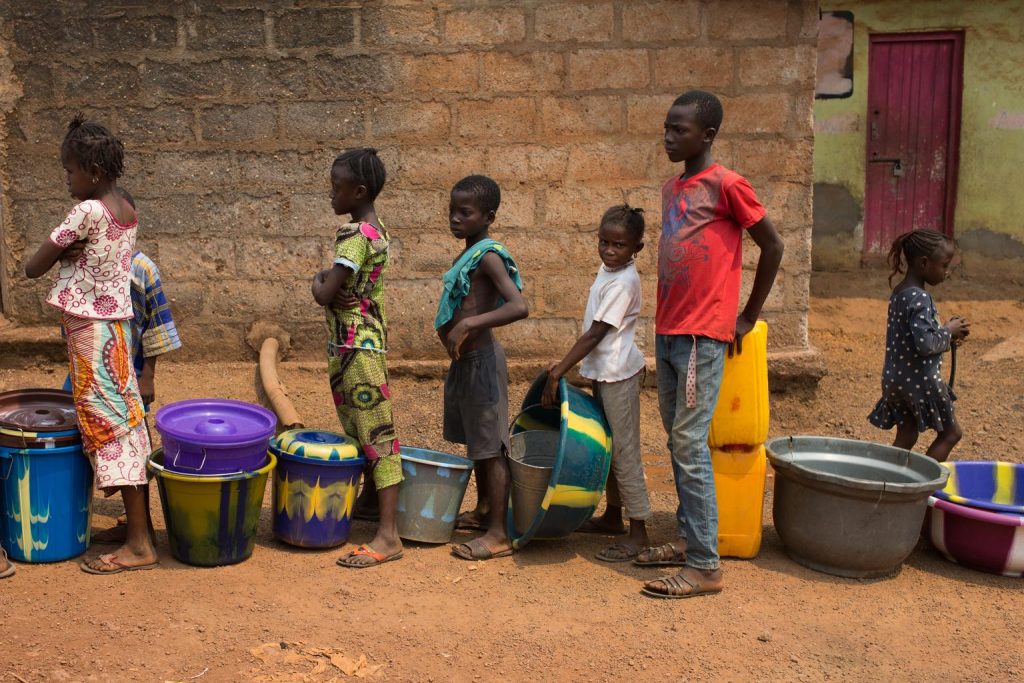
On 28 March, children queue with their containers to receive with water, in the city of Kenema in Kenema District, where social mobilizers are also raising community awareness about Ebola virus disease (EVD) and distributing soap to households during the three-day stay-at-home curfew. The water is being provided by the Ministry of Water with support from UNICEF.
From 27 to 29 March 2015 in Sierra Leone, a government-led stay-at-home curfew was held as part of the four-week Zero Ebola campaign to end infections in the country. The curfew was intended to re-energize Sierra Leoneans in the fight against Ebola virus disease (EVD). Health workers, surveillance officers and social mobilizers all played a role in the curfew, which provided an opportunity to teach communities about behaviours that contribute to the continued spread of EVD; to raise awareness of best practices that help prevent transmission of EVD (such as handwashing with water and soap); and to carry out door-to-door surveillance and contact tracing that allowed cases of EVD to be found, isolated and treated. UNICEF helped develop and supervise training for the social mobilizers and coordinate the mobilization efforts; procured soap distributed by the mobilizers during door-to-door outreach; and delivered water to some communities during the curfew.
Related content

Report
MHRN Roundtable Report: Social and Behavioural Science Priorities for Ebola Clinical Trials in DRC
This August 2026 roundtable consolidated lessons from past SBS research in/on Ebola clinical trials and discussed current challenges with clinical trial design and rollout.
Briefing
Key Considerations: Cross-Border Dynamics Between Uganda and DRC in the Context of the Bundibugyo Ebola Outbreak
This brief synthesises existing social and behavioural science evidence from the current and previous outbreaks on key socioeconomic and political dynamics in the Uganda-DRC borderlands.
Briefing
Key Considerations: Cross-Border Dynamics Between South Sudan and DRC in the Context of the Bundibugyo Ebola Outbreak
This brief updates previous SSHAP analyses to highlight key socioeconomic and political considerations in the South Sudan–DRC borderlands that shape Ebola preparedness and response.
Article
Contextual note: Funeral practices in Ituri
This note is the second produced by "the collective for Ituri", an informal network primarily driven by social scientists who provide contextual information for the response to the Bundibugyo Ebola epidemic in Ituri, eastern DRC. This note expands on the…
