This question bank is a menu of qualitative questions related to healthcare workers’ knowledge, perceptions and practices during infectious disease outbreaks.
This resource is intended to help responders determine organisational priorities and needs to develop a localised preparedness and response strategy for the multi-hazard impacts of El Niño and other relevant climatic events (e.g., drought, flooding, cyclones).
This brief highlights key issues and good practices that can be carried into the design and delivery of mpox response activities in urban informal settlements.
This brief provides an overview of the experimental stages of vaccine development during a disease outbreak and highlights key considerations at each stage from a social science perspective.
This brief provides a socio-behavioural analysis of the vulnerabilities, risks and operational key considerations for working with people with diverse sexual orientation, gender identity and/or expression in the mpox response.
The Social Science in Humanitarian Action Platform is supporting UNICEF, WHO, IFRC and other partners in the Democratic Republic of Congo to respond to the Ebola outbreak in Equateur Province. The Platform has four key streams of action: 1) Rapid…
This brief summarises key considerations regarding cross-border dynamics between Burundi and Tanzania in the context of viral haemorrhagic fever (VHF) outbreaks in Tanzania and Uganda.
This brief synthesises social and behavioural science research on the use of vaccines during health emergencies in sub-Saharan Africa, including experimental vaccines undergoing clinical trials.
This Question Bank is relevant to outbreaks where person-to-person transmission has been identified as significant to an outbreak's spread and where patient experiences must be understood for a community-centred response.
Key Considerations regarding the outbreak of Marburg virus disease in Rwanda, including national response capabilities, local governance structures, and regional and economic implications.
This report summarises contributions from speakers and participants at a Social Science in Humanitarian Action Platform (SSHAP)-organised online meeting to discuss mpox and discrimination issues in African settings, and operational responses to mpox that are contextually sensitive.
A Question Bank for use by field teams and local research teams working in communities with mpox transmission and those at risk of transmission with the aim of supporting the collection and use of consistent and high-quality social and behavioural…
This Key Considerations brief presents considerations for contextualising and responding to the mpox outbreak in the Democratic Republic of the Congo, focusing on women and children living and working in artisanal and small-scale mining areas.
This workshop report offers recommendations and reflects on discussions from a workshop attended by social scientists, policymakers, and humanitarian and public health practitioners from Uganda, the Democratic Republic of the Congo and South Sudan that was facilitated and hosted by…
This report summarises a roundtable discussion which aimed to share strategic information from social science research, help actors in epidemic preparedness and response put in place targeted and appropriate interventions, and highlight the roles social science researchers can play in…
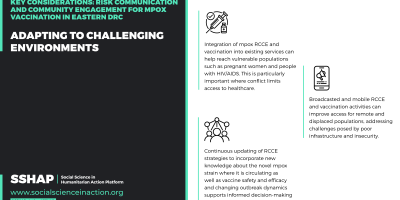
This infographic summarises insights from the SSHAP briefing 'Key Considerations: Risk Communication and Community Engagement for Mpox in Eastern DRC', presenting social and political considerations for the design and implementation of vaccination-related risk communication and community engagement (RCCE) strategies.
This infographic summarises the Key Considerations briefing on responding to food insecurity in South Sudan, highlighting the importance of investment in agriculture and livelihoods, market access and infrastructure, and promoting sustainable peace.
This Key Considerations brief presents social and political considerations for the design and implementation of vaccination-related risk communication and community engagement (RCCE) strategies for mpox in the eastern Democratic Republic of the Congo (DRC).
This landscape paper summarises the contextual factors that shape health emergencies and responses to health emergencies in the West Africa region, drawing on examples from Nigeria, Senegal and Sierra Leone.
This report synthesises the discussions at a SSHAP-organised roundtable on the mpox outbreak in the Democratic Republic of the Congo held in May 2024 to appraise the situation, with a focus on social science insights for informing context-sensitive risk communication…
This Key Considerations brief analyses the causes of food insecurity in South Sudan and the responses by government and non-government actors and partners, and offers considerations for these actors to support ending food insecurity, especially via bolstering agriculture and livelihoods.
This infographic summarises the insights from a recent key considerations brief on responding to floods in South Sudan, describing the multidimensional impacts of flooding on peace, health, livelihoods and governance.
This Key Considerations brief looks at interconnected problems in the context of South Sudan through a focus on flooding, with wider relevance to other countries in the region, such as the Democratic Republic of the Congo and Sudan, experiencing similar…
El Niño can be viewed as a multi-hazard event, and considerations for information needs cut across different populations and risks, including direct weather-related hazards, reduced agricultural production, greater food insecurity and malnutrition, increased transmission of infectious diseases and effects on…
In March 2023, in support of the Ministry of Health, at the request of the Measles Coordination Unit (Direction Surveillance Epidémiologique-DSE), the Integrated Analytics Cell (CAI) carried out an integrated analysis in the Kilwa health zone (HZ) to understand the…
L’objectif de notre partenariat est de faciliter et encourager les communautés et les autorités sanitaires à concevoir des stratégies de Santé Publique responsables, redevables et efficaces reposant sur l’analyse de données objectives et multisectorielles. L’AIE adopte une approche holistique…
Recent large-scale epidemics and pandemics have demonstrated the importance of engaging communities as partners in preventing, detecting and responding to public health emergencies. Community-based surveillance (CBS), which relies on communities to report public health information, can be an important part…
This Key Considerations brief provides an overview of the Marburg virus disease outbreaks in Equatorial Guinea and Tanzania, as well as contextual factors to inform considerations for responses in both countries.
The purpose of this guidance note is to support Ministries of Health, UNICEF, and other response partners to design and implement effective, community-centred, and data-driven community engagement for cholera outbreak response.
The national strategic plan for developing health laboratory services, from 2021 to 2025, focusing in particular on: improving the delivery of laboratory services, supporting the different pillars of laboratory services, and strengthening governance.
Central and East Africa Hub
Republique Democratique Du Congo - Ministere De La Sante Publique, Hygiene Et Prevention
This document sets out the Ministry of Health’s strategic response to the Ebola Virus outbreak in North Kivu and Ituri provinces in 2019. Taking into account the impact of insecurity in these regions, the plan details how the government planned…