This paper seeks to understand the fear many Guineans feel towards Ebola response initiatives and why the educators, doctors and burial teams have sometimes encountered resistance, occasionally violent. Resistance has been catastrophic for the epidemic, preventing treatment, contact tracing and quarantine, permitting its spread. The paper sketches a history of dissent and violence during the epidemic before showing how some actions that Ebola response teams interpret as ‘resistance’ are less actions ‘against’ Ebola response, than actions that have their own cultural logics.
But the paper then considers how resistance emerges as cultural sensitivities play into divisive ethnic and related party-political tensions relations, and the interpretive grids through which people make sense of politicians and the ‘white’ world. The analysis calls into question the social distance between the institutions of epidemic response and the communities affected, and the politicisation of health delivery where political parties are read as ethnically aligned.
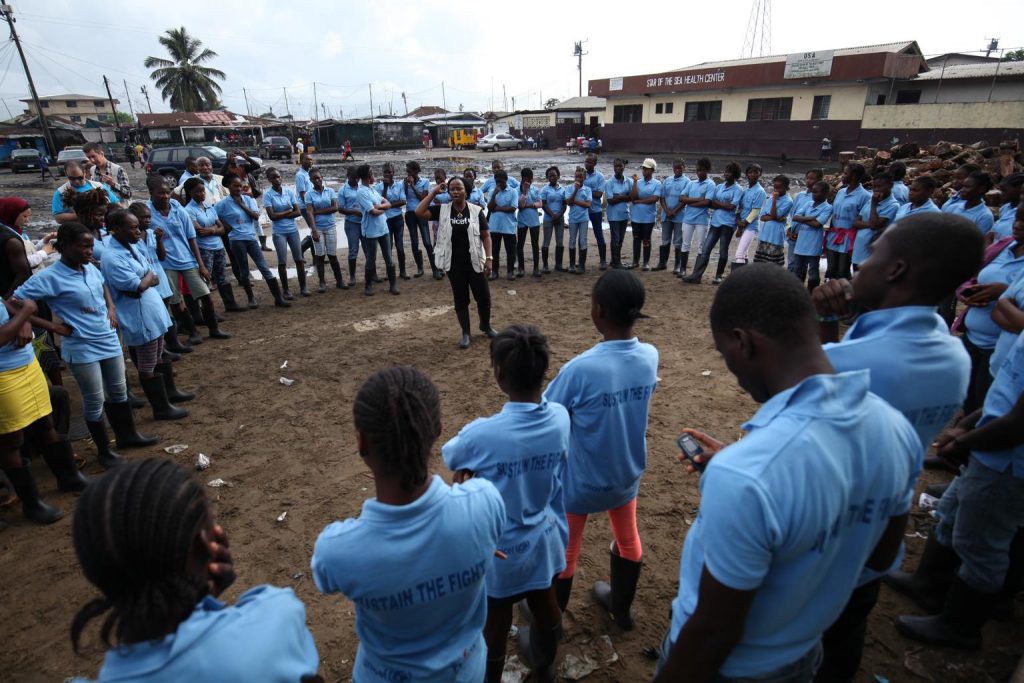
![On 5 November, in the initial phases of U-Reports launch in Liberia, a UNICEF worker teaches adolescents how to use the technology, in the West Point neighbourhood of Monrovia, the capital. The adolescents are UNICEF-supported social mobilizers from the group Adolescents Leading an Intensive Fight against Ebola (A-LIFE), and they are learning how to use the technology to track data on EVD as well as on sexual health and teen pregnancy.
In November 2014, Liberia remains one of three countries in West Africa experiencing widespread and intense transmission of Ebola virus disease (EVD). UNICEF continues to support social mobilization efforts to raise awareness of the disease, its symptoms and how to prevent its spread all of which are critical to curtailing the unprecedented outbreak. U-Report, a text-based communication platform previously developed by UNICEF, was customized and deployed for use within Liberias mobilization efforts. Using Short Message Service (SMS), U-Report allows individual subscribers to ask questions about issues, to get real-time answers and to share information with other users U-reporters across the country. By giving people a new and effective platform for communication, it is intended to strengthen community-led development, citizen engagement and behavioural change. [Note, this story captions applies to all images below.] UNICEF/UNI174448/Jallonzo](https://www.socialscienceinaction.org/wp-content/uploads/2017/01/UNI174448_Med-Res-1024x683.jpg)