




This brief considers the humanitarian and policy implications of the general food and cash assistance prioritisation strategy in Uganda’s refugee settlements.
Outbreak of Marburg virus disease in Rwanda, October 2024
Key Considerations regarding the outbreak of Marburg virus disease in Rwanda, including national response capabilities, local governance structures, and regional and economic implications.
From in-kind to cash-based assistance in Lebanon and Syria
This brief explores the role and implications of cash-based assistance in humanitarian efforts within Lebanon and Syria, including how these programmes function aside more traditional approaches to assistance delivery.
Meeting report: Mpox and discrimination in African settings
This report summarises contributions from speakers and participants at a Social Science in Humanitarian Action Platform (SSHAP)-organised online meeting to discuss mpox and discrimination issues in African settings, and operational responses to mpox that are contextually sensitive.
Epidemic/pandemic preparedness in Brazil amongst transnational migrants
This Fellows brief analyses the Brazilian response to COVID-19 regarding transnational migrants and considers how to build a preparedness considerate of migrants’ rights, cultures and political demands.
From data to action: How findings from an interagency rapid qualitative assessment are stimulating action to support drought-affected communities in Zambia
This brief shares findings and learnings from a rapid qualitative assessment to inform community engagement strategies and hold response actors accountable to affected populations.
Balancing epidemic preparedness and response with humanitarian protection in Ugandan refugee settlements
This brief presents considerations for preparedness and response, focusing on refugee settlements in north Uganda and drawing on ethnographic data collected during COVID-19.
LGBTQIA+-inclusive humanitarian action in the Philippines
This brief examines the social, economic and legal landscape for LGBTQIA+ groups in the Philippines, exploring their specific capacities and vulnerabilities during crises and offering practical guidance.
Mpox question bank: Qualitative questions for community-level data collection
A Question Bank for use by field teams and local research teams working in communities with mpox transmission and those at risk of transmission with the aim of supporting the collection and use of consistent and high-quality social and behavioural data.
Mpox, mining, and vulnerabilities of women and children in eastern DRC
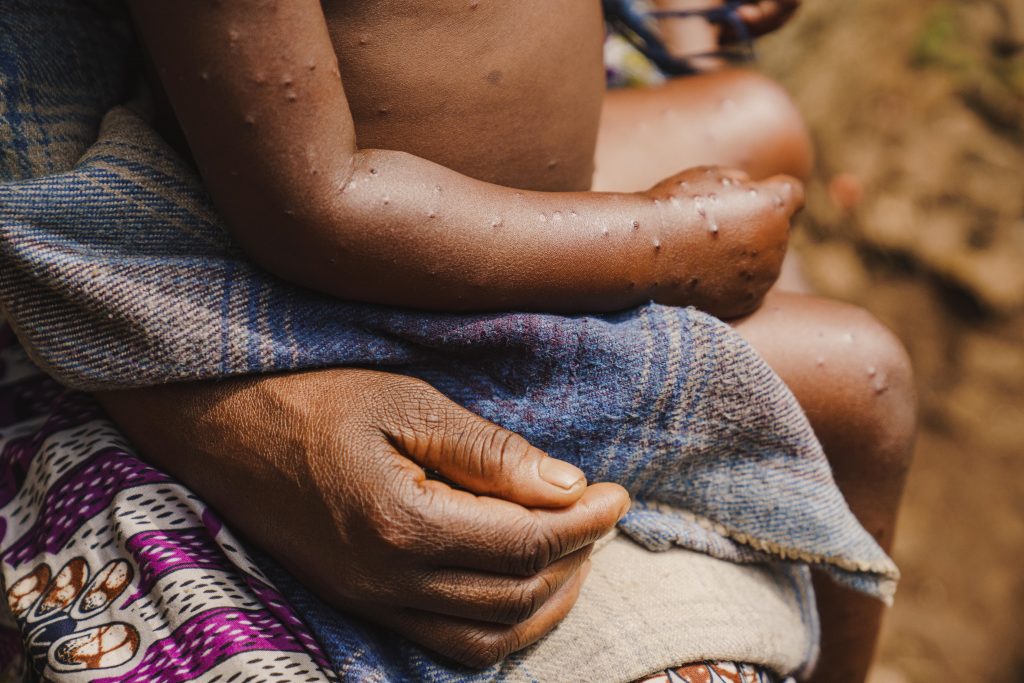
This Key Considerations brief presents considerations for contextualising and responding to the mpox outbreak in the Democratic Republic of the Congo, focusing on women and children living and working in artisanal and small-scale mining areas.
How can epidemic preparedness and response be improved in the Central and East African Borderlands?
This workshop report offers recommendations and reflects on discussions from a workshop attended by social scientists, policymakers, and humanitarian and public health practitioners from Uganda, the Democratic Republic of the Congo and South Sudan that was facilitated and hosted by SSHAP Central and East Africa Hub.
Epidemic preparedness and response in Senegal
This report summarises a roundtable discussion which aimed to share strategic information from social science research, help actors in epidemic preparedness and response put in place targeted and appropriate interventions, and highlight the roles social science researchers can play in preparing for and responding to epidemics.
Risk communication and community engagement for mpox vaccination in Eastern DRC
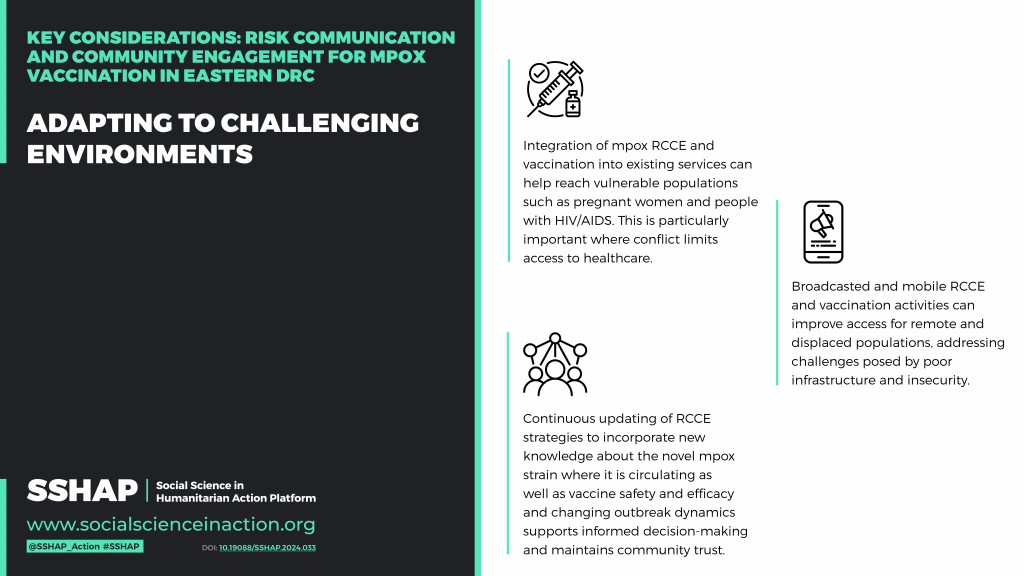
This infographic summarises insights from the SSHAP briefing ‘Key Considerations: Risk Communication and Community Engagement for Mpox in Eastern DRC’, presenting social and political considerations for the design and implementation of vaccination-related risk communication and community engagement (RCCE) strategies.
Alleviating chronic food insecurity in South Sudan
This infographic summarises the Key Considerations briefing on responding to food insecurity in South Sudan, highlighting the importance of investment in agriculture and livelihoods, market access and infrastructure, and promoting sustainable peace.
Risk communication and community engagement for mpox vaccination in eastern DRC

This Key Considerations brief presents social and political considerations for the design and implementation of vaccination-related risk communication and community engagement (RCCE) strategies for mpox in the eastern Democratic Republic of the Congo (DRC).
SSHAP West Africa Hub: Health emergency cycles and social context in West Africa
This landscape paper summarises the contextual factors that shape health emergencies and responses to health emergencies in the West Africa region, drawing on examples from Nigeria, Senegal and Sierra Leone.
Roundtable Report: Discussion on mpox in DRC and social science considerations for operational response
This report synthesises the discussions at a SSHAP-organised roundtable on the mpox outbreak in the Democratic Republic of the Congo held in May 2024 to appraise the situation, with a focus on social science insights for informing context-sensitive risk communication and community engagement, and wider operational responses.
Scarcity and fear: A gender analysis of the impact of the war in Gaza on vital services essential to women’s and girls’ health, safety, and dignity – water, sanitation and hygiene (WASH)
One in a series of UN Women gender alerts begun at the start of the war in Gaza, this one focusing on WASH services.
Gaza is not a humanitarian crisis: on self-defence, depoliticising language, and contextualisation
A ‘Public Anthropologist’ blog by Heidi Mogstad, a researcher for the ‘War and Fun: Reconceptualizing Warfare and Its Experience’ research project.
Why ‘Framing Gaza’?
Allegra essayists write that the facts of war can no longer be disputed; instead, what is at stake is how violence and harm are framed.
Health in the crossfire – Analyzing and mitigating the multifaceted health risks of the 2023 war on Gaza
This paper examines the multifaceted and escalating health risks associated with the ongoing war in Gaza, employing a systems thinking approach to understand and address these complex challenges.
Mitigating risks of slow children development due to war on Gaza 2023
This paper explores multifaceted approaches to mitigate severe risks to children’s physical, cognitive, emotional and social development, emphasising the need for comprehensive support systems for children in conflict zones.
Children on the Gaza-Israel border: Victims of war
This commentary highlights the impact of armed conflict on children at the Gaza-Israel border.
Alleviating chronic food insecurity in South Sudan
This Key Considerations brief analyses the causes of food insecurity in South Sudan and the responses by government and non-government actors and partners, and offers considerations for these actors to support ending food insecurity, especially via bolstering agriculture and livelihoods.
Effective vaccine rollout and uptake in Sierra Leone
This Key Considerations brief proposes key considerations for ongoing vaccination efforts in Sierra Leone, including for the hepatitis vaccine and new malaria vaccine (RTS,S/AS01 (RTS,S)), offering insights on planning equitable vaccine campaigns for new infections.
Child engagement in the context of disease outbreaks in Eastern and Southern Africa
This infographic, in Arabic, French, Portuguese, Spanish and Swahili as well as English, summarises insights from a recent key considerations brief exploring why, when and how to engage children in the prevention, response and recovery stages of disease outbreak in Eastern and Southern Africa.
Responding to floods in South Sudan through the humanitarian-peace-development nexus infographic
This infographic summarises the insights from a recent key considerations brief on responding to floods in South Sudan, describing the multidimensional impacts of flooding on peace, health, livelihoods and governance.
Child engagement in the context of disease outbreaks in Eastern and Southern Africa
This brief explores why, when and how to engage children in the prevention, response and recovery stages of disease outbreaks.
Responding to floods in South Sudan through the humanitarian-peace-development nexus
This Key Considerations brief looks at interconnected problems in the context of South Sudan through a focus on flooding, with wider relevance to other countries in the region, such as the Democratic Republic of the Congo and Sudan, experiencing similar self-reinforcing cycles of humanitarian, peace and developmental crises, exacerbated by floods.
Conflict-sensitive returns and integration in South Sudan
This research aims to provide a stronger understanding of the risks and opportunities associated with ‘returns’ and ‘integration’ in South Sudan, as well as highlight opportunities for conflict-sensitive (re)integration and early solutions activities.
Social, structural and community dynamics of cholera transmission and mortality in Ethiopia
This key considerations brief was developed to support response efforts by exploring the social and structural determinants and community dynamics of cholera infection and mortality in Ethiopia.
Psychosocial concerns in a context of prolonged political oppression: Gaza mental health providers’ perceptions
This qualitative exploratory study investigated the perspectives of mental health providers in Gaza regarding the primary concerns of their clients who are exposed to low-intensity warfare and structural violence.
Coping with trauma and adversity among Palestinians in the Gaza Strip: A qualitative, culture-informed analysis
In this article, the authors propose that coping is not only an individual property but also a structural feature.
‘Stop the war and let me return to my home, even if it is destroyed.’ Community priorities and perceptions of aid and support in Gaza (January 2024)
This report contains insights from a Ground Truth Solutions and Arab World for Research and Development study talking to people in Gaza to find out what the humanitarian situation looked like from their perspective.
A Palestinian poet’s perilous journey out of Gaza
A ‘letter from Gaza’ from Mosab Abu Toha, who fled his home with his wife and three children, before the IDF soldiers took him into custody.
In the face of genocide, the intifada must be globalised
Chloe Skinners writes that the ‘shaking off’ of colonial dynamics of racism, violence, dehumanisation and division must be globalised.
