




Displacement and humanitarian protection
The social and political dynamics of displacement, and humanitarian protection.
Briefing
Recommendations: Rapid Synthesis of Social and Behavioural Science learnings on Ebola for the Bundibugyo Virus Outbreak (2026) Ituri, DRC
A rapid synthesis of lessons learned from prior Ebola social and behavioural science (SBS) research to highlight critical insights for locally adapted and contextually informed response efforts.
Briefing
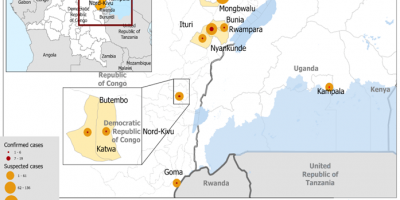
Ituri Ebola Outbreak 2026 (DRC) – Summary overview of context
This note details relevant contextual factors in Ituri Province, DRC, to inform the response to the outbreak of Ebola disease caused by Bundibugyo virus.
Briefing
Key considerations: the context of North Kivu province, DRC
This brief summarises key considerations about the context of North Kivu province in relation to the outbreak of Ebola in the DRC, August 2018.
Case study
SSHAP learning note: Building a localised approach
This learning note shares insights, experiences and lessons from SSHAP's approach to the localisation of its operational responses in sub-Saharan Africa.
blog
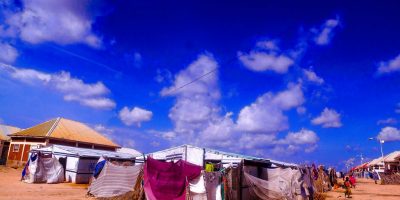
Humanitarian crises are growing in complexity and impact. According to the United Nations Office for the Coordination of Humanitarian Affairs nearly 300 million people globally needed humanitarian assistance and protection in 2024. In a world plagued by natural disasters, violent conflict, and public health emergencies, humanitarian service delivery is critical.
blog
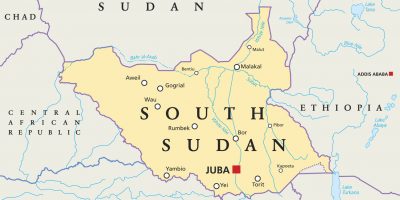
Among the countries worst affected from the sudden and wide-ranging US aid cuts is South Sudan. South Sudan relies on international assistance to provide basic services to its people. Cuts will devastate its healthcare system, including its ability to prepare for and respond to infectious disease outbreaks.
Article
Hiding in plain sight: IDP’s protection strategies after closing Juba’s protection of civilian sites
This article examines how former Protection of Civilian site (PoCs) residents are staying safe and protecting themselves after the United Nations Mission in South Sudan's (UNMISS) handing over of the PoCs to the Revitalised-Transitional Government of National Unity (R-TGoNU).
Article
Sing safety: understanding South Sudanese protection strategies through song
This article argues that paying attention to music can help humanitarians understand self-protection strategies, especially as music can create space for discussion even about emotive or political topics that cannot be verbalised in other ways.
Article
Safety among displaced South Sudanese in Khartoum: the role of Christian faith communities
Christianity occupies an integral part of South Sudanese journeys through wars and displacement. This article explores the role of Christian faith communities in providing protection during South Sudanese displacement in Khartoum.
Article
Seeking safety: Identifying protection gaps for artists in South Sudan
Protection of artists during times of conflict has no specific framework in international humanitarian law. However, cultural sites, artefacts and institutions are protected. This article contributes empirical evidence from South Sudan to reveal how artists experience the protection gap and…
Article
Negotiating faith in exile: learning from displacements from and into Arua, North West Uganda
Humanitarians have recently championed faith actors as valuable resources in delivering humanitarian aid. This paper explores how faith has been entangled within the dynamics of two spatially connected crises: Ugandans fleeing post-Amin reprisals in the mid-1980s, and South Sudanese fleeing…
Article
Protection and containment: surviving COVID-19 in Palabek refugee settlement, Northern Uganda
Humanitarian assistance is framed around ‘protection’. Deciding whom to protect and against what is not straightforward, particularly during a pandemic. This article critically explores containment and protection by focusing on refugee self-protection in Uganda.
Article
Community self-protection, public authority and the safety of strangers in Bor and Ler, South Sudan
Protection is not simply something done or delivered to people by states, humanitarian organisations and armed peacekeepers. We use interview data from communities in Bor and Ler, South Sudan, long affected by conflict, to show how attention to the relationship…
Article
Humanitarian protection activities and the safety of strangers in the DRC, Syria and South Sudan
Many contemporary humanitarian organisations derive their legitimacy from their claims to protect civilians. Yet, what these organisations do in its name includes a diverse and contested range of activities that are often far from what global publics and affected populations…
Article
The safety of strangers: the realities and politics of protecting civilians in times of war
Recent wars have brutally shown that civilians are not safe. This is despite high-level global commitments and multi-billion-dollar humanitarian spending to keep civilian strangers protected. The high civilian death tolls in recent armed conflicts are prompting new questions about how…
Briefing
Female genital mutilation among Sudanese displaced populations in Egypt
A Key Considerations brief considering the drivers and dynamics of FGM practices in the context of forced displacement to inform culturally sensitive strategies for FGM prevention and response.
Briefing
Addressing the humanitarian needs of forced rural-to-city migrants in north-west Nigeria with a focus on mental health vulnerability
This Fellows Brief calls for action to address the needs of a hitherto underserved, internally displaced people.
Briefing
Mutual aid lessons and experiences from Emergency Response Rooms in Sudan
A Key Considerations brief based on the first case study of the volunteer networks known as Emergency Response Rooms, conducted June to August 2024.
Briefing
Humanitarian responses to famine and war in Sudan
This Key Considerations brief offers key information about the background to the civil war in Sudan, responses to the humanitarian crisis and reasons why relief has been inadequate, setting out opportunities to push against the obstacles or constraints to relief.
Briefing
Food assistance prioritisation in refugee settlements in Uganda and its impacts
This brief considers the humanitarian and policy implications of the general food and cash assistance prioritisation strategy in Uganda’s refugee settlements.
news
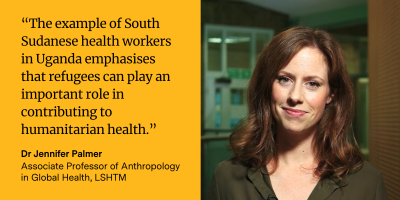
Overcoming barriers: Integrating South Sudanese refugee health professionals into Uganda’s workforce
Around the world many health professionals displaced as refugees face multiple barriers to securing meaningful work in host countries' health systems. Dr Jennifer Palmer, Associate Professor of Anthropology in Global Health, LSHTM, and SSHAP team member, talks about her research among South Sudanese health workers who are refugees in Uganda.
Infographic
Responding to floods in South Sudan through the humanitarian-peace-development nexus infographic
This infographic summarises the insights from a recent key considerations brief on responding to floods in South Sudan, describing the multidimensional impacts of flooding on peace, health, livelihoods and governance.
Briefing
Responding to floods in South Sudan through the humanitarian-peace-development nexus
This Key Considerations brief looks at interconnected problems in the context of South Sudan through a focus on flooding, with wider relevance to other countries in the region, such as the Democratic Republic of the Congo and Sudan, experiencing similar…
Report
Conflict-sensitive returns and integration in South Sudan
This research aims to provide a stronger understanding of the risks and opportunities associated with ‘returns’ and ‘integration’ in South Sudan, as well as highlight opportunities for conflict-sensitive (re)integration and early solutions activities.
blog
In this blog, Sylvie Imata and Godefroid Muzalia, who work at Groupe d'Etudes sur les Conflits et la Sécurité Humaine (GEC-SH) - a Central & East Africa Regional Hub partner organisation - explore how humanitarian actors, including NGOs, can be aware of and sensitive to the needs and perceptions of…
Infographic
Crisis in Sudan: Note on displacement from Sudan to South Sudan
This infographic summarises the insights from a recent briefing note on displacement due to the crisis in Sudan.
Briefing
Crisis in Sudan: Briefing note on displacement from Sudan to South Sudan
This Key Considerations brief focuses on the historical and socio-political dynamics humanitarian agencies need to consider when providing assistance to South Sudanese fleeing Khartoum and other parts of Sudan to South Sudan, and to Sudanese fleeing Sudan to South Sudan.
Research paper
Youth, sin and sex in Nigeria: Christianity and HIV/AIDS-related beliefs and behaviour among rural-urban migrants
In Nigeria, popular understandings of HIV/AIDS and individual risk assessment and behaviour unfold within an interpretative grid that draws on a religious moral framework. This paper reports results from a two‐year study of HIV/AIDS‐related beliefs and behaviour among adolescent and…
Research paper
Xenophobia’s Contours During an Ebola Epidemic: Proximity and the Targeting of Peul Migrants in Senegal
This article examines the effect of geographical proximity on targeting patterns during Ebola-era xenophobic outbursts by Senegalese against a migrant Peul population of Guinean origins. It highlights the limited extent to which epidemics shape the micro-dynamics of outbreaks of xenophobia…
Research paper
Without Rain or Land, Where Will Our People Go? Climate Change, Land Grabbing, and Human Mobility: Insights from Senegal and Cambodia
Based on a multi-case and multi-sited qualitative study in both Senegal and Cambodia, involving more than 150 participants in semi-structured interviews and focus groups affected by four different agribusiness projects, this paper shows how these three major contemporary challenges are…
Research paper
‘When Migrants Become Messengers’: Affective Borderwork and Aspiration Management in Senegal
This article draws on ethnographic fieldwork to explore how affect and emotions are used in migration awareness campaigns and how local communities respond. ‘Aspiration management’ works to instil a sense in would-be Senegalese migrants that their hopes of migration to…
Research paper
West African Migration in the Age of Climate Change : Translocal Perspectives on Mobility from Mali and Senegal
This thesis contributes to the debate on climate change, environment, and migration by scrutinizing conceptual and methodological deficiencies and adopting a migration research perspective. The author uses a multi-sited ethnography in Mali and Senegal to show how human activites shape…
