Search
Search within South Asia
24 results found
Briefing
LGBTQIA+-inclusive humanitarian action in the Philippines
This brief examines the social, economic and legal landscape for LGBTQIA+ groups in the Philippines, exploring their specific capacities and vulnerabilities during crises and offering practical guidance.
Infographic
Disability-Inclusive Humanitarian Action and Emergency Response in South and Southeast Asia and Beyond hine
This infographic shares the key messages of a recent briefing on disability in the context of humanitarian and public health emergencies in South and Southeast Asia. Its focus is on Nepal, but the principles are universally relevant and can be…
Briefing
Key Considerations: Disability-Inclusive Humanitarian Action and Emergency Response in South and Southeast Asia and Beyond hine
In many settings, people with disabilities face multiple and complex layers of environmental, societal and structural barriers. These barriers can lead to them being disproportionately harmed, neglected and excluded during humanitarian and other emergency responses.1–3 This is especially evident in…
Briefing
Supporting Better Governance of Flood Relief Efforts in Pakistan
The 2022 Pakistan Floods are a climate change disaster. Getting the governance of disaster and crisis management right is critical for relief, rehabilitation, and recovery and to prepare for future climate emergencies. This SSHAP brief highlight 5 actions to tackle…
Evidence review
Localisation of Polio Vaccination Efforts in the Newly Merged Districts (Tribal Areas) of Pakistan
This brief draws on evidence from academic and grey literature, data on polio vaccine uptake, consultations with partners working on polio eradication in Pakistan, and the authors’ own programme implementation experience in the country. The brief reviews the social, cultural,…
Evidence review
Review of the Evidence Landscape on the Risk Communication and Community Engagement Interventions Among the Rohingya Refugees to Enhance Healthcare Seeking Behaviours in Cox’s Bazar
This review paper synthesises and assesses the quality of the evidence landscape available and how the Rohingya seek and access healthcare services in Cox’s Bazar
Briefing
India’s Deadly Second COVID-19 Wave: Addressing Impacts and Building Preparedness Against Future Waves hi
This Key Consideratins briefing examines the second wave of COVID-19 in India and recommends measures to further arrest the spread of infection and to prevent and prepare against future waves.
Briefing
Smart Cities and COVID-19: Implications for Data Ecosystems from Lessons Learned in India arbnhine
Best data practice recommendations for the use of technology for surveillance, fact-checking and coordinated control during crisis or emergency response.
Infographic
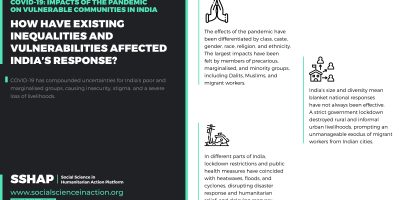
COVID-19: Impacts of the Pandemic on Vulnerable Communities in India
How have existing inequalities and vulnerabilities affected India’s response?
Research paper
COVID-19 and pastoralism: reflections from three continents
How have COVID-19 disease control measures affected mobility and production practices, marketing opportunities, land control, labour relations, local community support and socio-political relations with the state and other settled agrarian or urban populations? This article reflects on five diverse cases…
Evidence review
In-Focus: COVID-19, Uncertainty, Vulnerability and Recovery in India guhi
How COVID-19 has intersected with and multiplied existing uncertainties faced by different vulnerable groups and communities in India
Infographic
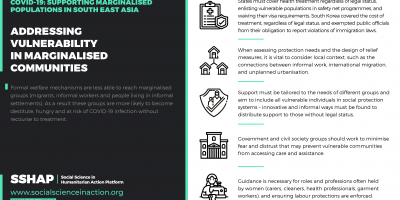
COVID-19 Supporting Marginalised Populations in South East Asia
Formal welfare mechanisms are less able to reach these vulnerable groups.
Briefing
COVID-19 in the Context of Conflict and Displacement – Myanmar
Key considerations focusing on how conflict, displacement and inter-communal tensions may influence disease control in Myanmar.
Background report
Knowledge of, Attitudes toward, and Preventive Practices relating to Cholera and Oral Cholera Vaccine among Urban High-Risk Groups: Findings of a Cross-Sectional Study in Dhaka, Bangladesh
In endemic countries such as Bangladesh, consequences of cholera place an enormous financial and social burden on patients and their families. Cholera vaccines not only provide health benefits to susceptible populations but also have effects on the earning capabilities and…
Briefing
Cultural Epidemiology of Pandemic Influenza in Urban and Rural Pune, India: A Cross-Sectional, Mixed-Methods Study
The objective of this study was to identify and compare socio-cultural features of pandemic influenza with reference to illness-related experience, meaning and behaviour in urban and rural areas of India. Cross-sectional, mixed-methods, cultural epidemiological survey with vignette-based interviews. Semi-structured explanatory…
Background report
Gender-Based Violence Among Documented Rohingya Refugees in Bangladesh
The Rohingya, a Muslim minority group from the northern part of Rakhine State (formerly Arakan) in Myanmar, is among the most vulnerable of the world’s refugee communities. This study aims to shed light on gender-based violence among documented Rohingya refugees…
Evidence review
Health Shocks and Coping Strategies. State Health Insurance Scheme of Andhra Pradesh, India
The objectives of the study are three-fold: to investigate who are vulnerable to welfare loss from health shocks, what are the household responses to cope with the economic burden of health shocks and if policy responses like state health insurance…
Evidence review
Impact of Post-Conflict Development Interventions on Maternal Healthcare Utilization
We evaluate the effectiveness of a post-conflict development programme on maternal health-care utilization in the Chittagong Hill Tracts of Bangladesh. Our work varies from conventional impact evaluation studies because of the inclusion of two post-conflict psychosocial risks: the household’s actual…
Background report
The Political Economy of Avian Influenza in Indonesia
Why is the response to H5N1 highly pathogenic avian influenza (HPAI) so challenged in Indonesia? Why did the virus spread so fast, and why has the disease persisted? Are there features of the country and its culture that encourage or…
Briefing
Is the Health System Response Out of Sync with the Demands of the Islanders in the Indian Sundarbans?
Five years ago, a mid-summer nightmare named Aila crashed on the Sundarbans with murderous fury and wreaked destruction beyond repair. On May 25, 2009 the tropical cyclone hit the Sundarbans in India and Bangladesh with a wind speed of 110…
Briefing
Focus on Nepal Earthquake and Earthquakes in Southern Asia
Nepal witnessed a 7.8 magnitude earthquake on 25th April and a 7.3 quake on 12th May, the worst natural disasters since 1900 in terms of number of dead, population affected and economic losses (A). The earthquakes killed more than 9,000 people…
Background report
Looking Upstream: Enhancers of Child Nutritional Status in post-Flood Rural Settings
Child undernutrition and flooding are highly prevalent public health issues in many developing countries, yet we have little understanding of preventive strategies for effective coping in these circumstances. Education has been recently highlighted as key to reduce the societal impacts…
Background report
The International Response to Highly Pathogenic Avian Influenza: Science, Policy and Politics
Over the last decade, the avian influenza virus, H5N1, has spread across most of Asia and Europe and parts of Africa. In some countries – including Indonesia, China, Vietnam, Bangladesh, Nigeria and Egypt – the avian disease has probably become…
Evidence review
Multiple Shocks, Coping and Welfare Consequences: Natural Disasters and Health Shocks in the Indian Sundarbans
Based on a household survey in Indian Sundarbans hit by tropical cyclone Aila in May 2009, this study tests for evidence and argues that health and climatic shocks are essentially linked forming a continuum and with exposure to a marginal…