Summary of key considerations
- Conceptualising borders: Treat borders as networks of people, markets, healers, clinics and roads through which risk moves, rather than simply as territorial boundaries.
- Movements from the Democratic Republic of the Congo (DRC) to South Sudan: Prepare for increased movement from DRC through formal and informal South Sudanese crossings into Uganda while the DRC–Uganda border remains closed.
- Refugee movements: Recognise that refugees regularly cross borders in response to food insecurity and to maintain livelihoods, land claims, family ties and burial obligations.
- Perceptions of border posts: Account for widespread use of informal panya routes by people seeking to avoid fees, taxation, military authorities or other risks associated with official crossings.
- Politicised trade: Ensure any Ebola-related border measures consider the importance and political sensitivity of the Juba–Nimule trade corridor and existing tensions affecting East African truckers.
- Land-grabbing at borders: Consider how land-grabbing by armed government actors in South Sudan as well as the Uganda People’s Defence Force (UPDF) around Nimule and Kajokeji contributes to displacement and insecurity.
- Forested borderlands: Recognise that forested borderlands facilitate cross-border mobility, trade and trafficking, whilst sustaining ethnic connections and armed-group economies.
- Gold trade: Incorporate an understanding of the mobility, seasonality, gender dynamics and armed control associated with artisanal gold mining and trading into Ebola preparedness and response planning.
- Cross-border markets: Protect women’s livelihoods and food access by addressing Ebola fears and disruption in the cross-border markets on which many female-headed households depend.
- Ebola fears: Address Ebola fears and their interaction with local beliefs by engaging customary authorities, healers, diviners, and other trusted local actors.
- Engaging cross-border populations: Work with trusted chiefs, refugee committees, health teams, trade organisations, and cross-border committees to support communication and surveillance, while avoiding unsafe attempts to trace armed groups.
- Adapting burial practices: Work locally with families, religious leaders and customary authorities to identify safe adaptations that preserve culturally important elements of a good burial.
- Surveillance: Given weak connectivity and the limited reach of digital surveillance, complement border and health-facility screening with structured offline community listening.
- Risk communication and community engagement: Tailor gender-sensitive communication to specific groups and prioritise interpersonal methods and accessible languages for populations with low literacy.
- Contact tracing: Recruit trusted and demonstrably neutral contact tracers who can address fears that personal information may be shared with armed or political actors.
- Collaboration with armed actors and security personnel: Do not involve armed actors in locating cases, tracing contacts, enforcing safe burials or transporting people, as this may undermine trust and reinforce perceptions of Ebola as a weapon of war.
- Health system strengthening: Align Ebola preparedness with longer-term humanitarian strategies and use investments to strengthen a health system facing conflict, economic decline, aid cuts, and overlapping crises.
- Further social science research: Continue research into changing mobility, border-screening perceptions, livelihood impacts, social protection, and shifting structures of power and public authority in the borderlands.
About this brief
The current outbreak of Bundibugyo Ebola virus, confirmed in Ituri Province of the Democratic Republic of Congo (DRC) on 15 May 2026, poses risks to neighbouring countries. Uganda reported cases on the same day in travellers from DRC, highlighting the threat of cross-border transmission driven by porous borders, displacement, conflict and strong social and trade ties. Although South Sudan has not reported cases at the time of writing (13 August 2026),1 it has strengthened preparedness efforts, particularly in the Southern Greater Equatoria region (Eastern Equatoria, Central Equatoria and Western Equatoria states of South Sudan), due to its shared border with affected areas in DRC and Uganda.2,3
The Africa Centres for Disease Control and Prevention (CDC) and the World Health Organization (WHO) emphasise a mobility-sensitive and cross-border approach informed by previous cross-border Ebola outbreaks.4 The approach incorporates population movements and protection needs to support targeted context-sensitive interventions at border crossings, along transport routes, and other high-risk locations.
This brief updates previous analyses from the Social Science in Humanitarian Action Platform (SSHAP),5–7 and builds on consultations with co-authors and reviewers, web searches and reviews of newspaper coverage to highlight key socioeconomic and political considerations in the South Sudan–DRC borderlands that shape Ebola preparedness and response. It focuses on cross-border livelihoods, mobility, security, and healthcare-seeking with particular attention to preparedness and socioeconomic consequences of cross-border health measures, on the South Sudan side of the border. Complementary research from the Ituri Collective and the Multi-Hazard Response Network provide additional context on DRC.8–11
Key considerations
- Conceptualising borders: South Sudan has benefitted from substantial continental readiness planning since May 2026. A key concept guiding preparedness discussions during meetings and trainings in the country is about what constitutes a ‘border’. Rather than simply a line or a boundary, for the purposes of readiness, a border should more meaningfully be considered as network of people, markets, healers, clinics and roads through which risk moves.
- Movements from DRC to South Sudan: As of August 2026, the DRC–Uganda border is closed to help control Ebola transmission, but the Uganda and DRC borders with South Sudan remain open. While evidence suggests the DRC–Uganda border closure has not eliminated movement, response actors in South Sudan assume more people from DRC are now travelling through South Sudan to reach Uganda through formal and informal crossing points. At the end of May 2026, just after Uganda closed its border, around 1,000 people per day were estimated to travel by road between Ituri Province’s capital, Bunia, through the Kengezi Base/Morobo point of entry to South Sudan on the road to Yei.
- Refugee movements: There are small populations of long-term refugees from South Sudan in DRC (90,000 in Haut Uélé and Ituri Provinces) and from DRC in South Sudan (15,000 in Western Equatoria). Food insecurity is often the driver or pendular flows across the border. However, most refugees from Western Equatoria now prefer to join the >1 million others displaced from South Sudan in Uganda, because of the access to education in English. Refugees in all locations need to periodically move back across the shared borders to explore livelihood opportunities, to maintain claims on land, or for social reasons such as attending funerals or taking dead relatives back home for decent burial.
- Perceptions of border posts in South Sudan: The borders between South Sudan, DRC and Uganda are porous and many travellers use panya roads (informal roads in the bush). Official border posts are frequently viewed with suspicion as they are seen as part of the political and economic apparatus of politicians and the state to collect taxes. Such informal routes are used by people who fear military authorities at border posts, small-scale traders who can’t afford border fees, people trading in illicit commodities and by armed opposition groups.
- Politicised trade: South Sudan’s trade with Uganda and Kenya through the official Nimule border crossing in Eastern Equatoria and along the Juba–Nimule corridor is vital for the country’s food supplies, especially as the Sudan war has limited northern supply routes, but this corridor has become increasingly politicised. High-level talks between the Kenya and South Sudan governments as well as talks between Ugandan and South Sudanese politicians and administrators have centred on long-standing complaints by East African truckers who have been subject to recurring violence and extortion by border security personnel and armed groups. Any Ebola-related border restrictions would therefore be happening within this already politicised trade context.
- Land-grabbing at borders: The borders around Nimule and Kajokeji are also subject to land-grabbing by armed government actors in South Sudan as well as the Uganda People’s Defence Force (UPDF), which contributes to forced displacement.
- Forested borderlands: These areas of Western and Central Equatoria (bordering Haut Uélé and Ituri Provinces in DRC) provide a mix of safety, unhindered cross-border movement, trade and trafficking opportunities. Many ethnic groups span both sides of the border. Armed groups here are reported to fund their operations through the illicit export of natural resources including timber, gold and poaching.
- Gold trade: The current outbreak in Ituri, DRC, is thought to have begun in the gold mining town of Mongbwalu. Artisanal gold mining structures the provincial economy across Ituri and generates significant flows of people to and from mining sites, so understanding the political economy of this trade is vital for the Ebola response. The gold trade in South Sudan has some similarities with Ituri such as its seasonality, gendered divisions of labour, and its control by armed actors and political elites. However, it is on a smaller scale and there appear to be few direct connections between people involved in the gold trade until flows reach and combine in North-West Uganda. Gold from Yei and other sites in Central Equatoria moves through the official Nimule crossing with the cooperation of military actors on both sides of the South Sudan/Uganda border as well as through a large number of informal border posts and panya roads in Central and Western Equatoria by individual traders seeking to avoid armed groups.
- Cross-border markets: Numerous cross-border markets are located across the borderlands between South Sudan, DRC and Uganda. Most small-scale traders are women from female-headed households who depend on cross-border trade as their primary source of income. Evidence from Yambio in Western Equatoria suggests one weekly market has been suspended, with female traders afraid to go because of Ebola risks, which has increased the price of imported staples.
- Ebola fears: Ebola is feared in the Greater Equatoria region and there is precedent for communities to collaborate with authorities on Ebola public health measures during past outbreaks, particularly in the area of safe and dignified burials. Local authorities in Yei have already been instrumental in effectively dealing with rumours and reassuring the public, such as when a soldier with ulcers was seen vomiting blood. At the same time, ideas of witchcraft and poisoning are prevalent in the Southern borderlands and have historically resulted in violence. Some forms of witchcraft are said to have been imported from Uganda and DRC, and there is potential for Ebola narratives to interact with these perceptions and local beliefs. Engaging customary authorities, diviners, healers and ‘witchdoctors’ will therefore also be important to address fears in the wider public.
- Engaging cross-border populations:
- During epidemics in South Sudan, customary chiefs expect to be trained by government authorities and partners on health topics to be able to serve as a primary point of contact for their communities and organise community action. In some areas of the Greater Equatoria region, however, chiefs face security risks moving between government-controlled towns and rebel-controlled countryside, so may have different relationships among these different groups of people.
- In refugee settlements, communication should be through non-customary authorities such as Refugee Welfare Committees and Village Health Teams.
- Reaching cross-border traders can be done through the leaders of trade organisations which are usually based in the market areas of all payams and the main urban centres. They should be engaged to cascade information to their colleagues, but also to act as part of a community-based surveillance system linking both urban and rural areas.
- People in borderland areas can also be asked to join cross-border committees to advise on surveillance and response strategies.
- The movement of armed groups across borders is unpredictable and secretive. Attempts to trace or control such movements, even in the context of Ebola preparedness, would likely be unsafe and have direct political implications.
- Adapting burial practices:
- South Sudanese people have decades of experience having to adapt or suspend burial practices because of war, flooding, migration, urbanisation, and public health emergencies including Ebola. Mobilising religious and customary leaders and working with families to talk through potential adaptations can reduce friction around funerals and ensure communities feel the deceased have a good burial.
- Proper burial is seen as critical for both the living and the deceased. Among other things, the care and financial support of widows, children and vulnerable dependents are often decided at funerals, so it is important to support communities to be able to continue with burials in a safe way.
- Burial practices, from transporting and washing bodies to moving limbs into correct positions, vary greatly across groups in the borderland regions, including in populations displaced from other areas. Practices must therefore be assessed locally and collaboratively with specific groups to understand which activities constitute a transmission risk and who is most likely to be involved in them.
- Surveillance: The main sources of data about people with Ebola-like symptoms come from screening personnel working alongside security and customs officers at border points, health workers at facilities, and community-level ‘boma health workers’ in high-priority counties. Compared to DRC and Uganda, online social media posts from South Sudan are more constrained by telecommunications connectivity, suggesting more limited opportunities for digital technologies to identify early warning signals. Offline structured field listening and other approaches are needed to support event-based surveillance for Ebola and to surface community narratives about the response more generally.
- Risk communication and community engagement: Communication materials and engagement efforts must continue to be tailored to specific stakeholder groups and be gender sensitive. Many people, in particular, women, have low literacy (around 29 per cent) and prefer inter-personal communication methods. Written materials in English or Juba Arabic are often poorly understood by community members, even if they can speak those languages to some degree.) and prefer inter-personal communication methods. Written materials in English or Juba Arabic are often poorly understood by community members, even if they can speak those languages to some degree.
- Contact tracing: Among communities who have recently suffered large-scale loss and abuses by different armed factions, asking people for details about their movements and social relations as part of contact tracing efforts is likely to be viewed with suspicion. Many people will have concerns that such information could be passed on to government, opposition and rebel groups to be used as part of ongoing hostilities. It is therefore important that staff recruited for contact tracing are trusted by the communities where they work and perceived as neutral, without active connections to armed groups.
- Collaboration with armed actors and security personnel: Although some armed personnel (pro-government state forces, militia and organised forces including police and fire services, prison guards and wildlife personnel) have already had roles in preparedness activities, in the case of a confirmed Ebola event, armed actors should not be used to track down suspected Ebola cases or be involved in contact tracing efforts, particularly in territory formerly held by the Southern People’s Liberation Army in Opposition (SPLA-IO), National Salvation Front (NAS), or other militias. The involvement of armed actors in enforcing safe burials or taking people to Ebola treatment centres could undermine trust at the local level and elevate concerns that Ebola is a weapon of war used by the government to coerce, control, displace and monitor affected populations.
- Health system strengthening: Years of conflict, economic decline and aid cuts have eroded South Sudan’s health system which must respond to multiple, overlapping crises faced by the population. It is therefore important to responding agencies, health workers and the public, alike, that Ebola preparedness efforts contribute to health system strengthening more broadly and are aligned with longer-term humanitarian strategies.
- Further social science research: More, ongoing research is needed on current cross-border dynamics including mobile populations’ perceptions of screening procedures at border crossings, how mobility may have changed and how livelihoods have been affected, as well as social protection options available. Detailed mapping of power and how public authority has been affected by current conflict and other crisis dynamics could also provide more granular insights to inform community engagement in the borderlands of Central and Western Equatoria.
Borderlands: Socioeconomic characteristics
Geography
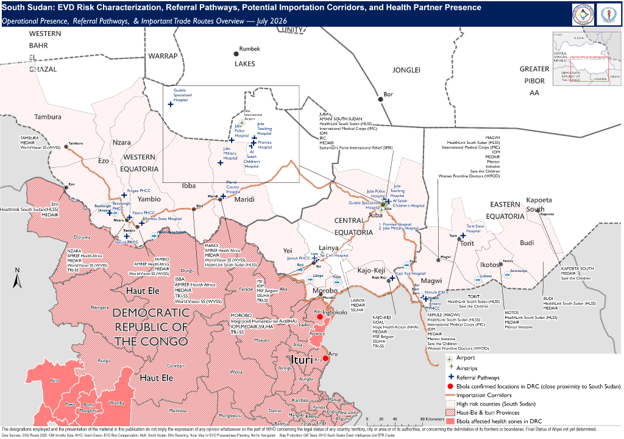
The South Sudan Ministry of Health and WHO have identified 15 counties to be at high risk of Ebola importation (Figures 1 and 2). Fourteen are along South Sudan’s Southern borders across Eastern, Central and Western Equatoria States (collectively referred to as the Equatorias or Greater Equatoria region). These include, from West to East: Tambura, Ezo, Nzara, Yambio, Ibba and Maridi (Western Equatoria, bordering Central African Republic (CAR) and DRC), Yei, Morobo and Kajokeji (Central Equatoria, bordering DRC and Uganda) and Magwi, Torit, Ikotos, Budi and Kapoeta South (Eastern Equatoria, bordering Uganda and Kenya).12 The capital, Juba, located in Northern Central Equatoria, is also considered high risk because it is a major transport hub within 200km of DRC and Uganda borders. Risk maps created by REACH which integrate numbers of infected people with mobility patterns of mobile phone subscribers travelling to and from affected zones in DRC suggest that Ebola preparedness activities should prioritise Central and Western Equatoria (Figure 1).2,13 As of late July 2026, some preparedness measures were also being extended to Bor City in Jonglei state, given that it is a key transportation hub beyond Juba.14
Western Equatoria and the southern part of Central Equatoria make up the greenbelt of the country where agriculture is the main livelihood, while the borderlands in Eastern Equatoria become mountainous and then pastoral, where cattle-keeping predominates and is an important part of exchange and social cooperation. While some parts of the southern border follow mountains, game parks or roads, demarcation of land boundaries along most of the border is unclear.
The White Nile, which flows north from Uganda’s Lake Albert on the border with DRC, enters South Sudan at Nimule, then flows north through Juba and Bor, through the large Sudd wetlands, and up to Sudan. While the river is important for transporting humanitarian supplies and some trade north of Bor, between Lake Albert and Bor, it is only navigable by canoe. Commercial trade instead moves by road.15
All previous outbreaks of Ebola in South Sudan in 1976, 1979 and 2004 have emerged in the tropical forests of Western Equatoria, primarily in Nzara, Maridi, Tambura and Yambio, with some cases travelling to and being identified in the national capital, Juba.16,17 Western and Central Equatoria are also the states most affected by the current mpox outbreak, while cases in the ongoing cholera, polio, measles and hepatitis E outbreaks are concentrated more in the north, centre and east of South Sudan, including Jonglei; these areas are also affected by severe flooding, conflict, displacement and food insecurity.14,18 Nearly the entire country experiences high malaria transmission throughout the year.
Figure 1: Health zones (DRC) and counties (South Sudan) at risk of Ebola, based on historical mobility patterns
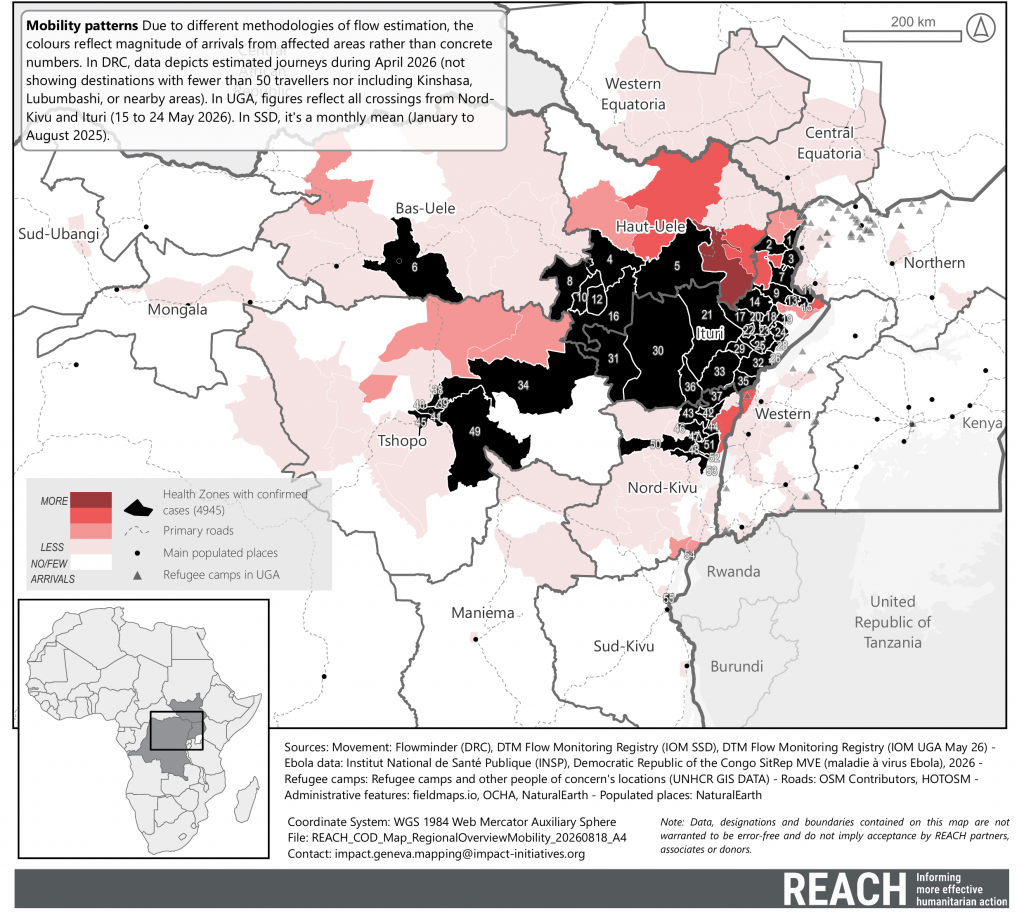
Figure 2: Locations of counties in South Sudan at high risk of Ebola importation, along with travel corridors and presence of operational partners
Cross-border social ties, ethnicity and language
The borderlands are characterised by important historical, cultural, socioeconomic and trading links. South Sudan is home to around 70 ethnic groups. Some of the largest in the southern borderland areas include Toposa, Didinga, Lotuko, Lokoya, Acholi and Madi (Eastern Equatoria), Bari, Pöjulu, Nyangwara, Mandari, Kuku and Kakwa (Central Equatoria), and Moru, Baka and Azande (Western Equatoria), with several extending into Uganda, DRC and other neighbouring countries (Table 1).10,11 Some of these groups, especially the Acholi, Madi, Kakwa and Azande are divided by international borders, with their members inhabiting parts of neighbouring countries.
These identities are therefore not fixed or strictly separate. There is a long history of exchange, movement and mixing between groups, with shared languages, cultures and practices. Intermarriage occurs extensively between as well as within ethnic groups in the borderlands. Families live across formal national boundaries and some split their lives between countries as a strategy to remain safe.12 For example, Azande in South Sudan, DRC and CAR frequently marry and maintain extensive social networks.
Population movement across the borderlands is significant and fluid with people moving to visit family, for economic reasons, to farmland, attend school and seek traditional and biomedical healthcare, as well as for safety. This tri-national border area would therefore be better perceived as a borderland zone, rather than a borderline which would be impossible to effectively control and monitor through the dense forest.
While many South Sudanese communities sought refuge in DRC during earlier periods of insecurity, and some remain there still, the majority of South Sudanese refugees, including those from close to DRC border, now seek refuge in Uganda as it is viewed as being more stable with a strong education system that uses English.13 English became the sole official language used in government and education after independence in 2011, but Juba Arabic serves as the most widespread lingua franca for daily communication and is the language used by the military. The use of local languages, however, is essential for direct communication with affected and at-risk remote communities. In Western Equatoria the local languages are Zande, Avokaya, Baka, Morokodo and Mündü, and around Tambura include Belanda Bor and Belanda Viri. On the DRC side of the border, Avokaya is also spoken (and has a number of dialects), Lingala is limited to the larger urban centres, and Bangala is widely used for trade.7
Table 1: Locations of main ethnic groups in Greater Equatoria and their ethno-linguistic relationships in Uganda and DRC
| Linguistic grouping (Countries where they are found) | Ethnic group (present in Equatoria, South Sudan) | Primary location | ||
| South Sudan | Uganda | DR Congo | ||
| Surmic languages (South Sudan, Ethiopia) | Didinga | Budi | ||
| Ateker-Lotuko-
Maa languages (South Sudan, Ethiopia, Uganda, Kenya, Tanzania) |
Lotuko, Lokoya, Toposa/Jiye | Torit, Ikotos, Juba, Lafon, Kapoeta, parts of Jonglei State | Karamoja | |
| Luo languages (South Sudan, Uganda, DRC, Ethiopia, Kenya, Tanzania) | Acholi | Magwi | Gulu, Kitgum, Amuru, Lamwo, Agago, Nwoya, Omoro, Pader | |
| Bari-dialects (South Sudan, Uganda, DRC) | Kakwa | Yei, Morobo | Koboko, Yumbe | |
| Kuku | Kajokeji | Moyo | ||
| Bari, Pöjulu, Nyangwara, Mandari | Juba, Terekeka, Lainya | |||
| Moru-Madi languages (South Sudan, Uganda, DRC) | Ma’di, Olu’bo | Magwi, Juba | Adjumani, Moyo | |
| Avokaya, Logo | Maridi | Faradje (Haut-Uélé) | ||
| Moru/Morokodo | Maridi | |||
| Keliko, Omi | Morobo | Ituri | ||
| Lugbara, Aringa | Arua, Maracha, Terego, Madi-Okollo, Yumbe, Koboko | Ituri | ||
| Bongo-Baka-Bagirmi languages (CAR, Chad, South Sudan, Sudan) | Baka | Maridi, Yei | ||
| Zande languages (CAR, South Sudan, DRC) | Azande | Yei, Maridi, Yambio, Tamura, parts of Western Bahr al-Ghazal | Bas-Uélé, Haut-Uélé, Tshopo | |
Source: Authors’ own. Created using data from McKulka (2013)19.
Refugee communities
The total number of refugees and asylum-seekers from South Sudan living in neighbouring countries climbed dramatically between 2014–18 related to political conflicts starting in Juba and spreading to the north-east of the country and to the Equatorias. Following the 2018 peace agreement, numbers of South Sudanese refugees living in neighbouring countries were stable at around 2 million from late-2018 until mid-2024 but have been slowly increasing since then.
Uganda hosts the largest proportion of South Sudanese refugees and asylum seekers, who live in settlements located close to the borders or as self-settled individuals in urban areas. There are more than 1,056,000 South Sudanese refugees and asylum-seekers in Uganda.20 However, some of these refugees and asylum-seekers need to periodically move back across the shared borders to explore livelihood opportunities, to maintain claims on land, or for social reasons such as attending funerals or taking dead relatives back home for decent burial. A poignant example of ongoing displacement is of hundreds of South Sudanese from the border areas in Kajokeji County triggered by alleged attacks by Ugandan Peoples Defence Forces (UPDF) in territory claimed by both Uganda and South Sudan.21 Additionally, after the Khartoum government fell in April 2023, many South Sudanese who had settled in Sudan needed to flee, but didn’t feel safe going back to their indigenous areas. Many Nuer people from northern South Sudan, for example, chose to re-settle in Uganda. This is an example of a group of refugees who might be expected to engage in less cross-border movement.
In DRC, there are around 90,000 refugees and asylum-seekers from South Sudan, mainly in settlements in northern Haut Uélé (one settlement, Aba) and Ituri provinces (four settlements), including a small but continuous flow into the Kakwa chiefdom in Aru, DRC, on the Uganda border, via Uganda.22 Pendular flows across the South Sudan/DRC border are driven mainly by food insecurity, with humanitarian assistance in both countries challenged by remote locations, insecure operating environments and reductions in aid funding.
South Sudan hosts much smaller refugee populations from neighbouring countries to the South, including around 15,000 from DRC, 5,000 from CAR and 500 from Uganda and about 64,000 refugees and asylum-seekers in total live in the Equatorias.23,24 There are six refugee settlements in Western Equatoria (including Makpandu with ~14,000 people near Yambio) and three in Central Equatoria (including Gorom with ~17,000 near Juba) as well as other populations of self-settled refugees and asylum-seekers in Juba (~20,000) and Maridi.24 The health facilities serving these settlements are heavily dependent on UNHCR and NGO support for medical supplies and personnel. Refugee settlements typically have existing structures for community-based surveillance through trained refugee community health workers which can be mobilised for Ebola response.
Livelihoods and cross-border trade
Years of instability and weak governance have left South Sudan with poor domestic productive capacity and a dependency on imports of consumable goods and services. The vast majority of official imports come from neighbouring countries Uganda and Kenya, with informal trade also flowing from DRC and Sudan. East African sources have become even more important since the war in Sudan has disrupted northern trade routes since 2023. Any Ebola-related border restrictions would therefore be coming into this already politicised trade context.
Large-scale, commercial trade is predominantly through the Nimule crossing on the Uganda border, which is also the site of most political attention. Strikes by East African truck drivers over the past six years, however, have repeatedly disrupted cargo movement here, affecting supplies of food, fuel and other essential commodities that people in Juba depend on. The Kenyan Government’s Ministry of East African Community Affairs has recently engaged South Sudan in high level talks to address the truckers’ association’s continued complaints of assaults, shootings, illegal roadblocks and extortion by security officers and armed groups operating along the Nimule-Juba corridor.22 This border crossing was also the site of a trade crisis with Uganda in 2023, when the South Sudan National Bureau of Standards impounded 70 trucks carrying grain worth US$2.7 million for two months over concerns the food contained high levels of toxic aflatoxins from mold.25 The Nimule crossing route is also important for many middle-class and wealthier people in Juba who have families in Kampala.
Trade also happens at official border crossings in Central Equatoria at Lasu (bordering Haut-Uélé province in DRC) and Kaya (bordering Uganda, with direct road connection to Ituri province, DRC), as well as Nabiapai in Western Equatoria (also bordering Haut-Uélé). Women traders sell their wares at the numerous smaller-scale border markets. Most informal trade with DRC is in small goods traded from motorbikes or bicycles. Petty traders usually pay a flat rate tax per month and avoid additional customs duties unless they are stopped at a roadblock.
There is also a wide range of illicit trade in timber, gold, petroleum, livestock and other commodities, concentrated around the border areas between DRC, West Nile in north-western Uganda and South Sudan. Well-armed poachers also operate in the area, hunting for wildlife body parts (ivory, pangolin scales) as well as bush meat, and cross between South Sudan, CAR and north-eastern DRC, including into Garamba National Park.7 Armed groups in the region are reported to largely fund their operations through the illicit export of natural resources.26
Gold mined in the Juba, Lobonok and Yei areas is typically exported from Juba by air, or to Kampala, Uganda via the Nimule crossing. Gold from Yei is also transported to Arua, Uganda via the Kaya crossing and combined with flows from DRC.27 A small amount also gets smuggled out through the Lasu border post (west of Yei) to DRC into Aba (Haut Uélé) where armed groups from South Sudan and DRC facilitate its movement onto Arua. Gold from Kapoeta goes to Kenya. Within South Sudan, small scale artisanal mining tends to be done by local people, with men responsible for digging and women for washing the gold.27 Mining is done mainly in the dry season, when it is safer to dig holes in the riverbeds.28 Mining sites and transportation networks are controlled by political elites and armed groups with previous violent flare-ups around sites in Lainya, Lobonok, Yei and Kaya River area (Central Equatoria) and Tambura (Western Equatoria) which can keep local miners away.29 Military actors on both sides of the South Sudan/Uganda border cooperate to move gold through official checkpoints, while small-scale traders tend to use panya roads. The triple border between DRC, South Sudan and Uganda hosts a large number of informal border posts or checkpoints including at Oraba, Salia Musaba, Busia and Koboko which may host markets, are accessed mainly by motorcycles, and unofficial crossing fees are negotiated between soldiers and traders.29
Cattle trading across the southern borders is common and happens mostly unofficially. Nomadic Fellata/Mbororo pastoralists from Sudan migrate during the dry season with large herds into Western and Central Equatoria and sell the cattle to traders who then move them into Garamba National Park in DRC. The Fellata/Mbororo often set up their camps in forests, to avoid conflicts with farmers, but women may come to markets to sell dairy products and buy other staples.30 They often have tense relationships with authorities who describe their presence as illegal and attempt to impose fines on the group.
Bushmeat is an important and popular source of animal protein in Western Equatoria and the bushmeat trade brings rural and urban population together, serving as a possible pathway for human-to-human transmission.7
The DRC–Uganda border is currently closed, but the borders with South Sudan remain open. Trade dynamics between South Sudan, DRC and Uganda are a risk factor in terms of the spread of Ebola, but also provide a potential opportunity for preparedness and prevention efforts through traders. This is critical, not only for their safety, but because they can access areas that many preparedness actors find difficult to work in due to insecurity dynamics, have in-depth knowledge about cross-border connectivity, and can cascade information to multiple communities.
Public authority in borderlands
Immigration officials, under South Sudan’s Ministry of Interior Affairs, are responsible for entry points into the country, whilst the national army or South Sudan People’s Defense Forces (SSPDF) deal with security issues. However, local authorities under Eastern, Central and Western Equatoria States are responsible for governance of local border areas. Local government administrators and customary authorities (chiefs and ‘elders’) play active roles in managing conflicts as well as ensuring service delivery, including healthcare.
The history, form and function of chiefs differs greatly in different parts of South Sudan. In Western Equatoria, many Zande chiefs belong to the royal Avungara clan and can trace their ancestry to precolonial kings or princes.31 There and elsewhere in the Equatorias without kingdoms, some chiefs inherit their position, others are popularly elected or are selected by their community’s elders or by government. Elders are a fluid category of people with cultural knowledge, experience and authority; many have had positions of influence within government, the church or aid organizations. In some locations, such as Nimule, there are large populations of long-term internally displaced people (IDPs) who are informally organised under their own clan structures and operate separate customary judicial systems. For many chiefs, abandoning indigenous territory or crossing an international border is understood to mean a loss of power.31 In comparison, elders are less stigmatised for leaving the country. Additionally, within some areas of Western and Central Equatoria, chiefs face security risks moving between government-controlled towns and rebel-controlled countryside (especially border areas), so may be less in touch with and have lost authority among certain groups of their people.
United Nations (UN) agencies, international non-governmental organisations (INGOs), and national civil society organisations (CSOs), especially faith-based organisations, play a significant role in service provision, especially healthcare, and local peacebuilding and reconciliation at the grassroots level. Village health committees are made up of community volunteers who support health facilities and health workers in their area; they exist in all villages and neighbourhoods of urban areas, with equivalent systems in refugee and IDP camps. During epidemics, chiefs expect to be trained by government authorities and partners on health topics to be able to serve as a primary point of contact for their communities. In Western Equatoria, few customary authorities have joined cross-border displacement flows, and the ones that have are not allowed to operate their own courts. However, other forms of non-customary authority have emerged in the refugee camps in Uganda, including Refugee Welfare Councils, which are initiated and recognised by the refugee settlement authorities, and supra-ethnic community organizations, organised by refugees themselves.31
Borderland territorial struggles
A multitude of actors including government and different state agencies have constructed their authority through attempts to govern the border and surrounding borderlands.32 The (re)claiming of land is, for example, particularly acute around the Nimule border crossing, where numerous armed government actors report to different authorities in the central government in Juba. Uganda is also reported to be engaged in land-grabbing near Nimule and Pogee and there are ongoing tensions related to the Uganda People’s Defence Force (UPDF) barracks at Bibia encroach on South Sudanese territory.33,34 The Kajokeji boundary with Moyo and Yumbe districts remains unclear and contested. As mentioned earlier, there is an ongoing displacement of civilians sparked by UPDF attack in Kajokeji County, claimed by South Sudan. Whilst there are challenges of border regulation in the Azande borderlands between DRC, South Sudan and CAR, they are less prone to territorial struggles.35 Sudan and Uganda are key guarantors to the sensitive 2018 peace agreement, the Revitalised Agreement on the Resolution of the Conflict in the Republic of South Sudan (R-ARCSS), that relies on it being of political and economic benefit to these neighbouring countries. Historically, the north-western borders with DRC (and CAR) have not been of such political interest to Juba and as a result there is less state assertion of power over the borderlands. The solution to cross-border land conflict lies in local-level initiatives but external actors should be mindful of the way that humanitarian interventions, including those for health and in relation to Ebola preparedness, and particularly if they are seen as being led from Juba, could be portrayed as linked to broader politics of the borderlands and have the potential to be used as part of ongoing border disputes.
Cross-border mobility patterns
Formal and informal crossing points and key routes
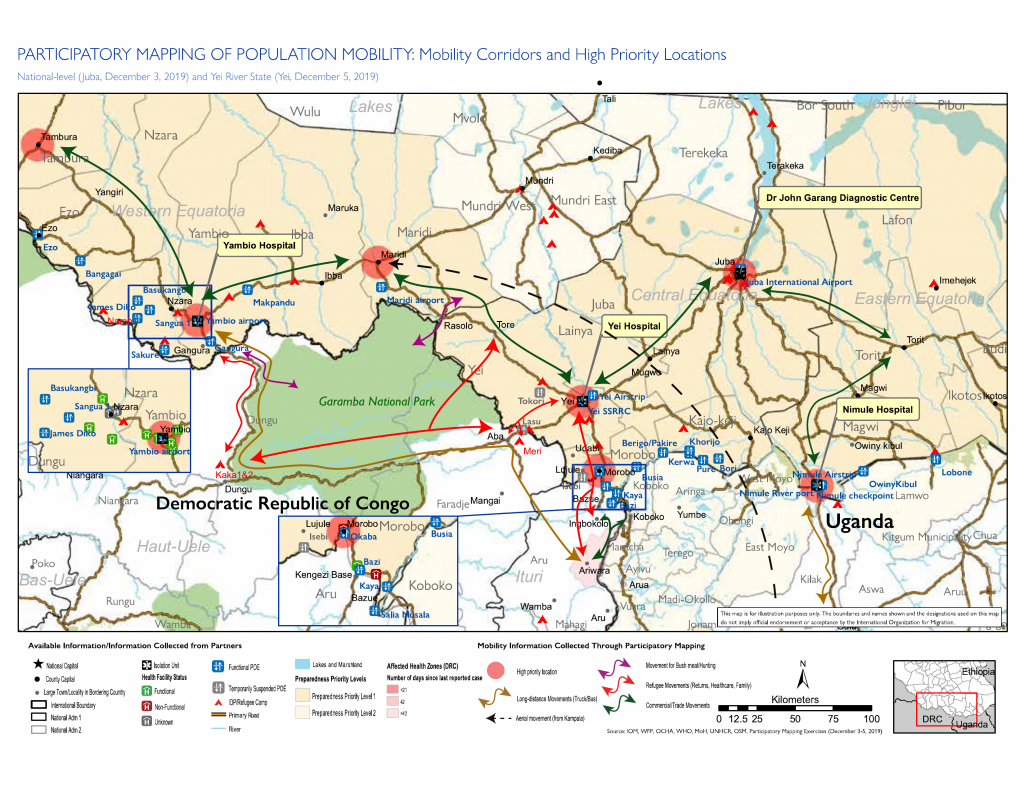
Most official movement between South Sudan and DRC goes via Uganda (see Uganda–DRC brief for current cross-border dynamics and the effects of Ebola-related border closures). Nevertheless, a large number of travellers also cross the border directly from DRC, including from Haut Uélé and Ituri Provinces (both of which, at the time of writing, reported active Ebola transmission). The borders between South Sudan, DRC and Uganda are highly porous and many travellers avoid the formal routes and crossing points, choosing instead to use panya roads (informal roads in the bush) and to cross the border at night to avoid checks and taxation. Border posts are frequently viewed with suspicion as they are seen as part of the political and economic apparatus of politicians and the state to collect taxes. Such informal routes are also used by armed opposition groups, people trading in illicit commodities and those who fear military authorities at border posts because of recent aggressions.36 For many in the borderlands, the official demarcations that separate South Sudan and neighbouring countries are seen as an impediment to informal movement and are often inconsequential to daily life. Multiple informal entry points are known to be located on the border between Moyo (Uganda) and Kajokeji (South Sudan), the densely populated areas on DRC border between Morobo and Lasu, southeast and southwest of Yei, respectively (South Sudan) (Figure 3). To fully understand movement, trading patterns and the crossing points being used, it is vital that local knowledge continues to be harnessed as movement patterns are constantly in flux and tend to shift quickly in response to a variety of factors.
Figure 3: Locations of informal border crossing points near areas at high risk of Ebola importation and key mobility corridors
Border control and monitoring
While the Uganda/DRC border has been closed to slow transmission of Ebola, as of mid-August 2026, the South Sudan/Uganda and South Sudan/DRC borders remain open to those seeking asylum, as well as for regular migration. Response actors assume that with Uganda–DRC border closed, more people from DRC are now travelling through South Sudan to reach Uganda, using unofficial crossing points.37 At the end of May 2026, just after Uganda closed its border, around 1,000 people per day were estimated to travel by road along the 510km route from Ituri Province’s capital, Bunia, via Aru, to the Kengezi Base/Morobo point of entry to South Sudan on the road to Yei.38 The route is mainly used for fuel and vehicle trade, while family visits account for approximately 10 per cent of movement.
The International Organization for Migration (IOM) conducts flow monitoring and supports surveillance and infection prevention and control at points of entry along the southern borders, including Source Yubu (near Tambura), Gangura (southeast of Yambio on the road to Dungu, Haut Uélé), Nabanga (between Yambio and Maridi bordering Garamba National Park), Bazi (near Morobo and Yei), Lasu-Libogo (Yei), Abaya and Kaya (near Kajokeji), Nimule and Pogee (Magwi County), Nadapal (Kapoeta) as well as at the Juba and Yei airports.39,40
An important finding from a study of community perceptions during the 2019 Ebola preparedness activities in Yei River State was that people who crossed the border on a frequent basis reported they were ‘tired of Ebola measures’ and routinely avoided screening and handwashing.41 Many instead called for ‘more practical’ disease surveillance mechanisms to encourage communities to self-monitor population movement and suggested engaging with markets, schools, churches and refugee camps on both sides of the border, rather than focusing on formal border crossing points.
Markets
Numerous cross-border markets are located across the borderlands between South Sudan, DRC and Uganda at which communities take advantage of historical trading relationships, loosely enforced trade rules and the availability of a range of products that are otherwise not widely available in South Sudan such as particular types of clothing, construction materials and non-food items. The weekly border market at the Nabiapai border crossing is popular with people in Yambio, with the number of people crossing from DRC more than doubling on weekend market days (border screening data from August 2026 suggests 200-500 people cross daily during the week, while 800-1,000 people cross daily on weekends).7,42 The majority of small-scale traders are women from female-headed households who depend on cross-border trade as their primary source of income.27 Communication with cross-border traders should focus on prevention behaviours and a two-way flow of information should be quickly developed. The leaders of trade organisations are usually based in the market areas of all Payams and the main urban centres. They should be engaged to cascade information to their colleagues, but also to act as part of a community-based surveillance system linking both urban and rural areas.
Mass gatherings
Several thousand people normally attend national celebrations and political events throughout the year in cities across the country including Yei and Juba. For example, Martyr’s Day is celebrated annually on 30 July. These events could attract citizens living or temporarily staying across the borders and from other areas of Western and Central Equatoria.
Movement of armed groups
Recruitment, mobilisation, and the flow of resources for armed groups takes place across the borders between South Sudan, DRC, Uganda and CAR, and armed groups operating in the Equatoria states in South Sudan frequently seek shelter, medicine and reinforcements from neighbouring countries.43,44 The Sudan People’s Liberation Army-In Opposition (SPLA-IO) has historically sought refuge in the forested areas of DRC. National Salvation Front (NAS) units have also sheltered in border regions, where they sporadically attack positions held by the government’s South Sudan People’s Defence Forces (SSPDF) and targets moving along roads leading to neighbouring countries. The Azande Ani Kpi Gbi (AAKG) draws fighters from Zande areas of DRC and CAR and fights the SPLA-IO on behalf of the government in Western Equatoria.44 Insecurity has worsened, particularly in Tambura, amid deteriorating relations between the SPLA-IO and the SSPDF following detention and subsequent trial of suspended First Vice President Dr Riek Machar and some of his loyalists. Former Governor Alfred Futuyo, an ally of Dr Riek Machar, was forced to return to the bush to fight the government army. The movement of these groups is unpredictable and secretive and as soon as routes become visible, they are intentionally changed to ensure movements continue to be unseen. Attempts to trace or control such movements, even in the context of Ebola preparedness, will likely have direct political implications.
Vulnerabilities
People whose survival strategies depend on cross-border mobility will become more economically vulnerable if border restrictions are put in place or people fear crossing into DRC or mixing with others in high-traffic border areas. In one recent community discussion conducted by REACH in Yambio, for example, women mentioned that one weekly border market had been suspended because of Ebola and some women traders have stopped going which has reportedly increased prices of imported staples in the local area.
Additionally, if Uganda decides to close the border with South Sudan as they have done with DRC, people who need to cross the border may be forced to use more informal crossing points which can be riskier and harder to monitor to link people to health services. Men may be particularly impacted, as they are usually the ones displaced families rely on to maintain claims to land and livestock and prevent them from being grabbed by government officials or soldiers.
Women are also usually the primary carers at the household level and may therefore be at greater risk of exposure to Ebola. The outbreak comes in a context already marked by displacement, insecurity, widespread poverty, and high humanitarian needs, exacerbating the pre-existing vulnerabilities of women and girls and reduced access to essential services. Those who are often the first point of call outside the family for advice on illness, including herbal experts, traditional healers, faith leaders and others, may also be particularly vulnerable to infection.45 People living in overcrowded IDP camps and transit sites for returnees and refugees, where water, sanitation and hygiene (WASH) services are overstretched, may also be at higher risk.
Conflict dynamics and militarisation
Conflict dynamics
South Sudan gained independence in 2011 after decades of civil war and descended into war again in 2013 following intense infighting between politico-military elites. This led to the army splitting into factions: the governing Sudanese People’s Liberation Movement (SPLM) and the SPLM – ‘In Opposition’ (SPLM-IO). The conflict spread into the southern states bordering DRC and Uganda in late 2015. With the support of neighbouring countries, regional bodies and international actors, the warring parties signed the 2018 Revitalised Agreement on the Resolution of the Conflict in the Republic of South Sudan (R-ARCSS). However, conflict has continued in many parts of South Sudan since 2018, causing significant displacement of civilians.
Since the fighting between the government’s army (SSPDF) and the White Army (perceived to be allied to the SPLM-IO) in Nasir, Upper Nile State, in March 2025, tensions between the SPLM-IO and the SSPDF, backed by the Uganda People’s Defence Forces (UPDF), dramatically escalated. The SPLM-IO leader, Dr. Riek Machar, was suspended from the position of First Vice President, placed under house detention, and put on trial by special court in Juba, alongside some of his key allies. Cantonment sites were bombed and opposition fighters awaiting retraining and reintegration into the national army were dispersed. Subsequently, some SPLM-IO fighters resumed hostilities against the SSPDF in the Equatorias. They joined several smaller opposition groups in the Equatorias which were not signatories to the Agreement because of ongoing grievances with the government. As a result, significant insecurity has affected some areas along the borders, including Kapoeta, Magwi, Kajokeji, Maridi, Yambio and Tambura. Fighting in Morobo resulted in the displacement of approximately 6,000 civilians towards Juba County.46
Budget cuts have led to the closure of United Nations Mission in South Sudan (UNMIS) temporary operating bases in Yei and Tambura, further limiting protections for civilians and peace-building efforts.46 Protracted conflict has devastated the economy, disrupted social cohesion and weakened institutions and could negatively affect preparedness efforts.
Access for humanitarian actors
Incidents of violence against or obstruction of healthcare escalated between 2023 and 2025 in Eastern, Central and Western Equatoria, reflecting the wider deterioration of security in these areas.34,35 There has been looting of healthcare facilities, including in Morobo (Central Equatoria), and abductions of aid workers in Yei River and Morobo counties, resulting in loss of access to healthcare for some communities. In 2026, access to some areas of the border in Central Equatoria around Yei River remains especially challenging. International organisations, often perceived to be aligned with the government in Juba, can sometimes face challenges in forging legitimacy and operating in areas controlled by armed opposition groups and their sympathisers.7 In addition, the occurrence of armed robberies, hijacks and ambushes (for example on the roads from Yei to Morobo and Lasu, as well as Yei to Maridi) can temporarily halt the movement of humanitarian actors. At the time of writing, armed groups in Central Equatoria continued to carry out sporadic ambushes from their rural bases endangering humanitarian service delivery. On 11 August 2026, three aid workers carrying Ebola supplies were temporarily abducted in Libogo, a border town southwest of Yei.47
Collaboration with armed and state actors for Ebola
Collaborating with armed personnel in preparedness efforts in South Sudan (pro-government state forces, militia and organised forces including police and fire services, prison guards and wildlife personnel) must be considered with caution. Although some armed actors have already had roles in preparedness activities, in the case of a confirmed Ebola event, armed actors should not be used to track down suspected Ebola cases or be involved in contact tracing efforts, particularly in territory formerly held by the SPLA-IO, NAS, or other militias. The involvement of armed actors and other security personnel in critical Ebola response interventions such as contact tracing and burials could undermine trust at the local level and elevate concerns that Ebola is a weapon of war and used by the government to coerce, control, displace and monitor affected populations. Avoid over-militarising response activities, including providing security for humanitarian actors, as this could attract the attention of armed groups.
Health
Health infrastructure and medical pluralism
Across South Sudan, biomedical health services are largely provided by a patchwork of international and local non-government organisations as conflict and economic decline have continued to erode basic government supported healthcare delivery. In general, healthcare delivery faces serious bottlenecks including limited infrastructure; shortages of medical supplies, expertise and skills; and overstretched healthcare personnel who may go for many months with no salaries. With only 3 per cent of the national budget allocated to health care and over half of health care costs borne by individuals, access to care remains critically limited, leaving many people dependent on humanitarian services that are constrained by insecurity and frequently targeted.48 Severe aid cuts in recent years have particularly affected the health sector and led to facility closures. Health service disruptions, in turn, have been the focus of public protests to draw attention to the lack of government solutions.49
Different ethnic groups living together in urban areas often have different patterns of healthcare-seeking. In Nimule, for example, Dinka IDPs favour private healthcare providers that can speak their language and share information about the easiest ways to access hospital services without going through the outpatient department staffed by Equatorians.50 Different ethnic groups also share different discourses about individual diseases which may depend on their specific histories of exposure and displacement, education and sense of risk.51
Home care and alternative sources of care (including pharmacists, herbalists, spiritual and other kinds of healers) are common in both rural and urban areas. In recent years, as conflict and economic hardship escalated, a notable increase in the use of local healers has been reported. Ideas of witchcraft and poisoning continue to be prevalent in these borderlands and have historically resulted in violence. Mysterious illnesses and sudden death tend to arouse particular suspicion, and lead people to seek guidance from diviners, healers or ‘witchdoctors’. It is reported that people in Yei, Kajokeji and Nimule also believe that some forms of witchcraft have been imported from Uganda and DRC, and there is potential for Ebola narratives to interact with these perceptions and local beliefs.50,52,53
Cross-border health-seeking
Crossing the border between South Sudan, DRC and Uganda to seek healthcare is common, particularly by those who do not have access to formal biomedical care in the areas they live. A proportion of people who cross from DRC into South Sudan are known to continue their travel onwards to Uganda as it is perceived, in general, to have a significantly stronger and more developed health system than both South Sudan and DRC (although in reality some border areas of Uganda still have weak health infrastructure).54 Those who cannot afford biomedical care in South Sudan may also cross into Uganda to access healthcare in refugee settlements or to DRC to access non-biomedical healthcare. Local sources or providers of care (pharmacists, spiritual and other kinds of healers) should therefore be purposively included in Ebola preparedness efforts as they are often the first point of contact for many people.
Gendered patterns of care and risk
Assessments of symptoms within households are often undertaken in the first instance by women, drawing on symptomatic knowledge and experience of treatments that have worked in the past; and when seeking medical advice beyond the household, local expert women are often consulted first. Women are also usually the primary carers at the household level and may therefore be at greater risk of exposure to illnesses, including Ebola. Specific efforts should be made to provide women with basic training particularly in terms of infection prevention and control for homecare and identification of symptoms.
Burial practices
Burial practices
Proper burial of deceased kin is very important in South Sudan, and is seen as critical for both the living and the deceased.55,56 Among other things, the care and financial support of widows, children and vulnerable dependents are often decided at funerals.45
As in many other parts of the continent, burial in South Sudan is a multi-stage process – preparation, washing, movement, mourning, and burial – each carrying deep social, cultural, and spiritual significance, as well as transmission risks.8 Burial practices vary greatly across groups and religions and must be assessed locally to understand which practices may constitute a transmission risk and who is most likely to be involved in activities that put them at risk. Practices common across many groups include washing and preparing the body, dressing the body in the person’s best clothing, moving limbs into the correct position for burial, and if applicable, transporting the body to the deceased’s natal area.55 Others may help the grieving family to dig a grave, transport and carry the casket, organising special prayers, hosting coffins in home, and providing hospitality to those attending the funeral. Burial practices across the Equatorias tend to be longer and more elaborate than other ethnic groups from northern states such as the Dinka and Nuer, who usually must bury a deceased person within 24 hours,55 though familial obligations to a deceased person’s spirit may persist for decades.56
The location of burials is also important. Ancestor spirits are meaningful to many ethnic groups and many families want to bury their loved ones close to home to ensure they don’t forget the deceased, can take care of the grave and consult ancestors when needed. Among Zande, Dinka, and other South Sudanese groups, there is a common belief that, when a child dies, they should be buried next to the house of the mother because otherwise she will not be able to conceive again.57 If someone dies in a refugee camp, elsewhere in a neighbouring country, or on a battlefield, family members will strive to move the body to the ancestral home for good burial, to a large extent depending on the financial ability of those concerned and sometimes the social status of the deceased. Traditional funerals reflect power relations in South Sudanese society, with deceased men often having longer funerals and involving more ceremony compared to women and children, especially if the family of the deceased is impoverished.55
Adapting burial practices
Burial practices are not static, and epidemics, war, flooding, migration and urbanisation have created new dilemmas and discussions over what constitutes a good burial.58,59 There are clear precedents in which South Sudanese communities have altered their customary burial practices in response to conflict and other public health emergencies including Ebola. During the Ebola outbreak in Yambio in 2004, for example, it was documented that burials were conducted in accordance with local traditions and that ‘genuine funeral ceremonies’ were held whilst ensuring the use of safe and dignified burial methods.37
As part of community-led responses to epidemics, events including weddings and funerals may be altered (with reductions in size or the introduction of social distancing, for example), but would tend not to be suspended as weddings and funerals play such vital roles in families and communities. If disputes remain unresolved, a burial may be disrupted and people may become angry with response teams who are not sensitive to these issues. In such cases, it may not be the response itself that is being challenged, but ongoing, difficult community challenges or pre-existing family conflicts.10 In a borderland context where people have often faced forced displacement and intersecting emergencies, concerns surrounding burials are also linked to a larger social need to ensure the future survival of peoples’ kinship networks and wider community.59
Standard operating procedures for safe and dignified burials must be adapted to granular local contexts and community personnel who are usually involved in burials must be fully engaged. Time and resources spent agreeing changes in burial practices during the preparedness phase and prior to an event will be a valuable investment. So, too, will developing conflict-sensitive strategies to recruit safe and dignified burials team members. To ensure burial teams can work effectively throughout at-risk populations, recruitment of members should be ethnically diverse, socially relevant and perceived as fair. Involving families rather than bypassing them should be a guiding principle of action.10 Allowing family members to visually inspect the body of the deceased while maintaining safe distances, taking the time to consult with families to explain the situation, and mobilizing religious and customary leaders are also concrete steps that can reduce friction around funerals. Involving the army or other security actors during safe and dignified burials should be avoided at all times.
Politicisation of burial sites
The role of ancestors is significant for all ethnic groups across South Sudan and burial sites are considered an important sign of land ownership in customary courts because of the connection these sites give to a person’s ancestors.55,57 There is a risk that changes in burial practices may be used to imply changes in land rights, particularly in the contested borderlands. In recent years, cases of Ugandan communities accusing South Sudanese communities of performing burials in strategic areas in order to strengthen land claims have been reported.41
Ebola preparedness
National preparedness
South Sudan, along with other Priority 1b countries bordering an affected country with community transmission (Burundi and Rwanda), has benefitted from substantial continental readiness planning since May 2026.4 In particular, South Sudan has been included in high level cross-border meetings held with DRC’s and Uganda’s Ministers of Health since early on in the outbreak to support cross-border coordination and jointly agree immediate and mid-terms priorities.60 Priority actions have been developed for countries in each risk classification and according to all 14 preparedness and response pillars.4
Under pillar 1 (Coordination, leadership and governance) and pillar 10 (preparedness and readiness) a key expectation for countries at risk of Ebola is to regularly conduct readiness assessments to guide capacity strengthening and action plans. In South Sudan, overall national readiness climbed to 65 per cent in July (from 45 per cent in June and 29 per cent in May), above the WHO African Region average of 55 per cent, reflecting ongoing efforts of the South Sudan Government and partners to prepare the populace.14 Major gains were measured in coordination (83 per cent), public awareness (75 per cent) and case management (73 per cent) domains, while there remain major gaps in laboratory (60 per cent), point of entry surveillance (40 per cent) and infection prevention and control (IPC, 33 per cent) preparedness.61
Many observers inside the response, however, suggest these scores do not reflect the more challenging reality on the ground.62 There are substantial disparities between national and subnational readiness, for example, as a slow, politicised Juba-centric approach to decision-making makes subnational involvement in response design difficult. There are also persistent political power struggles over who is leading the response between the Ministry of Health and the National Public Health Institute (NPHI), which operates as an autonomous agency under the Ministry with a mandate to lead health emergency responses, making coordination structures challenging for response actors to understand. Additionally, only US$2 million has been secured for the country’s Ebola response, which is around half of what is needed to fund preparedness activities in a scenario with no confirmed cases; in a scenario with localised transmission, around US$11.8 million is expected to be needed.63 In early June 2026, the Senior Presidential Envoy, Hon. Adut Salva Kiir, visited the NPHI and donated ten vehicles to boost Ebola preparedness,64 however, more financial support to the health sector from government budgets is needed. In late July, seven foreign embassies which have invested in the Ebola response called on the South Sudanese government to ensure public health workers are paid on time.65
A key cross-cutting challenge for all pillars is that partners’ operational and surge capacities have been severely affected by funding cuts in recent years which has translated into operational delays. For example, in Yei, all United Nations offices were closed down because of funding cuts, while some have retained field offices in Yambio. Additionally, partners’ efforts and funds are needed to strengthen preparedness and response to health priorities beyond Ebola, given that it is not the biggest problem in South Sudan right now. As of July 2026, only around 40 per cent of the UN’s health sector response had been funded.66
Preparedness at county-level
The WHO and UNMISS have jointly led assessment missions to several high-risk counties including Yei, Morobo and Magwi. Some county health departments are now regularly convening meetings of the preparedness sub-pillar to share information and support planning. The Ministry of Health has also initiated surge-deployment of the health workforce for surveillance, case management and infection prevention and control (IPC) in high-risk locations including Nimule, Kaya and Yambio. Health facilities, including those in border areas, often do not have adequate safe water supply and storage or waste management systems, potentially increasing transmission risk. More generally in communities, WASH infrastructure is very limited, with chronic shortages of soap, safe water storage and functional handwashing facilities. Training of these personnel is being provided by a number of partners including MSF (e.g. case management in Yei), the South Sudan Red Cross (IPC, safe and dignified burials, community feedback and community-based surveillance in eight locations of Central and Western Equatoria),67 while IOM and UNICEF are collaborating with local organisations for RCCE and surveillance activities in several locations.68 There are plans for Yambio to become a regional referral lab. The Western Equatoria State Government allocated land for the construction of a modern high-tech reference laboratory, with the support of the African Union in partnership with the Africa Centre for Disease Control and Prevention (CDC).69 Once completed, the lab will ‘become a key diagnostic hub for Ebola, Mpox and other infectious diseases, strengthening health security in Western Equatoria and across South Sudan’.
Surveillance
A key concept guiding surveillance, community engagement and other preparedness actions in South Sudan and being circulated by WHO and other actors in training sessions is about what constitutes a border. While conventionally, a border is defined as a boundary between countries, for the purposes of readiness, ‘the meaningful border is the network of people, markets, healers, clinics and roads through which risk moves’.61 A border is therefore not a line, but a living community.
Key sources of surveillance data for the BVD response include:
- Point of entry (PoE) screening reports at official border crossings: As of 19 July 2026, 570,599 travellers had been screened, and no cases identified.14 22 high-risk points of entry have been identified by the NHPI: Sakura, Bazikangbi, Nabia-apai Yambio, Nabia-apai Ezo and Yambio airport (Western Equatoria); Kaya, Salamusala, Libogo, Bazi, Lasu, Aba, Juba and Yei airports (Central Equatoria), Nimule, Olikwi, Rei river port, Serentenya, Lobone, Poke and Jale (Eastern Equatoria); Wau airport (Western Bahr-El-Ghazal); and Bor fish transporters to DRC (Jonglei). Systematic screening is happening at some but not all of these PoE, with the support of development partners who work alongside border control officers. In late August 2026, Western Equatoria State Health Minister, Nama Bukulu, pointed out persistent surveillance gaps, calling for additional surveillance at border checkpoints, including night shifts to screen travellers arriving outside normal operating hours.42 Ezo’s Acting County Commissioner also pointed out that only one of three local crossing points were under any surveillance.70 PoEs can potentially become strategic locations for RCCE.
- Early Warning, Alert and Response System (EWARS) data: Data on a range of priority diseases, including Ebola, is reported weekly from health facilities to support disease surveillance and response;
- ‘Zero reporting system’ data: This system has been introduced for the BVD response and involves WHO staff calling health officials in all high-risk counties on a daily basis to verify whether there are any reports of people with Ebola-like symptoms and organising investigations for any alerts. County health departments receive their data both from health facilities and a network of Boma community health workers who may see people with Ebola-like systems in their daily work, during Ebola- or response-specific community engagement activities or through reporting from activated community-based surveillance (CBS) systems. At present, zero reporting is happening in 14/15 prioritised counties, with the support of 313/1,605 Boma Health Workers (19.5 per cent) across 12 counties.14
- National Call Centre: This hotline was set-up to answer questions posed by the public and receive reports of Ebola-like illness.
There remains a critical need to cascade activities including training from Juba out to the counties, ongoing capacity building and more fully integrated disease surveillance activities with routine health monitoring. Given the porous nature of the border areas, the associated challenges of formal screening measures and the fact that oversight of cross-border movement is limited due to the use of panya roads, CBS should be a critical component of all preparedness activities and linked to existing communication and engagement strategies.4
CBS preparedness is more likely to be successful and sustainable in communities that are actively engaged in designing and implementing a range of co-produced public health solutions.50 For mobile and cross-border populations, this could mean recruiting CBS volunteers from within regularly mobile populations (e.g. traders, motorcycle drivers) to refer people with symptoms to screening points and help them access care early. It could also mean asking people in borderland areas to join cross-border committees to advise on surveillance strategies or working with existing CBS in refugee settlements and displacement sites.4 In areas, hosting IDPs, response teams should work through displaced peoples’ own social structures, rather than relying solely on county/payam/boma authorities or host communities’ chief structures. CBS should always be integrated into existing health system and surveillance structures and be as light as possible so that it doesn’t pose a burden on the communities involved.
Online social media posts and articles about Ebola from South Sudan are more limited than from DRC and Uganda, suggesting more limited opportunities for digital technologies to identify early warning signals here, and that offline structured field listening and other approaches are needed to support event-based surveillance for Ebola and to surface community narratives about the response more generally.71
Risk communication and community engagement (RCCE)
Partners under the RCCE outbreak response pillar have reactivated the National Call Centre (phone number 6666) for Ebola awareness and community feedback, and have started to reach people through community dialogue, household awareness sessions, advocacy meetings and radio programmes, as well as printed information, education and communication materials. The collection of community insights is underway including rapid mixed methods and qualitative assessments, as well as rumour tracking, and the collection of community feedback through the Call Centre.
In urban centres, engaging youth (through schools, youth groups, football clubs, boda-boda riders, etc.), trade organisations and private sector health workers including traditional healers is critical. In rural and urban areas, communities may be reached through networks of church and local organisations. It may also be possible to engage some groups of poachers, who have been a source of Ebola misinformation in the Yambio area during the 2018–20 DRC outbreak, with the support of the Wildlife Service and local authorities.7
Communication materials and engagement efforts related to Ebola preparedness must continue to be tailored to specific stakeholder groups and be gender sensitive. Many people, in particular, women, have low literacy (around 29 per cent)72 and prefer inter-personal communication methods, making use of creative methods including theatre or video.41 Spoken language is not always comprehended in the same way as written language and materials in English or Juba Arabic are often poorly understood by community members, even if they can speak those languages to some degree (see above section and Table 1 on ethnic groups and languages predominating in borderland communities).
Two-way engagement such as through rapid qualitative assessments, community feedback mechanisms (community meetings, community health worker-led surveys of households and hotlines) to understand community information needs and perceptions can help adapt responses, create a sense of trust and shared ownership, and to mitigate misinformation. Ebola communication should evolve based on feedback and as local-level awareness and knowledge on Ebola grows. Inappropriate messaging can prevent people from reporting symptoms and seeking help, and exacerbate discrimination and stigma, especially in the context of vulnerable groups in border regions. Communication and reporting related to Ebola should be constructive and emphasise the high chance of survival if a patient presents quickly for treatment and be clear about what such treatment entails, including what it will cost. Messaging that centres on Ebola (or the Bundibugyo strain, specifically) as a deadly, dangerous or incurable disease must be avoided, as should any communication that reinforces fear and stigma, including alarmist comments and reporting suspected cases as ‘breaking news’.73
Moreover, urgently dealing with rumours and associated public fears is paramount. For example, in June 2026, authorities in Yei Country had to quickly respond to rumours of an Ebola incident, when a soldier was seen vomiting blood.74 The case was investigated and it turned out to be ulcers, and measures were subsequently taken to reassure the public, including the media speaking to the recovering patient from his hospital bed.
Lessons from previous filovirus outbreaks
South Sudan has significant historical experience with Ebola.45,75 Ebola was first detected in South Sudan in 1976, in Nzara and Maridi (Western Equatoria), with subsequent outbreaks in Nzara and Yambio in 1979 and in Yambio in 2004.16 South Sudan also mounted significant preparedness activities in response to outbreaks in DRC and Uganda in 2019 and 2022. Many people in the borderlands remember the dangers of Ebola, as well as adaptations that have been made during previous outbreaks (including to burial practices); this represents a foundation that can be built upon. Communities already have varied systems and structures in place for managing infectious diseases.45 These should be central to Ebola preparedness and response. This will help ensure responses are locally appropriate and do not undermine people’s livelihoods, and that they build on experience and practices already in place and familiar to communities. Community strategies for infectious disease management more generally include symptomatic identification, followed by patient isolation, interruption of transmission and attempts at treatment. Methods to interrupt transmission of infectious diseases vary across the country but include organising houses for isolation; social distancing, including rearrangement of market stalls; marking out separate food and water access points for households; managing linen, beds, plates and cups and drinking water provision to avoid cross-contamination; and using urine, hot water, and ashes for disinfection. During periods of isolation, if people can still care for themselves, water, food and medicine may be left at the door; if not, a family member (often an elderly woman) provides care at significant personal risk. Different communities use crossed posts, rope barriers, poles or ash markings across paths or around houses to warn people away from sick households.45
Localised response
Chronic crisis has created a context of prolonged international interventions and a complex political economy of aid in South Sudan. Since the late 1980s, large-scale international aid operations have been implemented during times of both war and peace. These operations have often dwarfed local and national initiatives, even with the large-scale reductions in foreign aid since 2025. The ongoing conflict and politics of aid influence people’s perceptions of humanitarian actors, UN agencies and the peacekeeping mission. This, in turn, has ramifications for preparedness and response efforts in terms of trust, access and transference of information, particularly when engaging with communities who have recently suffered large-scale loss and abuses by different armed factions. For example, asking people for personal information and details about their movements and social relations as part of contact tracing efforts is likely to be viewed with suspicion and concern that such information could be passed on to government, opposition and rebel groups to be used as part of ongoing hostilities. In this context, surveillance as part of an Ebola response has particular connotations that should not be underestimated. Additionally, as previously seen with Covid-19,45,76 an over-focus on Ebola by humanitarian responders risks frustrating and alienating communities already dealing with a multitude of life-threatening health crises and other risks.
Trusted actors
South Sudan has faced repeated social rupture and readjustments, and the population’s ability and willingness to adapt behaviours and customary practices to save lives should not be underestimated. To align with this opportunity, Ebola preparedness strategies must continue to focus on strengthening local trust and access. Preparedness and response interventions are feasible at the community level if conducted by trusted, non-militarised personnel who have local authority. This is particularly critical for Ebola preparedness and response teams operating in opposition controlled or aligned areas and who collaborate with interlocutors who are already accepted and trusted at local levels. Faith-based organisations and both local and INGOs with positive long-term experience in high-risk areas should continue to be capacitated as key partners, not only for risk communication and engagement, but to deliver other pillars of the response. Customary chiefs (who still retain significant authority including over armed youth in some areas) and civil society leaders should continue to be engaged as important local actors. Trader and market associations that operate across the borderlands also offer a strong entry point even though their influence and reach may have declined due to the recent conflict. Local actors should continue to be adequately supported in terms of technical capacity and resources (including appropriate remuneration) and more vertical interventions that focus on Ebola readiness must be aligned with longer-term humanitarian principles and ongoing health-system strengthening.
Collective action
Community-led planning in response to outbreaks is common across many locations, and typically begins with a community meeting, bringing together a wide range of local authorities and decision-makers, including chiefs, elders and government officials, as well as people with medical expertise or experience of epidemics, and/or who play a role in treatment pathways.45 A response strategy is agreed, including plans for quarantine, reorganisation of markets, cleaning, and organisation of information drives, often based on discussion of lessons learned from previous outbreaks. People are then nominated to travel and share information about the outbreak and decisions taken.
Collaborating with local media
Radio is the dominant source of news and information for most people in South Sudan, particularly Radio Miraya (based in Juba) and the numerous church-supported and community radio stations that are well trusted and have significant coverage broadcasting in multiple languages.28 Radio stations in South Sudan do not merely broadcast messages; they foster dialogue and civic engagement through call-in shows where listeners share feedback with humanitarian responders or local authorities.77 They have also been used to counter dis- and mis-information spread on social media in recent outbreaks of mpox, malaria, Covid-19 and cholera. Many humanitarian and development programmes also pair radio programming with interpersonal communication strategies such as community listening groups led by community health workers at markets or water points, to enable listeners to ask questions, e.g., around Ebola preparedness and prevention strategies. Listening groups can also be aided by pre-loaded audio devices in rural areas where there might be low broadcast coverage or people lack fuel or batteries to operate radios.
Engaging with armed groups
When, where and how to engage with armed groups in Ebola preparedness efforts continues to require careful consideration and coordination by response partners. It is likely that the response will need to work with multiple, specific interlocutors in different locations to access the various armed groups, many of whom will not necessarily be in touch with each other and may not cooperate on humanitarian issues. Identifying pathways to communicate with different armed groups must be done sensitively. Armed groups on all sides of the conflict have previously used misinformation as a means to further their objectives and this has had a negative impact on what people are willing to believe in terms of public information.
Contributors
This brief was written by Jennifer Palmer (London School of Hygiene & Tropical Medicine, LSHTM), Leben Moro (University of Juba), Naomi Pendle (University of Bath), Alice Robinson (University of Manchester), Rose Burns (LSHTM) and Luisa Enria (LSHTM). It was reviewed by Emmanuelle Veuillet (University of Juba), Joris Gaster (IMPACT Initiatives) and Annie Wilkinson (Institute of Development Studies).
Acknowledgements
This brief has been produced for the Multi-Hazard Research Network (MHRN). This project was funded by the UK Government’s Foreign, Commonwealth & Development Office (FCDO) through the Science for Emergencies Centre (SEC), under the Global Research and Technology Development (GRTD) portfolio. The views expressed in this brief are those of the authors and do not necessarily reflect the official policies or positions of the FCDO, the UK Government, or its partners.
First published by the Institute of Development Studies in September 2026.
Suggested citation: Palmer, J. et al. (2026), ‘Key Considerations: Cross-Border Dynamics Between South Sudan and DRC in the Context of the Bundibugyo Ebola Outbreak’, Multi-Hazard Research Network (MHRN) Brief 1, Brighton: Institute of Development Studies, DOI: 10.19088/MHRN.2026.001
This is an Open Access brief distributed under the terms of the Creative Commons Attribution 4.0 International Licence (CC BY), which permits use, distribution and reproduction in any medium, provided the original authors and source are credited, and any modifications or adaptations are indicated.
Available from:
Institute of Development Studies, Library Road,
Brighton, BN1 9RE, United Kingdom
+44 (0)1273 606261
IDS is a charitable company limited by guarantee and registered in England
Charity Registration Number 306371
Charitable Company Number 877338A

References
- WHO. Ebola disease caused by Bundibugyo virus, Democratic Republic of the Congo & Uganda. Disease Outbreak News https://www.who.int/emergencies/disease-outbreak-news/item/2026-DON613 (2026).
- IMPACT Initiatives. Regional Overview: Evolution of Ebola-Affected Areas and Mobility Patterns – August 2026. https://repository.impact-initiatives.org/document/repository/2c9caf35/REACH_COD_Map_RegionalOverviewMobility_20260818_A4_3pages.pdf (2026).
- Chamla, D. et al. Size of the 2026 Ebola outbreak and risk of cross-border spillover from Bundibugyo virus in Ituri Province, DR Congo, and its implications for preparedness: a recalibrated stochastic modelling study. The Lancet Infectious Diseases https://doi.org/10.1016/S1473-3099(26)00320-8 (2026) doi:10.1016/S1473-3099(26)00320-8.
- Africa CDC & WHO. Bundibugyo Ebola virus | Continental preparedness and response plan: June – November 2026. Reliefweb https://reliefweb.int/report/democratic-republic-congo/bundibugyo-ebola-virus-continental-preparedness-and-response-plan-june-november-2026 (2026).
- Pendle, N., Marko, F., Gercama, I. & Bedford, J. Cross-Border Dynamics Between South Sudan and DRC. https://www.socialscienceinaction.org/resources/key-considerations-cross-border-dynamics-south-sudan-drc/ (2019).
- Moro, L. & Robinson, A. Cross-Border Dynamics Between Uganda and South Sudan in the Context of the Outbreak of Ebola, 2022. https://www.socialscienceinaction.org/resources/key-considerations-cross-border-dynamics-between-uganda-and-south-sudan-in-the-context-of-the-outbreak-of-ebola-2022/ (2022).
- Bedford, J. Bushmeat in the Border Areas of South Sudan and DRC. https://www.socialscienceinaction.org/resources/key-considerations-bushmeat-border-areas-south-sudan-drc/ (2019).
- Schmidt-Sane, M. et al. Recommendations: Rapid Synthesis of Social and Behavioural Science Learnings on Ebola for the Bundibugyo Virus Outbreak (2026) Ituri, DRC. https://www.socialscienceinaction.org/resources/recommendations-rapid-synthesis-of-social-and-behavioural-science-learnings-on-ebola-for-the-bundibugyo-virus-outbreak-2026-ituri-drc/ (2026).
- Villa, J. et al. Contextual Note on the Ebola Bundibugyo Outbreak in Ituri (2026). https://www.socialscienceinaction.org/resources/contextual-note-on-the-ebola-bundibugyo-outbreak-in-ituri-2026/ (2026).
- Villa, J. et al. Contextual Note: Funeral Practices in Ituri. https://www.socialscienceinaction.org/resources/contextual-note-funeral-practices-in-ituri/ (2026).
- Villa, J., Wilkinson, A., Bedford, J., Schmidt-Sane, M. & Duclos, D. Ituri Ebola Outbreak 2026 (DRC) – Summary Overview of Context. https://www.socialscienceinaction.org/resources/ituri-ebola-outbreak-2026-drc-summary-overview-of-context/ (2026).
- WHO. WHO Weekly Situation Update on Ongoing Health Emergency Events in South Sudan – Week #: 23; Date: 12th June 2026 – South Sudan. https://reliefweb.int/report/south-sudan/who-weekly-situation-update-ongoing-health-emergency-events-south-sudan-week-23-date-12th-june-2026 (2026).
- INRB. DRC Ebola Bundibugyo – Epidemic Intelligence Dashboard. https://inrb-umie.github.io/BDBV2026-Epidemic_Dashboard/.
- WHO. WHO Weekly Situation Update on Ongoing Health Emergency Events in South Sudan – Week #: 29; Date: 13 – 19 Jul 2026. https://reliefweb.int/report/south-sudan/who-weekly-situation-update-ongoing-health-emergency-events-south-sudan-week-29-date-13-19-jul-2026 (2026).
- UNOPS. South Sudan River Barge System Feasibility Report 2018. https://content.unops.org/publications/South-Sudan-River-Barge-System-Feasibility-Report-2018.pdf (2018).
- CDC. History of Ebola Outbreaks. Ebola https://www.cdc.gov/ebola/outbreaks/index.html (2026).
- Baron, R. C., McCormick, J. B. & Zubeir, O. A. Ebola virus disease in southern Sudan: hospital dissemination and intrafamilial spread. Bull World Health Organ 61, 997–1003 (1983).
- FEWS NET. South Sudan: Food Security Outlook Update: Conflict and poor rains to sustain Emergency and risk of Famine through the harvest, June 2026 – January 2027. https://reliefweb.int/report/south-sudan/south-sudan-food-security-outlook-update-conflict-and-poor-rains-sustain-emergency-and-risk-famine-through-harvest-june-2026-january-2027 (2026).
- McKulka, T. A Shared Culture: The People and Cultures of South Sudan. https://southsudanmuseumnetwork.files.wordpress.com/2017/02/asharedstruggle.pdf (2013).
- UNHCR. Uganda Comprehensive Refugee Response Portal. https://data.unhcr.org/en/country/uga.
- Eye Radio. Kajo-Keji commissioner says Ugandan army attacked SSPDF post. https://www.eyeradio.org/kajo-keji-commissioner-says-ugandan-army-attacked-sspdf-post/ (2026).
- UNHCR. Operational Data Portal – South Sudan / Democratic Republic of the Congo. https://data.unhcr.org/en/situations/southsudan/location/4808 (2026).
- UNHCR. South Sudan Situation: Population Dashboard – 31 May 2026. UNHCR Operational Data Portal (ODP) https://data.unhcr.org/en/documents/details/123016 (2026).
- UNHCR. UNHCR South Sudan Population Overview of Refugees and Asylum-Seekers. https://data.unhcr.org/es/documents/download/120734 (2026).
- Uganda suspends food export to South Sudan over alleged quality concerns. Milling Middle East & Africa Magazine (2023).
- Africa Uncensored. The Profiteers Documentary. (2018).
- Hunter, M., Sibanda, M., Opala, K., Kaka, J. & Modi, L. Illicit Gold Markets in East and Southern Africa. https://globalinitiative.net/analysis/illicit-gold-east-southern-africa/ (2021).
- Gibb, M., Dubois, T., Vidakas, Y. & Yankey-Wayne, V. Letter Dated 1 July 2025 from the Panel of Experts on South Sudan Established Pursuant to Security Council Resolution 2206 (2015) Addressed to the President of the Security Council. https://documents.un.org/doc/undoc/gen/n25/068/36/pdf/n2506836.pdf (2025).
- Hunter, M. & Opala, K. Tarnished Hope: Crime and Corruption in South Sudan’s Gold Sector. https://globalinitiative.net/analysis/south-sudan-gold-sector-crime-corruption/ (2023).
- Brockmann, J. New approach to solving cattle migration conflict brings hope to Central Equatorian communities. UNMISS https://unmiss.unmissions.org/en/news/new-approach-to-solving-cattle-migration-conflict-brings-hope-to-central-equatorian (2026).
- Braak, B. & Kenyi, J. Customary Authorities Displaced: The Experience of Western Equatorian Ugandan Refugee Settlements. https://reliefweb.int/report/uganda/customary-authorities-displaced-experience-western-equatorians-ugandan-refugee (2018).
- Schomerus, M. & de Vries, L. Improvising border security: ‘A situation of security pluralism’ along South Sudan’s borders with the Democratic Republic of the Congo. Security Dialogue 45, 279–294 (2014).
- International Crisis Group. South Sudan: Rearranging the Chessboard. https://www.crisisgroup.org/rpt/africa/south-sudan/243-south-sudan-rearranging-chessboard (2016).
- Network, C. R. Pogee Community Demands Urgent Government Action Over UPDF Border Encroachment. Catholic Radio Network for South Sudan and Nuba Mountains | CRN https://catholicradionetwork.org/2025/09/23/pogee-community-demands-urgent-government-action-over-updf-border-encroachment/ (2025).
- Leonardi, C. & Santschi, M. Dividing Communities in South Sudan and Northern Uganda: Boundary Disputes and Land Governance. http://riftvalley.net/publication/dividing-communities-south-sudan-and-northern-uganda#.XGvH8i2cbBI (2016).
- Twijnstra, Hilhorst & Titeca. Trade networks and the practical norms of taxation at a border crossing between South Sudan and Northern Uganda. Journal of Eastern African Studies https://www.tandfonline.com/doi/abs/10.1080/17531055.2014.899139 (2014).
- Christino, A. Before the First Case: The Frontline Workers Helping South Sudan. IOM South Sudan https://southsudan.iom.int/stories/first-case-frontline-workers-helping-south-sudan-prepare-ebola (2026).
- IOM. DRC — Ituri: Population Mobility Mapping for Epidemic Preparedness and Response (May 2026) | Displacement Tracking Matrix. https://dtm.iom.int/sites/g/files/tmzbdl1461/files/reports/2026.05_PMM_Ituri%20province.pdf?iframe=true (2026).
- IOM. IOM Multi-Country EVD Preparedness & Response Plan (Jun – Nov 2026) – Democratic Republic of the Congo | ReliefWeb. https://reliefweb.int/report/democratic-republic-congo/iom-multi-country-evd-preparedness-response-plan-jun-nov-2026 (2026).
- IOM. South Sudan — Flow Monitoring Registry – Cross Border Movements #83 (01 – 30 April 2026) | Displacement Tracking Matrix. https://dtm.iom.int/sites/g/files/tmzbdl1461/files/reports/IOM_DTM_SSD_FMR_April_2026.pdf?iframe=true (2026).
- Gercama, I., Bedford, J. & Tulloch, O. “We Have to Work Together as One to Stop Ebola”. A Rapid Qualitative Study on Preparedness and Community Perceptions. Yei River State, South Sudan. (2019).
- Wabwireh, D. South Sudan Steps up Ebola Preparedness along Porous DRC Border. https://www.africanews.com/2026/08/18/south-sudan-steps-up-ebola-preparedness-along-porous-drc-border/ (2026).
- Small Arms Survey. Conflict in Western Equatoria. Human Security Baseline Assessment (HSBA) for Sudan and South Sudan. https://migration.iom.int/reports/south-sudan-—-ebola-preparedness-flow-monitoringdashboard- september-2019 (2016).
- Craze, J. Making the Enemy: The War in Western Equatoria and Western Bahr El Ghazal States. https://www.smallarmssurvey.org/sites/default/files/resources/SAS-HSBA-Situation-Update-2025-Making-the-Enemy-EN.pdf (2025).
- Kindersley, N. et al. Community Approaches to Epidemic Management in South Sudan: Lessons from Local Healthcare Systems in Tackling COVID-19. https://reliefweb.int/report/south-sudan/community-approaches-epidemic-management-south-sudan-lessons-local-healthcare (2021).
- United Nations Security Council. Secretary-General’s Report on the Situation in South Sudan (13 April 2026). https://unmiss.unmissions.org/sites/default/files/2026-05/Secretary-General%27s%20Report%20on%20the%20situation%20in%20South%20Sudan%20%2813%20April%202026%29.pdf (2026).
- Morgan, F. Abducted Aid Workers Freed After Week-Long Ordeal in Yei. Access Radio Yei News https://radioyei.org/news/security/abducted-aid-workers-freed-after-week-long-ordeal-in-yei/ (2026).
- Insecurity Insight. South Sudan – Violence against health care in conflict 2025. https://www.insecurityinsight.org/wp-content/uploads/2026/04/2025-SHCC-South-Sudan.pdf (2025).
- Palmer, J. & Moro, L. Meeting Report: The Impact of Global Aid Funding Cuts on People and Programmes in South Sudan. https://www.socialscienceinaction.org/resources/meeting-report-the-impact-of-global-aid-funding-cuts-on-people-and-programmes-in-south-sudan/ (2025).
- Palmer, J. J., Kelly, A. H., Surur, E. I., Checchi, F. & Jones, C. Changing landscapes, changing practice: negotiating access to sleeping sickness services in a post-conflict society. Soc Sci Med 120, 396–404 (2014).
- Palmer, J. J. Sensing Sleeping Sickness: Local Symptom-Making in South Sudan. Med Anthropol 39, 457–473 (2020).
- Allen, T. Witchcraft, Sexuality and HIV/AIDS among the Azande of Sudan. Journal of Eastern African Studies 1, (2007).
- Storer, E., O’Byrne, R. J. & Reid, K. Poisoning at the periphery: allocating responsibility across the Uganda/South Sudan borderlands. Third World Thematics: A TWQ Journal 2, 180–196 (2017).
- REACH. Situation Overview: Central and Eastern Equatoria, South Sudan: July – September 2018. https://reliefweb.int/sites/reliefweb.int/files/resources/reach_ssd_situation_overview_central_and_eastern_equatoria_july_september_0.pdf (2018).
- Idris, I. Cultural Practices on Burial and Care for the Sick in South Sudan. https://www.socialscienceinaction.org/resources/cultural-pactices-burial-care-sick-south-sudan/ (2018).
- Yien, M. & Pendle, N. Social networks and the dead: learning from South Sudanese military widows in exile in Khartoum (Sudan). Journal of Refugee Studies 38, 636–654 (2025).
- Braak, B. Graves, trees, and spray-paint: land tenure formalisation and five normative repertoires in post-conflict South Sudan. Legal Pluralism and Critical Social Analysis 55, 58–76 (2023).
- Pendle, N., Sergeeva, I. & Yut, L. D. Wartime burial from below: combatants’ responses to combatants’ deaths in Ukraine and South Sudan. Third World Quarterly 46, 2037–2056 (2025).
- Cormack, Z. Death and Mourning in a United Nations Protection of Civilians Site in South Sudan. Journal of Intervention and Statebuilding 18, 117–131 (2024).
- WHO-AFRO. High-level ministerial meeting on cross-border coordination on the Ebola disease outbreak caused by Bundibugyo virus. https://www.afro.who.int/news/high-level-ministerial-meeting-cross-border-coordination-ebola-disease-outbreak-caused (2026).
- Bategereza, A. Readiness in South Sudan. (2026).
- Mercy Corps. South Sudan at the Crossroads: Cross-Border Ebola Risk from DRC and the Case for Immediate Preparedness (August 2026). https://reliefweb.int/report/South-sudan/South-sudan-crossroads-cross-border-ebola-risk-drc-and-case-immediate-preparedness-august-2026 (2026).
- UNICEF. Ebola Bundibugyo Virus Disease (BVD) Preparedness in South Sudan. (2026).
- Loku, L. Adut donates 10 vehicles to boost South Sudan’s Ebola preparedness. One Citizen Daily Newspaper (2026).
- Sudans Post. Foreign missions urge South Sudan to pay health workers amid Ebola alert. Sudans Post https://www.sudanspost.com/foreign-missions-urge-south-sudan-to-pay-health-workers-amid-ebola-alert/ (2026).
- UN OCHA Financial Tracking Service. South Sudan Humanitarian Needs and Response Plan 2026. https://fts.unocha.org/plans/1512/summary (2026).
- IFRC. South Sudan: BVD Outbreak Readiness – DREF Operation (MDRSS019). https://reliefweb.int/report/south-sudan/south-sudan-bvd-outbreak-readiness-dref-operation-mdrss019 (2026).
- Innocent, J. Yei authorities set for Ebola preparedness initiatives. One Citizen Daily Newspaper (2026).
- Gaaniko, J. WES secures land for high-tech lab to strengthen Ebola and Mpox responses. One Citizen Daily Newspaper (2026).
- Louro, D. WHO, UNMISS and partners strengthen Ebola preparedness in Ezo. UNMISS https://unmiss.unmissions.org/en/news/who-unmiss-and-partners-strengthen-ebola-preparedness-in-ezo (2026).
- UNICEF. Community Insights on Ebola-BVD in Outbreak and At-Risk Countries DR Congo, Uganda, Angola, Burundi, Central African Republic, Republic of Congo, Ethiopia, Kenya, Rwanda, South Sudan, Tanzania and Zambia 25 to 31 May 2026. https://static1.squarespace.com/static/62e895bdf6085938506cc492/t/6a31c07541de24471a43157a/1781645429637/EXTERNAL+-+UNICEF+SCL+-+Ebola+BVD+-+Weekly+Report+-+1+June+2026.pdf (2026).
- UN Women ESARO. Gender, Education and Literacy in South Sudan. https://africa.unwomen.org/en/digital-library/publications/2025/01/country-gender-equality-profile-sectorial-briefs-for-south-sudan (2022).
- Internews. The Ebola Outbreak: What Journalists Need to Know – ESAR RCCE Media Dialogue. (2022).
- Innocent, J. Health authorities dismiss Ebola rumours in Yei after ulterior tests confirm stomach ulcers. vol. 6 (2026).
- Bakri, A. Fighting the first Ebola virus epidemic in the World in 1976: Memoirs of a young doctor. Sudanese Journal of Paediatrics 14, (2014).
- Robinson, A. et al. “This Is Your Disease”: Dynamics of Local Authority and NGO Responses to Covid-19 in South Sudan. https://www.socialscienceinaction.org/resources/this-is-your-disease-dynamics-of-local-authority-and-ngo-responses-to-covid-19-in-south-sudan/ (2021).
- Subandrio, S., Omiri, S., Marol, C. & Palmer, J. The impacts of global aid funding cuts on independent journalism in South Sudan. Social Science in Humanitarian Action Platform https://www.socialscienceinaction.org/blogs-and-news/the-impacts-of-global-aid-funding-cuts-on-independent-journalism-in-south-sudan/.